Antonio Molina - A Manuscript of Ashes
Здесь есть возможность читать онлайн «Antonio Molina - A Manuscript of Ashes» весь текст электронной книги совершенно бесплатно (целиком полную версию без сокращений). В некоторых случаях можно слушать аудио, скачать через торрент в формате fb2 и присутствует краткое содержание. Год выпуска: 2008, Издательство: Houghton Mifflin Harcourt, Жанр: Современная проза, на английском языке. Описание произведения, (предисловие) а так же отзывы посетителей доступны на портале библиотеки ЛибКат.
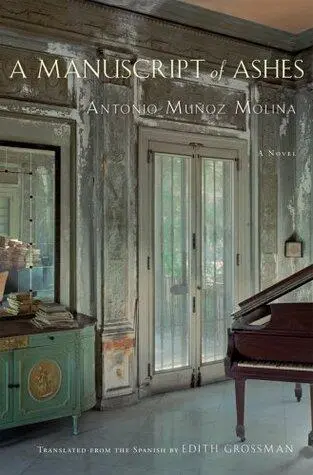
- Название:A Manuscript of Ashes
- Автор:
- Издательство:Houghton Mifflin Harcourt
- Жанр:
- Год:2008
- ISBN:нет данных
- Рейтинг книги:5 / 5. Голосов: 1
-
Избранное:Добавить в избранное
- Отзывы:
-
Ваша оценка:
A Manuscript of Ashes: краткое содержание, описание и аннотация
Предлагаем к чтению аннотацию, описание, краткое содержание или предисловие (зависит от того, что написал сам автор книги «A Manuscript of Ashes»). Если вы не нашли необходимую информацию о книге — напишите в комментариях, мы постараемся отыскать её.
The country house is full of traces of the poet — notes, photographs, journals — and Minaya soon discovers that, thirty years earlier, during the Spanish Civil War, both his uncle and Solana were in love with the same woman, the beautiful, unsettling Mariana. Engaged to Manuel, she was shot in the attic of the house on her wedding night. With the aid of Inés, a maid, Minaya begins to search for Solana’s lost masterpiece, a novel called
. Looking for a book, he unravels a crime.
A Manuscript of Ashes — читать онлайн бесплатно полную книгу (весь текст) целиком
Ниже представлен текст книги, разбитый по страницам. Система сохранения места последней прочитанной страницы, позволяет с удобством читать онлайн бесплатно книгу «A Manuscript of Ashes», без необходимости каждый раз заново искать на чём Вы остановились. Поставьте закладку, и сможете в любой момент перейти на страницу, на которой закончили чтение.
Интервал:
Закладка:
"There's another creature I'm looking for in the world," I quoted, but Mariana was no longer beside me, she was looking at things beyond my desire to immobilize them in her, torn by the hands of the clock that joined to indicate twelve o'clock and by the still distant whistle and the column of smoke that thickened into a soot-stained cloud when the train, stained by war and with ripped banners hanging from the sides of the locomotive, obscene like an old animal with wet skin, stopped in front of us. Through the smoke that dissipated to reveal dark anxious faces at the windows looking at the platform, I saw Orlando, who signaled to Mariana by waving his drawing portfolio over the heads grouped at the windows, taller than the others, and before he saw me, because I was still sitting on the bench on the platform, I heard over the din of the cars and the shouts of the soldiers his huge voice and laugh as he embraced Mariana, picking her up and swinging her around. "Solana, you old satyr, prince of your own darkness, you're even paler than you were last Sunday. Or was it Saturday when we got drunk the last time?" Big, tired, his clothes in the disarray of nighttime drunkenness, with thin damp hair at his temples, smelling of alcohol and medicine because he suffered attacks of asthma, laughing with an obstinacy in his intoxicated eyes that sometimes seemed close to madness, Orlando got down from the train bringing with him like an emissary all the excitement of the war and the blind urgency of Madrid. He brought portfolios of drawings that fell to the ground when he embraced Mariana and that I collected from between people's feet, and a suitcase that had been mislaid somewhere in the corridor or in his compartment. When we climbed into the train to look for it, urged on by Orlando's despair, who said he had packed the sketches for a masterpiece in it, a slim boy with long, very black hair whose face I vaguely recognized appeared with it. "God, here at last," Orlando said in a way that didn't reveal if he was referring to the suitcase or the boy. "I was afraid I had lost them both, and I swear to you that I would have preferred to lose the suitcase than him. Santiago, this is Mariana, who has been kind enough to invite us to her wedding with a local landowner. I think you already know Solana. He's the one who writes those fine articles in Octubre on art and the proletarian revolution. He aspires to a position in the political bureau."
He talked so much and so rapidly and with such a perverse edge that I estimated he had been drinking right up to the moment the train arrived in Magina. The flask of liquor bulged in his jacket pocket, but when he introduced us to the boy he had brought with him, I understood that pride and not alcohol was the real reason for his elation. "Solana, you ought to get right back to Madrid. The front is going to collapse if you don't go in and recite some of your Communist ballads for our soldiers. Even the intellectuals are clamoring for you. The other day I ran into Bergamin, with that face that always looks as if he's just taken communion, and he said that as soon as you get back he was going to name you as his secretary for that congress you're all preparing in Valencia. Don't miss it, Mari-anita, the Congress of Anti-Fascist Intellectuals or something like that. Everything with capital letters." He put his hand on my shoulder not to be amiable so much as to keep his balance, and leaning on Mariana and me, he left the station. There he stopped beside the open car where Santiago and I had put the luggage, looking as if dazed at the vast blue sky and the double avenue of linden trees that cut across the plain toward Magina, whose highest towers looked like pointed needles above the empty fields. Orlando took off the red and black handkerchief he always wore around his neck and wiped the sweat off his face, staring at the light, the handkerchief paused by his mouth, like a mask he hadn't decided to remove. "Solana," he said, his back to us, "Solana you infidel, you should have told me, you should have warned me about the light. Didn't you realize that this is the light I've been waiting for? Even Velazquez is darkness compared with this." He staggered with his head turned toward the blue, and when Santiago got out of the automobile that was already running to take him by the arm as if he were a blind man, he suddenly became disheartened and closed his eyes and seemed to fall asleep against the back of the rear seat, his mouth and nostrils wide open, as if he were dreaming about the beginning of an asthma attack.
We were already crossing the first streets of low villas and dusty gardens where Magina ends in the north when I saw in the rearview mirror his open, reddened eyes staring into mine in an absent lucidity that his waking, or the silence that had overtaken the four of us since Mariana had started the car, stripped of any sign of mockery or pride. He let his head fall slowly onto Santiago's shoulder, and the boy remained solemn and firm beside him, looking at the long lines of houses, and when he lit a cigarette without moving his eyes away from the rearview mirror I thought I could detect in his expression an old countersign of desolation or renunciation, as if the illusions of alcohol had abruptly abandoned him. He moved his head a little and then I knew he was alluding to Mariana and was asking me about her without words. "You look beautiful when you're driving, Mariana," he said, his eyes half-closed to complete his indolence, "you remind me of that heroine in Orlando Furioso who rode on a winged horse wearing brilliant armor." He rested his hand on the back of Mariana's seat and caressed her hair with fleeting tenderness, like a dozing faun, as if he were touching the air or liquid silk that dissolved between his large, stained fingers. She looked away from the road for a moment to smile at him in the mirror with the tranquil gratitude of an accomplice, which was always present in the way she looked at Orlando. I was jealous when I caught their eyes meeting in the rearview mirror, because I desired the candid, offered part of Mariana that she revealed only in her behavior with Orlando as much as the other darker, more carnal part that belonged to Manuel, and I would have liked to join the two in a single indubitable woman not closed to my intelligence and desire, like the third Mariana, the only one I knew, shadow or reverse of the others or of herself, who always seemed to be to one side of things, who sometimes, that very morning, would take me by the arm and stop to tell me the exact words that burned inside me and that I would never say to her. "I'll always be with you. Whatever I do and no matter who I'm with, even if I don't see you again. I want you to know that and never forget it, not even when you don't care about me anymore."
SUDDENLY I NOTICED that we were proceeding more and more slowly now, because as we approached the Plaza of General Orduna, the sidewalks and streets were filling with a slow-moving crush of people. They came out of the narrow lanes, at first in silence, unarmed men in white shirts and corduroy trousers, tense women clustered at the corners who talked quietly and turned inquisitively to look at the car that by now was almost at a standstill and surrounded by a single-minded crowd who walked toward the plaza and seemed to inundate us and then drag us along to the rhythm of their movement forward. The voices still had the same vast, muffled sound as the footsteps, but very soon, when we finally entered the plaza — the small tree tops surrounding the amputated pedestal of General Orduna stood out above their heads — the great sound broke apart into a clamor of shouts and raised fists rhythmically beating the air as they leaned toward the closed balconies of the police station, toward the cubic tower where a red and yellow and purple flag hung over the broken sphere of the clock. Mariana sounded the horn several times, but by now it was useless, because we couldn't open a passage and there were hostile faces looking at us through the windows as if we were fish in an aquarium and furious fists pounding on the car body to the rhythm of their shouts, the single shout in which all the voices had already converged when Mariana stopped the car at one side of the plaza and we managed to get out by pushing the doors against the bodies that seemed to adhere with the tenacity of mollusks. "Give him to us," they shouted, "give us the traitor," convulsing in violent eddies toward the closed balconies of the police station, and no sooner did I ger out of the car than I found myself lost and far from the others in a dense pulsation in which bodies and voices were confused, driven by instinct or a determined rage as indecipherable in its purpose as the energy of the ocean. Like swimming in sand, I moved forward until I reached the hand that Mariana held out to me, but I could no longer see Santiago or Orlando. We drifted together toward the center of the plaza, where the bodies had erased the benches and the line of the gardens and covered in their flood tide the pedestal of General Orduna. Now we saw the closed doors of the police station and the only space not yet engulfed by the crowd: nine Assault Guards formed a semicircle in front of the building, standing firm, their legs apart, with hard somber faces under shining visors and rifles held against their chests, as if they didn't see the surging crowd that besieged them or the closed fists that stopped so close to their rifles. Then a side balcony opened and I saw a man in uniform who looked at the plaza without stepping outside entirely, smoking, partially protected behind opaque glass, but that image, endowed with the serenity of an illusion, vanished when I felt people shoving me and separating me from Mariana, because a police van was making its way unhesitatingly through the crowd and approaching the semicircle defended by the Assault Guards. I saw Mariana moving away and calling to me with her hand, as if she were being dragged out by the sea, my blind fear was that I had lost her and I shouted her name over the agitated heads that again occupied the fissure opened on the plaza by the passage of the van, and when I could no longer see her a brusque undulation of bodies threw her into my arms and knocked both of us against a tree trunk. As if waking from a bad dream, we found ourselves greedily embracing, her bare legs wrapped around mine and my open hands trembling at her waist and feeling for the first time since I met her the perfumed and delicate attraction, the curved, slender, definite body of Mariana. I brushed her forehead, her chestnut hair with my lips, I raised my eyes to the balcony of the police station and the man in uniform was srill there, calm, holding his cigarette at a middle height, looking at the plaza as if there were no one on it, or only us, Mariana and I, embracing under the faded foliage of a tree.
Читать дальшеИнтервал:
Закладка:
Похожие книги на «A Manuscript of Ashes»
Представляем Вашему вниманию похожие книги на «A Manuscript of Ashes» списком для выбора. Мы отобрали схожую по названию и смыслу литературу в надежде предоставить читателям больше вариантов отыскать новые, интересные, ещё непрочитанные произведения.



Обсуждение, отзывы о книге «A Manuscript of Ashes» и просто собственные мнения читателей. Оставьте ваши комментарии, напишите, что Вы думаете о произведении, его смысле или главных героях. Укажите что конкретно понравилось, а что нет, и почему Вы так считаете.