Mircea Cărtărescu - Blinding - Volume 1
Здесь есть возможность читать онлайн «Mircea Cărtărescu - Blinding - Volume 1» весь текст электронной книги совершенно бесплатно (целиком полную версию без сокращений). В некоторых случаях можно слушать аудио, скачать через торрент в формате fb2 и присутствует краткое содержание. Год выпуска: 1996, ISBN: 1996, Издательство: Archipelago, Жанр: Современная проза, на английском языке. Описание произведения, (предисловие) а так же отзывы посетителей доступны на портале библиотеки ЛибКат.
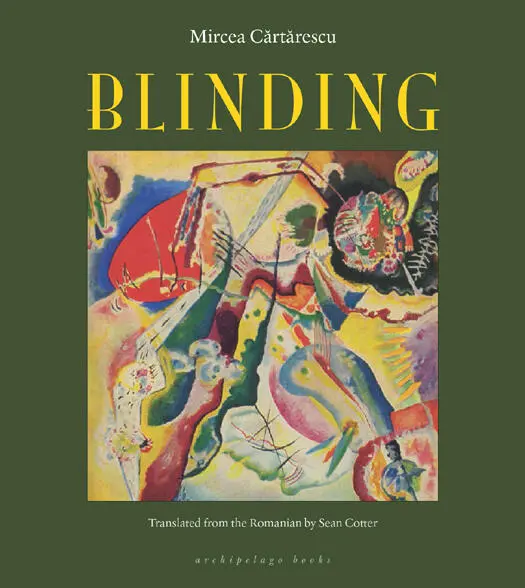
- Название:Blinding: Volume 1
- Автор:
- Издательство:Archipelago
- Жанр:
- Год:1996
- ISBN:9781935744856
- Рейтинг книги:3 / 5. Голосов: 1
-
Избранное:Добавить в избранное
- Отзывы:
-
Ваша оценка:
Blinding: Volume 1: краткое содержание, описание и аннотация
Предлагаем к чтению аннотацию, описание, краткое содержание или предисловие (зависит от того, что написал сам автор книги «Blinding: Volume 1»). Если вы не нашли необходимую информацию о книге — напишите в комментариях, мы постараемся отыскать её.
was one of the most widely heralded literary sensations in contemporary Romania, and a bestseller from the day of its release. Riddled with hidden passageways, mesmerizing tapestries, and whispering butterflies,
takes us on a mystical trip into the protagonist’s childhood, his memories of hospitalization as a teenager, the prehistory of his family, a traveling circus, secret police, zombie armies, American fighter pilots, the underground jazz scene of New Orleans, and the installation of the communist regime. This kaleidoscopic world is both eerily familiar and profoundly new. Readers of
will emerge from this strange pilgrimage shaken, and entirely transformed.
Blinding: Volume 1 — читать онлайн бесплатно полную книгу (весь текст) целиком
Ниже представлен текст книги, разбитый по страницам. Система сохранения места последней прочитанной страницы, позволяет с удобством читать онлайн бесплатно книгу «Blinding: Volume 1», без необходимости каждый раз заново искать на чём Вы остановились. Поставьте закладку, и сможете в любой момент перейти на страницу, на которой закончили чтение.
Интервал:
Закладка:
Released, finally, from the plodding narrows, Maria and Costel walked down toward University, happy and without a thought, they mixed into the scenery, drowned in the whirls and fractals of history, without distinguishing themselves from their world, and without understanding that they lived on a grain of sand on a beach wider than the universe, spread out and sifted, melancholically, by a mind that chose the two of them and decided their destinies. They were unfazed by the debt of their existence owed to their separation and imagination, down to the most hallucinatory details, by a monstrous cabal of neurons, by the fact that only for this sect are they significant, alive and bright-eyed, as they moved arm-in-arm, within the moment “now” in a world lacking time, over the sidewalk from Casa Armatei on the theater boulevard, into a Bucharest in which every building was only a wood and paper façade, propped up in back with rough-hewn boards, a city built with tweezers inside a green, paunchy glass.
But the clouds seemed so real! — blown along the sky by a dark, passionate wind, broken by the warm metal of the trams and the bay windows on the roof of the university. The white light was so comforting, sliding over the cheeks, and so nourishing for the arterial system, in the clammy air of young flesh, replete with desire, dreams, and adrenaline! In the breath of spring, Maria, the simple girl from the edge of town, almost past marrying age, felt she could love the awkward boy beside her, whose arm she gently pressed. She watched him from the corner of her eye, as he walked beside her through the fluid honey of the sun. He was very, very much a child, thin as a banjo and sickly pale, with pitch-black eyes. His flat hair, combed back and glued to his scalp with walnut oil, was a black mirror of shifting waters, a style that would have been completely ridiculous if it wasn’t the look of all the young men in the factories and workshops; when they were leaning over a wrench or lathe, a curl might fall loose, might fall in their eyes and they’d push it, irritably, back on top time and again. Costel was not that tall, not too handsome; he wasn’t “fine,” as the girls in the rug factory said, but at least he was gentle and serious, and his eyes (although Maria would later complain constantly that her husband was “jumpy” and “weird,” that she never knew what was inside his head) sometimes had a warm, meditative expression, as though, from time to time, someone else, a far superior person, had inhabited his mind, and Costel himself had gone to some other place. That look of noble contemplation — the deep and true melancholy that sometimes crossed his face, especially in the evening, even when he was wearing just torn pajamas and smoking smelly Mărăşeşti cigarettes — looked like it wasn’t his, and it wasn’t, actually, because in those moments Costel was completely without a self or a thought, the way an actor who plays a noble person may be, in his normal life, a middling blockhead. Without liking the boy from Banat too much, Maria loved, actually loved, even then, the deceitful sadness on his face, when his unknown ancestor, a great Polish poet of the XVIII century, arose within his tangled viscera, like puffs of steam over a coffee cup, to regard the world once more, through Costel’s black eyes, which were identical to his own.
High on the sweet amphetamine of springtime, the two young people went arm-in-arm through the yellow air, cold as glass, talking about nothing and laughing. Maria wondered how he was able to keep frowning even when he laughed, and Costel felt he was made entirely from scented air. He was trying as best he could to find Maria’s algorithm, to intuit (like in those almanac puzzles where, knowing which direction the first gear turned in a complicated system, you try to work out which way the last one turns) the ineffable functioning of her mind, to extract its secret, how it produced those happy smiles, equivocal, bitter, hesitant, those little grimaces of dissatisfaction that frightened him, those vague declarations of the eyes and eyebrows, those evanescent inflections of the voice, those tiny quivers of the wings of her nose. Thus did the young apprentice imagine the psychology of the girl he loved: the projections and diagrams of technical drawings, cycloids and hyperbolae, a rubber geometry, extensible and yet precise, from which, if you knew the laws and mastered the technology, you could obtain each of the thousands of possible effects and combinations. And if in saying something else or pressing her arm a little harder, Costel saw her react completely differently than he expected, his explanations were not mystical or poetic, nor did he credit them to the ineffable caprices of women; he blamed instead the imperfections in his technique, not following all the gears, bolts, pinions, clutches, and Maltese crosses closely enough. Looking at the stars sometimes, dreamily, in his underwear, on the small, rusty balcony of the house where he lodged, humming a little song from Banat:
Sure, I’d join the army too
Hai tri-li-li-li-li
If they used corn stalks to shoot
Hai tri-li-li-li-li
Costel thought the constellations were another kind of machinery, and he tried to examine their surfaces for shining traces of grease and lathe oil. The entire world was a mesh of gears, where the rotation of the most miniscule grains of sand at one end of the ocean produced, at the other, a devastating earthquake; the wing of a butterfly in the Antilles caused a tornado in Kansas; and a small concupiscent thought of a bum on Rahovei shifted the wrath of God toward a billion inhabited worlds. In his dreamer’s paranoid mind, and under the feminine lashes of his eyes, everything connected to everything else in a vast, crystalline conspiracy.
Turning from the boulevard, they sank into the spectral and sonorous streets behind the Hotel Ambassador. Maria took off her batik scarf and let her rings of hair, curled with an iron, flutter over her back. The day began to descend toward evening, but the air was still just as hot and windy as before, knocking against the glass edges of the buildings, which were eviscerated by emptiness and silence. Their steps took them, strange but somehow foreseeable, toward the street where Maria once lived over the tailor’s shop. More than ten years had passed since the terrible bombing of ’43, and the neighborhood had been completely rebuilt. Where the Verona tailor shop had been was now a square building, anonymous, green, with a white glass plaque at the entryway: “Phthisiology Laboratory, District 23 August.” Most buildings had a red or blue plaque like this one. Flapping red flags were not missing from the girders over the entryway, and a sickle crossed with a hammer inside a wreath of grain was sewn onto the flags with yellow fabric.
Maria frowned, and beneath the skin of her face, countless muscular fibers contracted at the command of a fine system of levers and threads under her skull, contributing (as Costel believed) to the outline of an expression full of emotion and hard to define. The shadow of her former adolescence now brought exaggerated relief to the hills of her cheek bones and chin, her philtrum, and the slight depressions in her cheeks, as clouds, running over hills, will suddenly block the sparkling sun and bring cold and chill — almost another season. Maria remembered, or something rose from her memory through a passive and painful process: Mioara. Cedric. Tătica sitting on the rock in the doorframe, holding his gray head in his hands. Her splendid adolescence never to return. A tiny, tapered tube, its lower end in the corner of her eye, secreted a teardrop. They walked past the former location of the workshop without her telling Costel that she once had lived there. She only, at the end of the street, leaned her head on his shoulder and continued walking like that, her face diagonal and her eyes a Modigliani, filled with watery ink.
Читать дальшеИнтервал:
Закладка:
Похожие книги на «Blinding: Volume 1»
Представляем Вашему вниманию похожие книги на «Blinding: Volume 1» списком для выбора. Мы отобрали схожую по названию и смыслу литературу в надежде предоставить читателям больше вариантов отыскать новые, интересные, ещё непрочитанные произведения.











Обсуждение, отзывы о книге «Blinding: Volume 1» и просто собственные мнения читателей. Оставьте ваши комментарии, напишите, что Вы думаете о произведении, его смысле или главных героях. Укажите что конкретно понравилось, а что нет, и почему Вы так считаете.