Mircea Cărtărescu - Blinding - Volume 1
Здесь есть возможность читать онлайн «Mircea Cărtărescu - Blinding - Volume 1» весь текст электронной книги совершенно бесплатно (целиком полную версию без сокращений). В некоторых случаях можно слушать аудио, скачать через торрент в формате fb2 и присутствует краткое содержание. Год выпуска: 1996, ISBN: 1996, Издательство: Archipelago, Жанр: Современная проза, на английском языке. Описание произведения, (предисловие) а так же отзывы посетителей доступны на портале библиотеки ЛибКат.
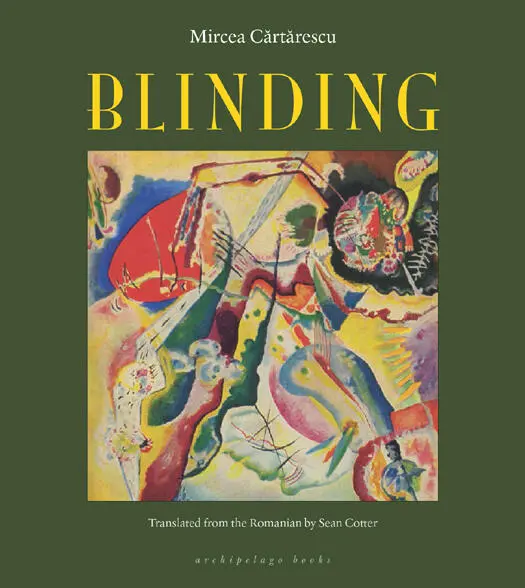
- Название:Blinding: Volume 1
- Автор:
- Издательство:Archipelago
- Жанр:
- Год:1996
- ISBN:9781935744856
- Рейтинг книги:3 / 5. Голосов: 1
-
Избранное:Добавить в избранное
- Отзывы:
-
Ваша оценка:
Blinding: Volume 1: краткое содержание, описание и аннотация
Предлагаем к чтению аннотацию, описание, краткое содержание или предисловие (зависит от того, что написал сам автор книги «Blinding: Volume 1»). Если вы не нашли необходимую информацию о книге — напишите в комментариях, мы постараемся отыскать её.
was one of the most widely heralded literary sensations in contemporary Romania, and a bestseller from the day of its release. Riddled with hidden passageways, mesmerizing tapestries, and whispering butterflies,
takes us on a mystical trip into the protagonist’s childhood, his memories of hospitalization as a teenager, the prehistory of his family, a traveling circus, secret police, zombie armies, American fighter pilots, the underground jazz scene of New Orleans, and the installation of the communist regime. This kaleidoscopic world is both eerily familiar and profoundly new. Readers of
will emerge from this strange pilgrimage shaken, and entirely transformed.
Blinding: Volume 1 — читать онлайн бесплатно полную книгу (весь текст) целиком
Ниже представлен текст книги, разбитый по страницам. Система сохранения места последней прочитанной страницы, позволяет с удобством читать онлайн бесплатно книгу «Blinding: Volume 1», без необходимости каждый раз заново искать на чём Вы остановились. Поставьте закладку, и сможете в любой момент перейти на страницу, на которой закончили чтение.
Интервал:
Закладка:
The police frequently stormed the priest’s cottage. They turned it upside-down and interrogated the two inhabitants, binding them in the complicated webbing of the lie detector. They found nothing suspicious, supposedly, but who would vouch on his life for the police? Those Who Know, with their infallible strategies, had surely infiltrated the forensics brigades. The file on the “Change,” thousands of pages long, matched, point by point, Breton’s Surrealist manifesto, published ten years earlier: “ L’homme, ce rêveur définitif …” Two young officers, who took turns leading the police literary circle and were poets themselves, one in the style of Auden, the other an e. e. cummings, were put at the disposition of W. W. Schrinke, the well-known psychoanalyst, and they studied the city’s rumors, complaints, and depositions for six months with the feeling, as one of them later said, that they were fishing in the sewers, through rotting rats, bloody bandages, and newspapers with fecal matter … The latent content of this enormous collective dream, the outline, tattered and symmetrical like a fish skeleton, began to appear, through the opercula and scales of hallucination, toward the beginning of the fifth month: during the night of the fifth-sixth of April, 1936, there would be a ritual reconciliation of Light and Dark, the two powers that struggled for supremacy within the mad labyrinth of history and the human body. In the course of the ritual, there would be a death and a rebirth. The newborn being would be beyond good and evil, thus able to penetrate the unknown beyond the tegument of our world, but the tremendous energy required to move beyond illusion would come from an abominable murder. So this was what the police were supposed to stop, the police who took no more account of metaphysics and religion than the dirt on a fingernail. They had a few years to work, during which they would watch the lake house night and day, interfere with The Albino’s clandestine dealings, and above all, try to discover the intended victim in time. The report from Professor Schrinke stated (or “divined”) that the victim would be someone very young, with black skin.
When she woke up, in her canopy bed with its golden brocade image of a unicorn resting its head in a virgin’s lap, Cecilia smiled lazily at her Uncle Monsú, as she had every Wednesday since they first met. Why did the pale man with black features attend weekly the girl’s rising? Why did Melanie and Vevé always show her a peculiar deference and do her bidding? Or that silly Cedric, who indulged her poking thin, gold needles into his buttocks and played the clown day by day, hamming it up, juggling plates and pineapples, stumbling like a drunkard, making a crooked saxophone meow like a cat until he got her to smile, and then, content, left for work? What family relations existed between them, in that world of aunties, uncles, and cousins, but without parents, or any trace of the past? She had been the princess of this little world for as long as she could remember: The Albino, Melanie, Cedric, and, more rarely, Fra Armando (but Cecilia felt strange around him, as though she didn’t have the gaze to meet the prelate when he gazed at her with ashen eyes, the way a museum piece, or a fish in an aquarium, doesn’t stare back at you when you stare at it), then, for a few years, her little maid Vevé … Cecilia was too used to her to worry her with these mysteries. (And she was used to almost no one else, since she didn’t count the black children as human beings. They played in the shadows and around the corners, or appeared, like ghosts, trodding toward the kitchen, and she was never sure how many there were, or who they belonged to.) But in her moments alone, in front of the crystal mirror, looking at her exotic beauty in the fairytale-blue air, she found herself touching her full, tattooed lips and asking, out loud, “Who am I?” At the sound of Cecilia’s voice, accompanied by the clinking of her glass ring against her crystalline teeth, Vevé would immediately appear, poking her little head into the ribbon-covered mirror and putting a comb carved from bone into her hair. The sad question would melt away in the opulent emptiness of the colonial cage, until it became an airy, frivolous aside.
That entire morning, Melanie and Vevé had labored to prepare Cecilia for the Ceremony, the great ceremony that everyone had told her about since she was little, first in the form of fairytales that enchanted and horrified her, and then in parables and allusions that she was not entirely able to follow. When, a few days earlier, the first drops of blood had slid like tears down her ebony thighs, Aunt Melanie, overcome with a strange trembling, had told her, through chattering teeth, that the Ceremony was coming. At that moment, Cecilia was playing with a thin kitten, with big, silly ears, giving it her toes to chew and scratch with its back paws. It stretched its face out and licked the menstrual dew before the girl could stand. Melanie jumped up like a demon, her lioness nostrils dilated and her eyes bloodshot; she grabbed the cat by the head and tore it in two pieces, hurling bits of flesh and fur onto the elaborate peacock design of the Persian carpet. Cecilia felt both ill and pleased at the sight, because she also felt, then, for the first time, from within her sealed shell, the spasms of desire for a man. She was wearing silk underwear, and had scented oils on her face and breasts. Her makeup was refined, and she was wrapped in the most splendid dress, with lamé flames, flashes of anaconda skin, and electric blue waters, wonderfully matching her silk, floral turban. Monsieur Monsú attended, without boredom, the almost eight hours of complicated cosmetic and vestimentary operations. Sunk into a wicker chair, he gazed at Cecilia as though she were a mystical bride, or a goddess.
And now, beside Cedric, fascinated by the medical store window display across the street, obscured occasionally by carts pulled by mules who poked long, nervous ears through their felt hats, by lemon-colored limousines, and even, once, by an empty hearse, with shining windows and flamboyant ebony sculptures, Cecilia waited patiently for her aunt, who had not emerged from the glass door. Finally, the towering Melanie appeared, walking proudly and carrying a giant paper bag with the store’s emblem, a dragon’s head in scarlet crayon, under which — the girl now noticed — was drawn, in calligraphy with fastidious volutes, the same M that marked all the businesses of Monsieur Monsú. Out of the top of the bag, over the corners of coffee-colored paper, strange spindles protruded, like very long screws, with metal butterflies gliding on their helixes, then the delicate edges of test tubes, then nickel devices that resembled elaborate forceps … She crossed quickly, clop-ping her high heels made of Hatteria under the hooves of her wide, bruised feet. “We can go now, we have everything we need. The damned sales clerk kept asking me questions, so I told him to call his boss” — she whispered to Cedric, who was overwhelmed with a deep melancholy. “There’s a taxi! Get it quick!”
“I still hadn’t realized what would happen, and I didn’t understand anything until I saw, there in the catacomb, the yellow butterflies, puffy and bloody, breaking out of the girls’ tongues and drying their wings in the torch flames. Only then did I know what a tangled mess I was a part of, and I knew I could not get out of it, since my flesh and mind were woven from the same tangle. A bird woven into a tapestry could more easily tear a hole in the fabric and fly away.” As Maria and Vasilica stopped eating, in the clay room of their family house in Tântava, and the mămăligă dried out on the wood table, Cedric, with his wide eyes, now full of the reflections of colored ghosts from the icons, took the story slowly and ever more painfully further. The rustic, yellow moon, yowled at by the village dogs, made its appearance in a corner of the window, while the snowfall stopped. The single candle glittered, with rays as thin as copper wire, over the half-shadowed faces of the sisters. Cedric was almost lost in the dark; only his eyes and teeth shone in the increasingly still light of the room. The Virgin and St. George, the archangels and pictures of Tătica in the first war, and the raw silk rags were oddly consonant with the substance of the story, because all the world’s beliefs housed hearths hot with magic, the same way any evil witch eventually finds her way to the one terrifying god, the potter, weaver, genetic engineer, mad savant, or rabbi that gave us life.
Читать дальшеИнтервал:
Закладка:
Похожие книги на «Blinding: Volume 1»
Представляем Вашему вниманию похожие книги на «Blinding: Volume 1» списком для выбора. Мы отобрали схожую по названию и смыслу литературу в надежде предоставить читателям больше вариантов отыскать новые, интересные, ещё непрочитанные произведения.












Обсуждение, отзывы о книге «Blinding: Volume 1» и просто собственные мнения читателей. Оставьте ваши комментарии, напишите, что Вы думаете о произведении, его смысле или главных героях. Укажите что конкретно понравилось, а что нет, и почему Вы так считаете.