Mircea Cărtărescu - Blinding - Volume 1
Здесь есть возможность читать онлайн «Mircea Cărtărescu - Blinding - Volume 1» весь текст электронной книги совершенно бесплатно (целиком полную версию без сокращений). В некоторых случаях можно слушать аудио, скачать через торрент в формате fb2 и присутствует краткое содержание. Год выпуска: 1996, ISBN: 1996, Издательство: Archipelago, Жанр: Современная проза, на английском языке. Описание произведения, (предисловие) а так же отзывы посетителей доступны на портале библиотеки ЛибКат.
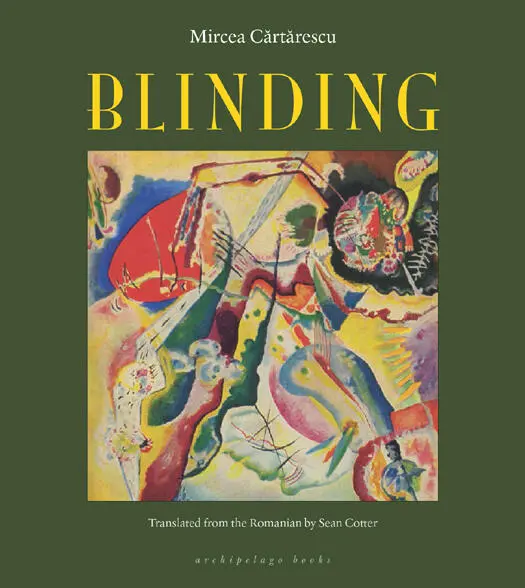
- Название:Blinding: Volume 1
- Автор:
- Издательство:Archipelago
- Жанр:
- Год:1996
- ISBN:9781935744856
- Рейтинг книги:3 / 5. Голосов: 1
-
Избранное:Добавить в избранное
- Отзывы:
-
Ваша оценка:
Blinding: Volume 1: краткое содержание, описание и аннотация
Предлагаем к чтению аннотацию, описание, краткое содержание или предисловие (зависит от того, что написал сам автор книги «Blinding: Volume 1»). Если вы не нашли необходимую информацию о книге — напишите в комментариях, мы постараемся отыскать её.
was one of the most widely heralded literary sensations in contemporary Romania, and a bestseller from the day of its release. Riddled with hidden passageways, mesmerizing tapestries, and whispering butterflies,
takes us on a mystical trip into the protagonist’s childhood, his memories of hospitalization as a teenager, the prehistory of his family, a traveling circus, secret police, zombie armies, American fighter pilots, the underground jazz scene of New Orleans, and the installation of the communist regime. This kaleidoscopic world is both eerily familiar and profoundly new. Readers of
will emerge from this strange pilgrimage shaken, and entirely transformed.
Blinding: Volume 1 — читать онлайн бесплатно полную книгу (весь текст) целиком
Ниже представлен текст книги, разбитый по страницам. Система сохранения места последней прочитанной страницы, позволяет с удобством читать онлайн бесплатно книгу «Blinding: Volume 1», без необходимости каждый раз заново искать на чём Вы остановились. Поставьте закладку, и сможете в любой момент перейти на страницу, на которой закончили чтение.
Интервал:
Закладка:
They left. Cecilia’s red lace parasol looked now almost purple. They waited for a taxi to pass down the rosy pavement. Svelte men, dressed in the latest zoot suits, would cast a glance at Cecilia, who stared straight ahead, barely blinking her exaggeratedly long lashes. “How long do we have?” the old lady asked. She had hardly been able to control her disquiet all afternoon, as she kept the girl, as directed, in ignorance. Cedric removed his pocket watch, attached by a fob to his buttonhole, opened the gold lid, thin as a leaf, and saw the needles already showing a few minutes before seven. “Less than an hour, Madame.” The shop window across the way displayed medical instruments — syringes so long they must have been for veterinarians, oddly shaped forceps, vases in the form of beans, revolting rubber tubes and back braces. A plaster mannequin — as naked as an ancient statue, but with no trace of sex — wore one of those flexible whalebone girdles that had become almost obligatory for certain women, older than forty and fat as hippos, in the Quarter. Melanie pressed her fingers on Cedric’s arm, indicating the shop window with her eyes. He nodded. She crossed while the other two remained in the labyrinthine twilight, ever more scarlet (but with a strange dirty yellow higher in the sky, much brighter than the air between the houses, a sky crossed high and low by bats), and since they were standing together, heavily made up and swathed in silk, with the moon of coagulated blood as an umbrella, with their black and pointed shadows lengthening over the wall behind, full of cherubs and stucco garlands, Cecilia and Cedric looked like they were cut from an old magazine, bordered with pictures of the music hall.
Cecilia had spent the day preparing for the solemnity of the spring night to come. From the moment she woke, The Albino had arisen before her eyes like a dream image that sometimes appears, for a moment, on the retina — a black man white as milk, with a large, raspberry-colored wart near his right nostril and eyes as yellow as a dog’s. When he bent over her, smiling strangely, his head filled almost the entire space below the gold canopy. Only a thin triangle of smoky air could be seen from the room, where Vevé, the little black girl, poked her bright face. The Albino owned the Monsú jazz club where Cedric played. He had come to the city more than twenty years before, in an odd automobile, carrying, on the back bench seat, with its neck sticking out through the window, a gigantic, fat bass that was once mahogany, but now black and grimy, so that everyone could see its scrolled, termite-pocked ebony neck and thick strings, braided at their ends with red and green threads. On the same back bench was a package, a large rectangle wrapped in coarse paper. The man looked like a being from another realm: wooly hair, a stooped quivering, and skin as white as that of any descendant of the old French gentry. His tuxedo resembled Humphrey Bogart’s and an ever-present Havana cigar drooped from his mouth. He made both whites (sailors and riff-raff) as well as blacks (saxophone players and whores) want to chase him away or cut him down. The one who set the car — rented by Monsieur Monsú (as he happened grotesquely to be called) — on fire, while it was parked in front of the premises, died within the week, from a scorpion sting. After a few months of fruitless vigil at the back door, where, at dawn, The Albino would leave the premises, after his car had been turned into a baroque braid of burnt iron, the hit man mistakenly shot the district police inspector and ended up in the electric chair. The woman who slipped into his bed to discover his secrets, a mulatta as heartless as death itself, one of those who allow scores of men to explore their secret tunnels from the age of seven, let him tie her hands behind her back and make love to her through the night. In the morning, she was ravished and smitten like the most pious of the pious, but Monsieur Monsú brutally threw her out and never again allowed her into his bed. She withered from love as if from a rare cancer. Wrapped in black lace, she spent her days in church, before the icon of the Holy Mother. On her deathbed, surrounded by mounds of roses, she raved: “He has diamonds for testicles … his sack is transparent, and they shine in the night …” Once the mulatta died, the French Quarter dwellers finally accepted the enigmatic man, who had such power and brought (from where?) new rites and customs, about which they didn’t speak, but which thrived, brightly colored, in everyone’s fantasies. His establishment, lined like a brothel with waves of cherry silk, was the first on Bourbon Street to develop the taste for a type of show that, at that time, didn’t have a name. Past two in the morning, on the central stage, in front of patrons snorting opium through filigreed pipes or debasing themselves with azure absinthe, the show featured bare men and women, coupling in knots like human snakes, using items that could be purchased, in order to continue the orgy at home, from a small shop owned by the same Albino: ivory phalluses carved vein by vein to match the god of plenty, black velvet masks, lace lingerie, complicated leashes and collars, crops made of hippopotamus … In time, a chain of similar stores scandalized the neighborhood, competing with and oddly replicating the traditional boutiques of Mardi Gras masks and voodoo accessories.
The great painting that had barely fit in The Albino’s car now dominated the circular hall. It was the only decoration on the back wall, opening like a window onto a scene of fantasy. The picture, after witnessing centuries pass, had acquired a dull sheen, radiating loneliness and melancholy. It showed gigantic palaces of rosy marble, their façades packed with colonnades and statues, rising, shining like mirrors, from the blinding evanescence of green, clear seas that sparkled under the abstract sun of a perfect dawn. Ships, loaded with barrels and anchored at the shore, seemed like part of the same shell of smoky glass as the dementedly ornamented buildings, and they had the most moving sculptures black gall could imagine: hate, ecstasy, evil, stupidity, illumination, Christian piety, scorn … endogenous aggressiveness, grotesquely unleashed, like a monkey with electrodes on his skull triggering the hippocampus … palaces of insanity and wisdom emerging, vertical, fragile, from the green, limitless ocean. There were no human beings anywhere. In the lower right corner, there was a signature in black ink: Desiderio Monsú . The spectral vision seemed to spread beyond the painting’s frame, and the bejowled mestizos, with enormous rings on their fingers, sweaty from their armpits to their waists, could sometimes make themselves believe that this place where they looked at those women’s pink bottoms, shimmying obscenely in front of them, being mounted by hairy men with bovine balls, was nothing other than a pavilion of pleasure or torture, a grotto of hell or heaven, surrounded by that unearthly scene, spread as far as imagination could extend. Then, a sudden nausea washed over their internal organs, and mad with the sadness of being merely human, and not gods or nightmarish demons, they would empty their glasses of whisky, tequila, or absinthe without a breath, hold out their hands and dampen their fingers between the thighs of the redheads and black women, and collapse with their heads onto tables of woven bamboo …
For ten years, The Albino bought up whole streets in the French Quarter: bars, jazz clubs, restaurants where crawfish were prepared in eighty ways, with ten varieties of Béarnaise, bordellos and Mardi Gras souvenir shops, tobacconists and palm-shaded residences … Fashion boutiques and barges in the port and prostitutes with branded buttocks now wore his insignia: a calligraphic M with a certain imperial refinement, barely distinguishable within a spiderweb of volutes. This same sumptuous M, as though in precious stones, was engraved into the side window of his black Packard, chauffeured by an Indonesian who brought him to and from the Monsú.
Читать дальшеИнтервал:
Закладка:
Похожие книги на «Blinding: Volume 1»
Представляем Вашему вниманию похожие книги на «Blinding: Volume 1» списком для выбора. Мы отобрали схожую по названию и смыслу литературу в надежде предоставить читателям больше вариантов отыскать новые, интересные, ещё непрочитанные произведения.











Обсуждение, отзывы о книге «Blinding: Volume 1» и просто собственные мнения читателей. Оставьте ваши комментарии, напишите, что Вы думаете о произведении, его смысле или главных героях. Укажите что конкретно понравилось, а что нет, и почему Вы так считаете.