Mircea Cărtărescu - Blinding - Volume 1
Здесь есть возможность читать онлайн «Mircea Cărtărescu - Blinding - Volume 1» весь текст электронной книги совершенно бесплатно (целиком полную версию без сокращений). В некоторых случаях можно слушать аудио, скачать через торрент в формате fb2 и присутствует краткое содержание. Год выпуска: 1996, ISBN: 1996, Издательство: Archipelago, Жанр: Современная проза, на английском языке. Описание произведения, (предисловие) а так же отзывы посетителей доступны на портале библиотеки ЛибКат.
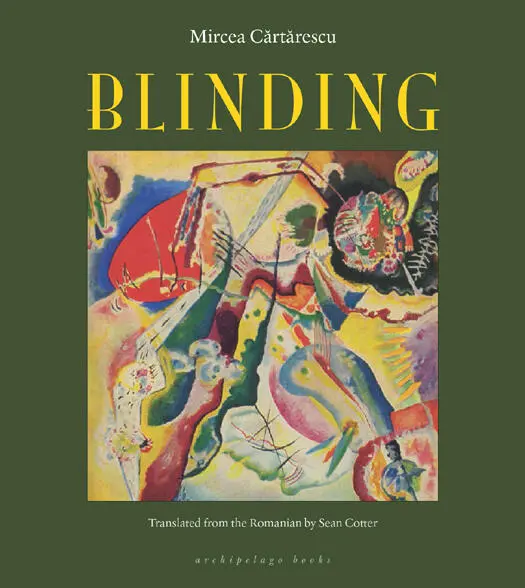
- Название:Blinding: Volume 1
- Автор:
- Издательство:Archipelago
- Жанр:
- Год:1996
- ISBN:9781935744856
- Рейтинг книги:3 / 5. Голосов: 1
-
Избранное:Добавить в избранное
- Отзывы:
-
Ваша оценка:
Blinding: Volume 1: краткое содержание, описание и аннотация
Предлагаем к чтению аннотацию, описание, краткое содержание или предисловие (зависит от того, что написал сам автор книги «Blinding: Volume 1»). Если вы не нашли необходимую информацию о книге — напишите в комментариях, мы постараемся отыскать её.
was one of the most widely heralded literary sensations in contemporary Romania, and a bestseller from the day of its release. Riddled with hidden passageways, mesmerizing tapestries, and whispering butterflies,
takes us on a mystical trip into the protagonist’s childhood, his memories of hospitalization as a teenager, the prehistory of his family, a traveling circus, secret police, zombie armies, American fighter pilots, the underground jazz scene of New Orleans, and the installation of the communist regime. This kaleidoscopic world is both eerily familiar and profoundly new. Readers of
will emerge from this strange pilgrimage shaken, and entirely transformed.
Blinding: Volume 1 — читать онлайн бесплатно полную книгу (весь текст) целиком
Ниже представлен текст книги, разбитый по страницам. Система сохранения места последней прочитанной страницы, позволяет с удобством читать онлайн бесплатно книгу «Blinding: Volume 1», без необходимости каждый раз заново искать на чём Вы остановились. Поставьте закладку, и сможете в любой момент перейти на страницу, на которой закончили чтение.
Интервал:
Закладка:
After the GAZ truck started and fell in with the snow-loaded cars with their windshield wipers on, across the area between the university and the imposing constructions of columns across the way, through the destructive gales, spring-dressed Maria passed, crossing the intersection at Children’s Romarta and continuing along the Casa Armatei. Plaster eagles on its roof were now snow-covered scarecrows, showing only their curved beaks, like claws from the paws of a white cat. From here started the movie theaters with names meant to remind everyone of popular democracy: Peace, Work, Brotherhood . From every cashier’s window, the steely eyes of a Soviet soldier watched you, a red star on his forehead and an automatic aimed at the guiltless passersby. Behind him stood a tank with the same starred pentagon on the turret, and the top half of the driver sticking out of his steel chamber. His ears stuck out of his black cap, and he held a red flag unfurled in majesty. However much the flag fluttered in the wind, you could still see, in the upper left corner, the hammer and sickle, sagely crossed. An alchemist like Fulcanelli (alas, the hidden author of The Mystery of Cathedrals was twenty years dead in anno domini 1955, when Maria met Costel again, after their short idyll in Govora, so no window of any workers’ movie theater in his beloved Bucharest would reflect his diminutive figure and drooping mustache) would have seen in these two symbols an unio mystica between sulfur and hydrargarum under the almighty sign of the Pentagram. Only one or two of the movie theaters showed tear-jerkers, where there were, even for the matinee, endless lines, because the young lathe operators and loom workers finished the night shift and went directly to the miserable, rat-poison-filled theaters to see Sara Montinel or Vico Torriani.
More than anything, Maria liked to watch movies. Even later, when she was burdened with life as a housewife, she would delineate her strange triangular world in the heart of Bucharest with three cinemas, located at equal distance from the block on Ştefan cel Mare: the Volga, the Melodia, and the Floreasca. It was rare that she would leave this territory where she felt safe, and when she did, her trips through the city (if she wasn’t going to Vasilica’s or to her godmother’s) were taxing adventures in lands full of danger, barred by oniric fears. It was as though the theaters on the triangle points protected, with their hallucinatory secrets, the only area of reality in the universe, where her house was, and the market, the grocery and the cafeteria, the newsstand and the neighbors, while outside of this wise eye open to the cosmos, the world disintegrated, and filled with pale demons and smoke … Maria went to see a movie the way other people went to church, ready for strong emotions, for tears, streams of tears sparkling in the dark of the hall, for long laughter, for hatred and love. She hated war movies, she only went to those where, as she said, “everyone laughed, and sang, and danced,” or those where a mother’s heart was torn by cruelty. If she thought a movie was “nice,” she saw it ten times with no decrease in pleasure. But, however tempting the movie was, Maria would wait patiently, for weeks on end, “for it to come by us,” on the pretext that the ticket was cheaper at the local theaters than downtown. In fact she was repulsed, especially as she got older, by the thought of leaving her zone. She might tell herself she wasn’t dressed well enough to go downtown, but actually the people seemed strange and hostile to her, and there was something else, an interior resistance, something that prohibited her from confounding herself with her image of herself as a young person, as though her life had been sectioned off at a certain moment and remodeled from the ground up, or as though a sinister (or ecstatic) enigma had rounded in the belly of her mind, like a pearl, adding layer over layer of pearly inhibition around a painful thought.
Now, however, as she was consuming her last stores of youth, Maria, the only point of light in a dull, Siberian city, walked without any trace of disquiet, passing gracefully among the tramps who masticated pretzels in front of the halls, toward the Brotherhood of Nations Theater, where they were showing a Gérard Philipe movie. Victoriţa, the thief, had seen it and thought about it so much, “what that boy did and how he lost the girl,” that Maria practically didn’t know whom she was on a date with, Costel or Gérard himself, the way that sometimes, when a movie was over and she went outside, out the back door, under the sky filled with stars, even though it had been daylight when she went in, she felt like she was living in a movie, one as long as her life, one that who knows who (many people, in any case) watched in a dark hall. And those people were living in another movie, one that others were watching, and so on, and so on.
She spotted Costel and laughed with a snort. He was still in his worn-out sweatsuit, still with those boots with metal on the heels, still poorly shaven, with those eyes that could be gentle or horribly serious, the black and beautiful eyes of a boy from Bănat. And his hair was as black as a crow’s feather, thick as a horse’s tail, combed back smoothly over his head. He seemed spacey, looking for her everywhere, with his hands in his pockets as always (“it’s okay, I’ll change him”), while it snowed like hell on his head and shoulders. But the gusts of eastern winds didn’t make him shiver like everyone else. The young locksmith from the ITB workshop, unbeknownst to him, had noble ancestry. The zipper on his sweatshirt was half open, revealing his undershirt and his completely bare, white chest as though it was a mild, early fall. He wasn’t even wearing his ancient, oil-stained beret, which Maria had made such fun of in Govora. Bored, he took some change out of his deep pants pocket and started to count it, leaning against the window where Gérard Philipe, in the high ruffled collar of his period costume, pointed the tip of his saber at an enormous bearded man’s chest. With a wide smile, Maria walked toward him and took his arm, while Costel, angry he hadn’t seen her coming, quickly stuffed the change into his pocket and said “Good evening” so formally that the girl turned even happier. These stupid boys from Bănat. In Govora, Costel had been one of a group of apprentices from a Lugoj vocational school, all of them dumb as rocks, slow-witted and lazy, and the damned girls from Muntenia, Maria and two others, who had gotten tickets through the Union, had lots of fun at their expense. They would make dates and not go, they’d ask them to bring them who knows what, they’d fool them, two or three times, with the same silly smiles … They went out with them on Saturdays, to a dance (two Saturdays in a row) where the girls danced with each other, like most girls there, while the guys from Bănat, stuck together like a hydra with multiple heads, drank borviz and muttered a word or two in their own silly language. Still, even from the first dance, when she had worn her dress with a sequin belt, which, unfortunately, had scorched on the cast-iron stove while she twirled with Ştefania through the poor dance hall — also known as the cafeteria —, Maria started to watch Costel from the corner of her eye. Maybe because she actually liked the guy, even though he was nearly four years younger, or maybe because she was in that period of eclipse that follows the loss of a beloved in a woman’s life. She often dreamed of a desolate aloneness, like a sad and sweet poison, and to manage the eternal afternoons between the midday meal and supper, she made recourse to the subterfuges that only people overcome by loneliness and nostalgia know. Lying in her iron-slat bed, her eyes closed, she counted to five thousand in her head, then opened her eyes and tried to guess how much of the winter evening had passed by the change of the light, from ash to dark pink, to brown. Then she watched the steady, silent snowfall over the silhouette of the old, crumbling bricks of the sulfuric acid plant, and then she would close her eyes and count again to five thousand, trying to avoid what, in the end, when evening came prematurely and the room fell dark, and only the snowflakes continued to fall, sparkling in the light of a yellow bulb hanging from a post outside, she could no longer avoid: thoughts of Pavel, her Pablo, the student she’d met two years before at a party at the I.O.R. plant, where Vasilica had taken her when she was dating Ştefan, whom she eventually married and had Marian with, Maria’s dear nephew. With her head turned to the wall, stuck to a pillow, and her body feverish under a thin, plaid dorm-room sheet, Maria slid her right palm softly over her breasts, touching her hardened nipples, moved it down her stomach and put her fingers under the elastic band of her underwear, burying them in her thick, wiry pubic hair. She stroked, sweaty, feeling excited and sad at the same time, in a desperate, perverse excitement, rejoicing in the suffering and degradation and destruction. The little round cylinder followed the wet line of her lips, and she extended the tip of her index finger to her anus, repeating, that is, drowning in the pain of love and unhappiness of sex, the motions of the beloved hand of a delicate and strong man, the man under whom, penetrated and drunk with love, holding him tightly by his neck, she had moved for the first time as a lover, as a woman. He had been her only lover, and he had disappeared five months ago. That’s how it was then: young people had dates in the city and went to a hotel or to some woman who kept rooms especially for amor . Going where one or the other lived was impossible, since most of them lived with host families, two or three to a room. If you missed a date, you might never run into the other person again, as happened with Maria and Pablito, the weaver and the philosophy student, who couldn’t find each other one evening in June, when, after a stupid misunderstanding (as the girl believed) she had been waiting in one spot for three hours, pacing, more and more frightened, under the chestnut blossoms along the road, their leaves luminous-transparent in the electric light, while he, probably with a bouquet of flowers — always, for every date — paced under some town clock, somewhere else. Much later, Maria heard that Pablito had found, in fact, a better offer — that he had always been embarrassed to be with a girl from the slums and to have to make love in sordid places, and then walk, late at night, through back alleys, dodging toppled drunks and offering cigarettes to half-asleep policemen.
Читать дальшеИнтервал:
Закладка:
Похожие книги на «Blinding: Volume 1»
Представляем Вашему вниманию похожие книги на «Blinding: Volume 1» списком для выбора. Мы отобрали схожую по названию и смыслу литературу в надежде предоставить читателям больше вариантов отыскать новые, интересные, ещё непрочитанные произведения.











Обсуждение, отзывы о книге «Blinding: Volume 1» и просто собственные мнения читателей. Оставьте ваши комментарии, напишите, что Вы думаете о произведении, его смысле или главных героях. Укажите что конкретно понравилось, а что нет, и почему Вы так считаете.