Mircea Cărtărescu - Blinding - Volume 1
Здесь есть возможность читать онлайн «Mircea Cărtărescu - Blinding - Volume 1» весь текст электронной книги совершенно бесплатно (целиком полную версию без сокращений). В некоторых случаях можно слушать аудио, скачать через торрент в формате fb2 и присутствует краткое содержание. Год выпуска: 1996, ISBN: 1996, Издательство: Archipelago, Жанр: Современная проза, на английском языке. Описание произведения, (предисловие) а так же отзывы посетителей доступны на портале библиотеки ЛибКат.
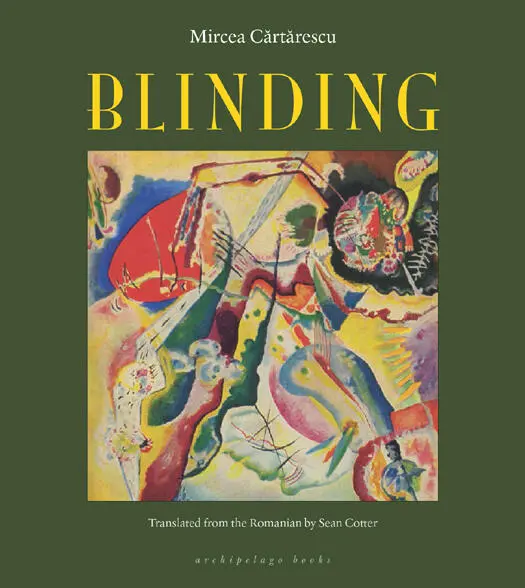
- Название:Blinding: Volume 1
- Автор:
- Издательство:Archipelago
- Жанр:
- Год:1996
- ISBN:9781935744856
- Рейтинг книги:3 / 5. Голосов: 1
-
Избранное:Добавить в избранное
- Отзывы:
-
Ваша оценка:
Blinding: Volume 1: краткое содержание, описание и аннотация
Предлагаем к чтению аннотацию, описание, краткое содержание или предисловие (зависит от того, что написал сам автор книги «Blinding: Volume 1»). Если вы не нашли необходимую информацию о книге — напишите в комментариях, мы постараемся отыскать её.
was one of the most widely heralded literary sensations in contemporary Romania, and a bestseller from the day of its release. Riddled with hidden passageways, mesmerizing tapestries, and whispering butterflies,
takes us on a mystical trip into the protagonist’s childhood, his memories of hospitalization as a teenager, the prehistory of his family, a traveling circus, secret police, zombie armies, American fighter pilots, the underground jazz scene of New Orleans, and the installation of the communist regime. This kaleidoscopic world is both eerily familiar and profoundly new. Readers of
will emerge from this strange pilgrimage shaken, and entirely transformed.
Blinding: Volume 1 — читать онлайн бесплатно полную книгу (весь текст) целиком
Ниже представлен текст книги, разбитый по страницам. Система сохранения места последней прочитанной страницы, позволяет с удобством читать онлайн бесплатно книгу «Blinding: Volume 1», без необходимости каждый раз заново искать на чём Вы остановились. Поставьте закладку, и сможете в любой момент перейти на страницу, на которой закончили чтение.
Интервал:
Закладка:
Later, a week or so after that illuminated night of disturbing hallucinations, the young man would tell Maria the story of his adventure in the belly of the dark. He was still seeing her, because of a certain resentment he felt toward the damned “yid” who in the midst of pleasure slandered the teachers of mankind, and she was seeing him out of loneliness and a desire to go to the movies, which was what she loved most in the world. Time had evaporated along with the light, and the only measure of his descent, metal rung after metal rung, was fear. His eyes went blind, there was screeching in his ears, the calcified chochlea spun crazily in the midst of nonbeing, and the analytical mind of fear broke open. The young man no longer knew whether he was climbing up or down, or along an endless railroad track, grasping the ties; all he could feel with his palms and fingers was the rhythmic interval of the form and the cold of metal bars, the only objects in space. But what if these were only subjective sensations? What if he was just lying under a sheet somewhere, and the nerves in the skin of his palms, projected into his brain’s sensorial-motor zones, constructed the sensation of narrow, cold cylinders, just the length he could feel with his palms or the tips of his fingers? In the middle of the dark, with your body completely liquefied, it was impossible to say whether your pancreas was still inside the somatic bag or sagging outside like a hanged man’s tongue, or to know if your skeleton had turned into a shell like a crustacean’s, or if your neurons had left the original ball under your skull behind, spreading, unraveling like obscene lace to the end of night. The organ of fear did not have a clear shape, like the fungiform papilla or the eyeball, since it was constantly devoured by what it perceived. The organ of fear was crazed with itself in every moment, it contracted and struggled in corrosive liquid, in unforgiving acids of fear. The young man descending no longer knew who he was, nor what area of the world he climbed toward, but he saw the fear, he saw it growing, becoming a fabled scene, painted with the nuances of horror, with desperation, disquiet, anguish, terror, panic … There were startled mountains and petrified cities and forests of cold sweat. Monuments of horror lorded over vast, misty piaţas. Adrenaline sculptures, fluorescent green, portrayed terrible violations, rendings and vivisections, ablations, desquamations, excoriations …
By now, he was no longer descending but levitating like a cloud through the spectral world, in the colossal thickness of fear, over towers of claws and trees that looked like knotted intestines. The dull green and opalescent venom became more frequent, the petrified howling omnipresent … He slid over wide and frightening planets, through empires of desperation that fulminated around him like fog, compact and sparse by turn. Immense towers with tiny windows shining in the green dusk adorned their peaked cupolas with statues of people with their faces in their hands, women overcome with shame, old people begging for death … Through an oval window, there was a girl with an unspeakably romantic form, long curly locks, pearly teeth between her coral lips, a white lace bodice and a blue satin crinoline, and hundreds of bows, with the tips of her lizard-skin shoes peeking out underneath. She was seated at a spinet piano, playing sounds like the clicks of knitting needles. It would have been a charming picture of love, if below her ebony bun, held by a tortoiseshell comb, on her delicate neck with curls of short hair, there wasn’t a hideous tumor, a growth as big as a newborn’s head, bruised and scratched, excreting a yellow pus between its flakes of pink skin … Further on, in a glass, angular hall as big as a train station, along the halls where the young man drifted, dissolved in terror like the steam of hot breath, a procession appeared, moving toward a crystal tomb. He had entered the room through an open transom, with dusty edges, held up by a black wire hook, and he found himself suddenly naked, walking next to the others along checkerboard tiles, bloody squares with marbled designs alternating with white squares, crystalline, like sugar. Every being in the long procession was marked by a monstrous debility: flayed oxen tongues emerged from twisted teeth, vulvas hung down like the whiskers of catfish, gigantic skulls, translucid, filled with violet liquid … He alone, as he suddenly saw in the pure, prismatic façade of the tomb, was whole and beautiful like a god, especially since … he had wings … long, multicolored wings, like a tropical butterfly, with electric blue dots and lilac edges, tips shaped like cobra heads in a yet warmer velvety purple … He looked at himself in the polished mirror of the empty tomb, while he felt six claws as sharp as needles entering his flesh, and he knew then that the enormous wings had not grown between his shoulder blades, like an anatomical anomaly, but that a great butterfly, as long as he was tall, had climbed onto his back and anchored itself firmly onto his ribs, and it watched him with bulging, glowing eyes that had thousands of hexagonal facets. He imagined the inevitable moment when the twisted spiral of its proboscis would unroll, like a curved needle, and slide into his occiput, gently popping through his epidermis, the tip, hard as a diamond, slicing at a slant his skull’s layers of bone, puncturing the duramater and piamater, advancing slowly, greased like gelatin, through the occipital lobe, and stopping in the center of his brain, in the middle of the limbic ring, equidistant from the fornix, mammillary bodies, hippocampus and amygdalae, and sucking out, like a vacuum, one cubic centimeter of cream-caramel matter and replacing it with an egg … The egg is pearly pink, with a soft, pulsing shell, it descends along the proboscis and beds there, between the snowflakes of the axon bodies and the mad labyrinths of the synapses. Then the proboscis withdraws, just as gently, now coated in blood, and spirals back into place, and the butterfly flies off in a zigzag through the air, toward the window open in the roof. The disfigured procession carries the young inseminated god in their arms, places him gently in the hollow of the tomb, and covers him with its heavy, prismatic lid.
He woke up reeling, like he’d suffered a syncope, and to find himself rubbing Pushkin’s right, blind eye with a rag that the soot turned black. He touched his neck, staring into space, pulling the pink atoms of dusk into his chest, just as he did at the table with white and red squares in the beer garden where he had taken Maria for some beer and sausages. For a week, roaming all around Herăstrău Park with a ladder on his shoulder and a bucket in his hand, he didn’t dare touch any of the stone celebrities rising from lilac bushes. When he saw an Ostrovsky or a Sholokhov, it was like he had seen one of those ghouls that the old folks in his village would use to scare kids. His heart jumped in his chest and his feet went cold. Maria laughed, as though he was telling her about a dream, but years later, during Catana’s funeral, lost in the immense tomb of marble, Ionel’s story would come back to her. There was a strange likeness between the stories, as though it was a variation of an old legend, from another province and another rhapsode, who had forgotten some details and included some of his own, until you’d have to compare hundreds of variants, to put one over the other and trace the similarities and differences, to understand what precisely had happened somewhere, sometime, what nucleus of physical objects and confused beings, consumed in the furious flames of time, had risen as transparent smoke into the air, walking simultaneously down thousands of endlessly forking pathways of stories. In any case, even if she were a Mafaldă with her pineal eye emerging between her eyebrows, barely covered by a translucent layer of skin and staring its blue at the faces of tarot cards, Maria could never have guessed the countless ways her family’s life would weave together with “Aunty Hirsch” and her husband Ionel, the peasant boy come to the city to have an unbelievable career. A photograph from the early 70s, black and white with serrated edges, shows Costel and Ionel laughing together against a backdrop of modern buildings and ornamental trees. Costel is in an officer’s coat but black civvy pants, while Ionel, almost unrecognizable, fat and red-faced, is wearing a black jacket and pants from a uniform.
Читать дальшеИнтервал:
Закладка:
Похожие книги на «Blinding: Volume 1»
Представляем Вашему вниманию похожие книги на «Blinding: Volume 1» списком для выбора. Мы отобрали схожую по названию и смыслу литературу в надежде предоставить читателям больше вариантов отыскать новые, интересные, ещё непрочитанные произведения.










Обсуждение, отзывы о книге «Blinding: Volume 1» и просто собственные мнения читателей. Оставьте ваши комментарии, напишите, что Вы думаете о произведении, его смысле или главных героях. Укажите что конкретно понравилось, а что нет, и почему Вы так считаете.