Mircea Cărtărescu - Blinding - Volume 1
Здесь есть возможность читать онлайн «Mircea Cărtărescu - Blinding - Volume 1» весь текст электронной книги совершенно бесплатно (целиком полную версию без сокращений). В некоторых случаях можно слушать аудио, скачать через торрент в формате fb2 и присутствует краткое содержание. Год выпуска: 1996, ISBN: 1996, Издательство: Archipelago, Жанр: Современная проза, на английском языке. Описание произведения, (предисловие) а так же отзывы посетителей доступны на портале библиотеки ЛибКат.
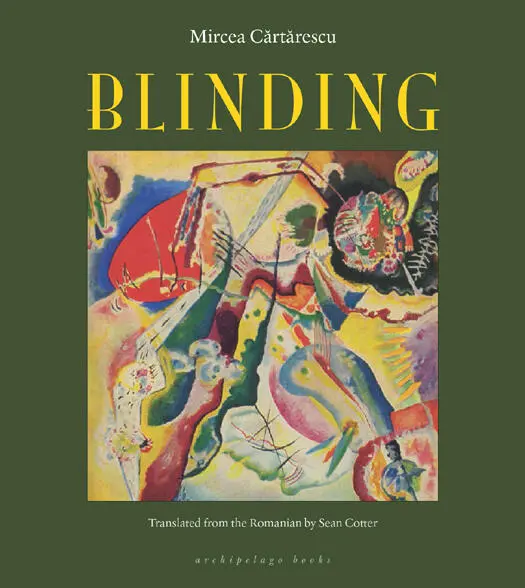
- Название:Blinding: Volume 1
- Автор:
- Издательство:Archipelago
- Жанр:
- Год:1996
- ISBN:9781935744856
- Рейтинг книги:3 / 5. Голосов: 1
-
Избранное:Добавить в избранное
- Отзывы:
-
Ваша оценка:
Blinding: Volume 1: краткое содержание, описание и аннотация
Предлагаем к чтению аннотацию, описание, краткое содержание или предисловие (зависит от того, что написал сам автор книги «Blinding: Volume 1»). Если вы не нашли необходимую информацию о книге — напишите в комментариях, мы постараемся отыскать её.
was one of the most widely heralded literary sensations in contemporary Romania, and a bestseller from the day of its release. Riddled with hidden passageways, mesmerizing tapestries, and whispering butterflies,
takes us on a mystical trip into the protagonist’s childhood, his memories of hospitalization as a teenager, the prehistory of his family, a traveling circus, secret police, zombie armies, American fighter pilots, the underground jazz scene of New Orleans, and the installation of the communist regime. This kaleidoscopic world is both eerily familiar and profoundly new. Readers of
will emerge from this strange pilgrimage shaken, and entirely transformed.
Blinding: Volume 1 — читать онлайн бесплатно полную книгу (весь текст) целиком
Ниже представлен текст книги, разбитый по страницам. Система сохранения места последней прочитанной страницы, позволяет с удобством читать онлайн бесплатно книгу «Blinding: Volume 1», без необходимости каждый раз заново искать на чём Вы остановились. Поставьте закладку, и сможете в любой момент перейти на страницу, на которой закончили чтение.
Интервал:
Закладка:
The young man got so thoroughly drunk that afternoon that he could barely crawl home to his room in the slums. He got barked at and even bitten by a pack of dogs, wet from where he fell in a puddle … In the morning, after nightmares of statues that spoke or grabbed at him, crushing his bones with stony arms, and after he had remembered, shuddering, that he had kissed nea Zambilă’s hand in the bar many times, in front of everyone, he shaved in his chipped mirror and went off to the new job. The City had given him all according to his need, and for days and weeks, he combed the stone locks of illustrious men, polishing pumice across the wide, convex ovals of their blind eyes, throwing away the cigarette butts that disrespectful people had stuck between their sensual granite lips. For days and weeks, he collected fresh excrement, half black-green, half white, from the birds that crowned the statues, and he crushed the speckled spiders that had woven dense webs from the cheeks’ massive ledges up to the eyebrows. It was spring, and the forsythia bushes made blinding yellow marks on the retina that remained after he looked away, as though he had looked at the sun. In the evenings, he would walk home through the amber fluid that flooded the poor neighborhoods, past girls playing with hoops and fat women on the stairs, or every few days, he would stop by Estera’s and rip her clothes off, almost as soon as he closed the door of her studio apartment on the terrace over the old, crumbling block; he threw her onto the bed with her face down and penetrated her from behind, and she, losing control of herself in excitement, with her braids stuck to her dripping face, would start with perverse and husky whispers, between her ever louder grunts: “Marx is a shithead … say it … say what I’m saying … Gheorghiu-Dej is an asshole … ah!.. aaa … Lenin … motherfucker … Stalin … aaah, aaaaah …” Stalin’s name would always send her into a ravishing orgasm, one that probably alarmed the whole block, after which she would rest — her creamy white skin with constellations of freckles on her buttocks, and even on her labia — for a few minutes and then go back to studying party documents, while Ionel, light as air, his penis resting soft and shiny on his groin, would put his hand behind his head and close his eyes. Beneath his eyelids he saw, much more precisely than in reality, statues, nothing but statues, entire nations of busts with names written below them in black letters, heads and shoulders emerging from each other, superimposing, intersecting … Their features combined: Caragiale wore Eminescu’s locks, Olga Bancic had Tolstoy’s beard, Makarenko was written under Alecsandri … Then he would drowse, lying on his back, and dream fragments of dreams where he saw himself at home in Teleorman; he’d open his eyes and see Estera, late into the night, still at her desk, her shoulder bones and breasts contoured by the lamplight and her dark, copper-colored curls, except for one strand, lit like a flame, beside the lampshade.
One evening in April, climbing his A-shaped ladder, fighting against the cockchafers that attacked Pushkin’s lichen-encrusted temples like tobacco crumbs, Ionel noticed a pitch-black crack at the base of the bust, where it connected to the pedestal. That afternoon he had played a game with himself, trying to guess the names of the stone citizens just by touching their faces. From far away, he would concentrate on the white shine of a group of lilacs, squinting his eyes and forcing himself not to look at the sculpture. He kept his eyes on the ground as he approached, and once he was on the ladder, he closed them completely. He would take the chiseled cheeks in his palms, pass his hands over their wrinkled foreheads, trace his finger over their rough curls, and then say confidently: “Ah, Beethoven, daddy-o, was that you all along? Why the ugly face?” He knew absolutely everyone, they were his colleagues, he patted them protectively on the cheek or pate, he touched the breasts, harder than any woman’s, what’s theirs is theirs, of an underground communist … if they got too dirty he’d tug their ear … With this Pushkin in the Ghica Tei Park, well hidden on a path no one ever took, there was something wrong. Unlike the other busts, firmly cemented onto their poorly painted plinths, this one, who looked Ionel in the eyes the way he once did d’Anthes, during their fatal duel, rocked, almost imperceptibly, with every scrub of the stiff brush on his sideburns. The fissure widened and trembled, dark as a line of ink. It is what it is, Ionel said to himself after he looked over both shoulders, assuring himself that the pathway was deserted. Gathering his courage, as he stood on top of the ladder and pushed hard on the young writer’s left shoulder, on the epaulette, without knowing if he felt joy or fear as he saw the bust pivot on the right shoulder, and a deep well open in the pedestal, with metal rungs down one side.
A beetle hit him in the lip like a brass bullet. The smell of lilacs grew stronger as the night thickened. Already, half of the sky was a deep blue, full of the new moon and a few sparkling stars, while a sweet pearly pink light and bloody clouds outlined the ornamental shrubs on the other side, dressing each branch with a rosy-brown mist. The air darkened into sepia, like in an old picture. Ionel hesitated for a moment, and then the most bizarre ideas entered his mind. It could be an extension of one of the sewers that led into the wastewater network, that branched beneath the entire city and led downstream, toward the Danube and then to the sea, taking away Bucharest’s fermenting turpitude: liquefied feces, newspapers used for toilet paper — the front page, with the smiling beloved Leader, crumpled into a star and smeared with shit — bloody pads of cotton, gray Volcano condoms that always broke, bunching up like painful rings at the base of the vigorous tools of men who hoped they wouldn’t dump a sixth runt into their wives, rotting rats, cats with their guts hanging out in delicate hues of blue and orange … Or it might be a secret drop site for the Securitate, the institution in charge of catching the spies who photographed national targets with ingenious cameras hidden in their glasses frames. Securitate officers were smiling, energetic men who defended revolutionary progress. They each had a delicate wife at home, a wonderful homemaker, and they based their work on subtle logical inferences … Major Frunză and Capitan Lucian were Ionel’s role models, when he read about their adventures, in book after book of the Enigma series that had appeared about a year ago. Or it could be the entrance to a Nazi bunker … but then why didn’t anyone report it when they built the statue? And suddenly the young peasant remembered the story of The Enchanted Flint where fantastic treasure, gemstones and precious scepters inlaid with gold and surrounded with pearls, had been the reward for the bold one who climbed into the hollow. “A treasure,” whispered Ionel with wide eyes. Sometimes, digging out their huts or a well, his fellow villagers would find a rusty bucket full of coins, or an emerald … Ionel took another look up and down the already dark path, and then he lowered himself into the pedestal, holding tight to the throat of the Russian poet, who now looked off to one side, as though he wanted no part of the deeds of these miserable, mortal creatures of flesh, skin, nerves, and blood that would scrub him for all eternity. Propping his hands against the well’s stone walls, the young man sank up to his waist into the pitchy darkness of the interior, where the slanted light of the moon lit only the first two steps. Ionel carefully went another step down and then dragged Pushkin’s bust back over the opening, obliterating the smell of the spring sky and leaving himself in an absolute night.
Читать дальшеИнтервал:
Закладка:
Похожие книги на «Blinding: Volume 1»
Представляем Вашему вниманию похожие книги на «Blinding: Volume 1» списком для выбора. Мы отобрали схожую по названию и смыслу литературу в надежде предоставить читателям больше вариантов отыскать новые, интересные, ещё непрочитанные произведения.










Обсуждение, отзывы о книге «Blinding: Volume 1» и просто собственные мнения читателей. Оставьте ваши комментарии, напишите, что Вы думаете о произведении, его смысле или главных героях. Укажите что конкретно понравилось, а что нет, и почему Вы так считаете.