Mircea Cărtărescu - Blinding - Volume 1
Здесь есть возможность читать онлайн «Mircea Cărtărescu - Blinding - Volume 1» весь текст электронной книги совершенно бесплатно (целиком полную версию без сокращений). В некоторых случаях можно слушать аудио, скачать через торрент в формате fb2 и присутствует краткое содержание. Год выпуска: 1996, ISBN: 1996, Издательство: Archipelago, Жанр: Современная проза, на английском языке. Описание произведения, (предисловие) а так же отзывы посетителей доступны на портале библиотеки ЛибКат.
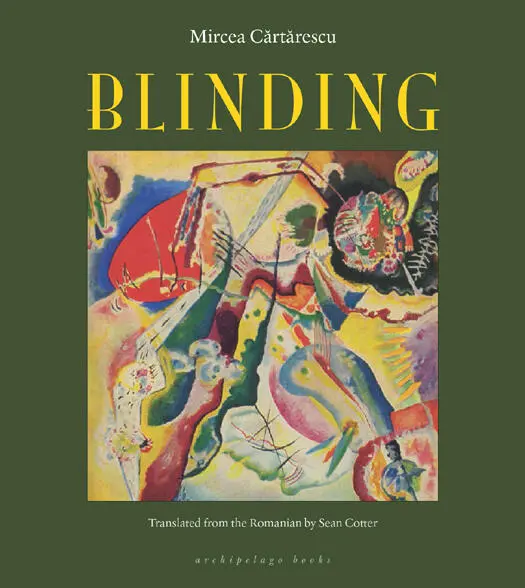
- Название:Blinding: Volume 1
- Автор:
- Издательство:Archipelago
- Жанр:
- Год:1996
- ISBN:9781935744856
- Рейтинг книги:3 / 5. Голосов: 1
-
Избранное:Добавить в избранное
- Отзывы:
-
Ваша оценка:
Blinding: Volume 1: краткое содержание, описание и аннотация
Предлагаем к чтению аннотацию, описание, краткое содержание или предисловие (зависит от того, что написал сам автор книги «Blinding: Volume 1»). Если вы не нашли необходимую информацию о книге — напишите в комментариях, мы постараемся отыскать её.
was one of the most widely heralded literary sensations in contemporary Romania, and a bestseller from the day of its release. Riddled with hidden passageways, mesmerizing tapestries, and whispering butterflies,
takes us on a mystical trip into the protagonist’s childhood, his memories of hospitalization as a teenager, the prehistory of his family, a traveling circus, secret police, zombie armies, American fighter pilots, the underground jazz scene of New Orleans, and the installation of the communist regime. This kaleidoscopic world is both eerily familiar and profoundly new. Readers of
will emerge from this strange pilgrimage shaken, and entirely transformed.
Blinding: Volume 1 — читать онлайн бесплатно полную книгу (весь текст) целиком
Ниже представлен текст книги, разбитый по страницам. Система сохранения места последней прочитанной страницы, позволяет с удобством читать онлайн бесплатно книгу «Blinding: Volume 1», без необходимости каждый раз заново искать на чём Вы остановились. Поставьте закладку, и сможете в любой момент перейти на страницу, на которой закончили чтение.
Интервал:
Закладка:
Cedric came inside the hall and entered the big room on the right. He was as happy as a puppy and equally ragged. He let his gauze strips fall off, and soon his broad grin flashed just as it had at the Gorgonzola. The girls brought him some ţuica and nuts. He ran his eyes over the icons on the walls, full of dragons and militant angels, the yellowed photos in frames of crushed glass, and the raw silk towels. Tătica and Mămica had gone to Bolintin that morning, and would be back late that night or the next day. They still had their wagon and two horses, fat and beautiful, already old, horses that a few years later would be taken by the collective to the ravine. The girls and Cedric had plenty of time to catch up, then, as much time as the day was long. Maria just had to run to the oven now and then, to check on the mămăligă or to make sure the stew was boiling.
They put a round table on the clay floor and sat around it, on little chairs. Maria put the mămăligă in the middle of the table and began to fill the bowls. While they ate in the dark mystery of the room, it snowed steadily and melancholically on the windows, and Cedric told them a fantastic story.
15
MARIA got off the tram at University, in a scene of deep winter. She couldn’t recognize the main boulevard or the side streets under the thick layer of snow. The familiar statues, Mihai Viteazul, Heliade, Gheorghe Lazăr, and Spiru Haret rose out of the snow like the turrets of gigantic submarines. The gray edifice of the university, stretched along its great length, looked like a basalt cliff by a frozen sea — an irregular cliff with allegorical statues on its face — Science, Art, Agriculture, Trade — that could have been elements of natural fantasy, bizarre stalactites that bad weather would carve into gryphons and trolls and countless other fairy-tale creatures. Trees with black branches, full of crows, knocked against the dry glass windows of the building. Each branch wore a delicate ice crust.
Color had completely disappeared from the city. You felt like you were in a black and white film, wound on a well-used reel. The old celluloid, stored damp, the copy of a copy of a copy, was full of spots and scratches, and when the film was projected they looked like long drops and streams of rain. The only living, flesh-and-blood presence, colorful as a flower, was Maria, who, in her summer dress and high heels, clopped quickly toward the movie theater, lifting her ankles out of the snow as deftly as a cat. In heavy clothes, heads hunched between their shoulders against the cold, the passersby seemed too immersed in their own problems to waste a glance at her, as her plump hips swayed past them. She was carefully dressed, but unfortunately in light clothes, untouched by the deadening air around her. The gale, from the Russian steppes, blew so hard from the side that you expected the trams and cars to roll over. With every gust, people turned their backs, cursing into their scarves.
A Russian GAZ truck stopped along the curb beside her. A young man in a sweatshirt and khaki hat with earflaps pulled down to his eyebrows (military issue, with the emblem ripped off the front) called to her from the driver’s side: “Maria! Maria!” Her heart jumped, as she was still dazed by the intense, spherical light of Cedric’s story, but she smiled when she recognized the man. “Ionel, Ionel, my boy, you have to stop your drinking,” she sang to him as she came over to the blue jeep. “Because all the girls laugh at me? Bottoms up? Hey, where are you going? You have a date? Toniiiight I have a daaaate … I’m so haaaapy, can’t be laaaate …” “Shush, no. I’m just going to a movie.” “What’s on?” “I don’t know what it’s called, one with the guy I like, Gérard Philipe.” Ionel smiled wryly. How the hell did Maria know every actor’s name? If he went to a movie with a girl, with an apprentice, they just chose one at random, and if they liked it, they told other people to see it too. He lived near Maria, on Silistra, but he was thinking about moving, since he was driving a truck for the state, now, for the newspaper Scintea, and there was no reason he had to keep living there with all the gypsies, in the slums. He had knocked on Maria’s door a few times, like boys will do, but without any luck. Once he had picked her up in the truck and they went to Casa Scinteii, when it had just been built, a marble palace that took the girl’s breath away. He took her inside, into the vast hallways and monumental stairways, everything in superhuman dimensions. The countless wooden doors with red plates for the various bureaus and editors looked somehow petty, like the ugly, jaundiced, clear-looking, cheap-suited inhabitants of the white stone castle. It was like the real, legitimate inhabitants, of noble and Olympian lineage, had been kicked out by a tribe of pygmies. Maria had let him take her out another time, for a pastry and a soda, but she wouldn’t let it go any further if you broke her arm. So much for that. She was a bit past her prime, at twenty-five, and if she didn’t hurry, she’d end up living with her cats, like everyone who kept her nose in the air, especially if she didn’t have anything between her ears. Ionel had left her in the pay of the Lord, and now, he was seeing a college student, Estera Hirsch, who, when they had kissed in a dark block stairway, put her tongue in his mouth right away, but to look at her, four-eyed and a little prim, active in the Young Workers Union, you wouldn’t have thought she was so fiery. But she was, and how! If the walls could talk in her studio apartment in Predoleanu, high, in the attic, in the clouds, if only they could talk … Between sessions of mad rolling around on her metal-slat bed, Estera would get up quietly and sit at her desk to study articles by Engels, naked as her mother made her, her chest freckled down to her nipples and her public hair as red as the cover of Lenin’s complete works, which lay in a pile next to her bed. She taught Ionel too, she wanted to raise his consciousness, she told him to go to night school … That’s a girl, with help like that he could be someone, he could work at HQ, doing propaganda, a man with an institute car waiting at the gate. For a country boy made truck driver, that would be something. “Okay, Maria, stay good!” he said while he turned the ignition.
Maria smiled after him condescendingly. Ionel was from Teleorman, his family had received some land after the War for Reunification, and they had spent the last few years resisting collectivization. He was the only one of his brothers to go to the city, where for a while he had worked paving streets, digging ditches for the sewers and other public works in the May 1 District, until, after he had gone into a family bar on Lizeanu to warm himself up, he had happened upon someone he knew, almost unrecognizable in his black leather coat with a nice wool hat sitting comfortably enough on his head. It was Zambilă, from Iliasca, whose father, half gypsy, half Serbian, had once set the village on fire and then cut his own throat with a sickle. They had a little drink together, a rye that was increasingly rare, being replaced almost everywhere by Two Blue Eyes ţuica, and nea Zambilă — now Comrade Ciocan, from the District, offered him a better job. Sculptors, volunteers in the War for Peace and Socialism, who rejected the formalist and intimist aberrations of bourgeois art, had placed thousands of busts in all of the parks in the Capital, busts of men of culture and art from all times and places across the globe, who, although they had not managed to correctly grasp the relationship of classes and the struggle of the proletariat for a better life, still displayed a critical-realist view of the society where they lived and worked. Countless Gorkys, Solohovis, Lermontovs (since pride of place must be given to the fighting heritage of the Russian people, our big brother to the east), Neculuts, Vlachuts, Cosbucs, Eminescus — the poet who, even though he didn’t completely understand … still wrote “The Emperor and the Proletarian” and “Our Youth” —, Shakespeares, Voltaires, and Victor Hugos have sprung up like specters, on vine and lichen-covered pedestals along dark paths, chastising from the heights of their genius the unprincipled couples necking under the moon. The most prolific seemed to be Bălcescu, as though he were multiplying in clones: starting from the hundred lei note, his frozen effigy had spread everywhere, as though the whole of the young people’s republic was a bank note, where a population of mites travelled the tangled lines and dots of blue watermarks, collecting in the beard, eyebrows and sunken eyes of the 1848 partisan. Then there were the statues of people from the Communist underground who had fought the bourgeois-landowner regime, who had pasted manifestos onto walls dimly lit by Bacovian light bulbs while a sweet girl in a white blouse stood lookout, who blew up a German landmine by hitting it with an iron hook, saving the bridge downstream at the price of their lives, who blew the factory whistle to call workers to strike, who were tortured in H-cell in Doftana and never betrayed their comrades — just like you saw in all the Romanian movies: Olga Bancic, Eftimie Croitoru, Basil Roaită, Ilie Pintilie, and others whose actions are not widely known … Not to mention the great socialist and communist leaders, Marx, Engels, Lenin, and Stalin, in bronze or red marble statues on enormous pedestals (but this would not be part of his beat). Of course, nea Zambilă, Ciocan from the District, did not string all these names together at the time. Instead he said only that he was in need of someone to clean the busts in the district parks, to clean off the clay, soot, dust and (pardon) pigeon droppings that stained their heads and shoulders. All Ionel would have to do is take a ladder and a bucket of water, and roam and scrub the park paths systematically, stopping by the citizens of granite and white stone to make them glow with cleanliness and general wellbeing.
Читать дальшеИнтервал:
Закладка:
Похожие книги на «Blinding: Volume 1»
Представляем Вашему вниманию похожие книги на «Blinding: Volume 1» списком для выбора. Мы отобрали схожую по названию и смыслу литературу в надежде предоставить читателям больше вариантов отыскать новые, интересные, ещё непрочитанные произведения.










Обсуждение, отзывы о книге «Blinding: Volume 1» и просто собственные мнения читателей. Оставьте ваши комментарии, напишите, что Вы думаете о произведении, его смысле или главных героях. Укажите что конкретно понравилось, а что нет, и почему Вы так считаете.