Mircea Cărtărescu - Blinding - Volume 1
Здесь есть возможность читать онлайн «Mircea Cărtărescu - Blinding - Volume 1» весь текст электронной книги совершенно бесплатно (целиком полную версию без сокращений). В некоторых случаях можно слушать аудио, скачать через торрент в формате fb2 и присутствует краткое содержание. Год выпуска: 1996, ISBN: 1996, Издательство: Archipelago, Жанр: Современная проза, на английском языке. Описание произведения, (предисловие) а так же отзывы посетителей доступны на портале библиотеки ЛибКат.
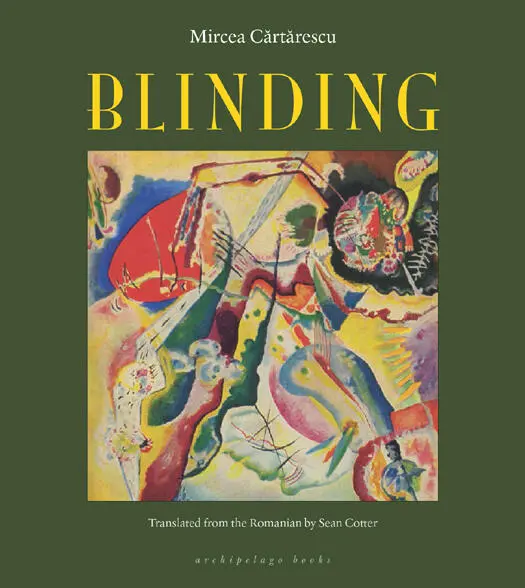
- Название:Blinding: Volume 1
- Автор:
- Издательство:Archipelago
- Жанр:
- Год:1996
- ISBN:9781935744856
- Рейтинг книги:3 / 5. Голосов: 1
-
Избранное:Добавить в избранное
- Отзывы:
-
Ваша оценка:
Blinding: Volume 1: краткое содержание, описание и аннотация
Предлагаем к чтению аннотацию, описание, краткое содержание или предисловие (зависит от того, что написал сам автор книги «Blinding: Volume 1»). Если вы не нашли необходимую информацию о книге — напишите в комментариях, мы постараемся отыскать её.
was one of the most widely heralded literary sensations in contemporary Romania, and a bestseller from the day of its release. Riddled with hidden passageways, mesmerizing tapestries, and whispering butterflies,
takes us on a mystical trip into the protagonist’s childhood, his memories of hospitalization as a teenager, the prehistory of his family, a traveling circus, secret police, zombie armies, American fighter pilots, the underground jazz scene of New Orleans, and the installation of the communist regime. This kaleidoscopic world is both eerily familiar and profoundly new. Readers of
will emerge from this strange pilgrimage shaken, and entirely transformed.
Blinding: Volume 1 — читать онлайн бесплатно полную книгу (весь текст) целиком
Ниже представлен текст книги, разбитый по страницам. Система сохранения места последней прочитанной страницы, позволяет с удобством читать онлайн бесплатно книгу «Blinding: Volume 1», без необходимости каждый раз заново искать на чём Вы остановились. Поставьте закладку, и сможете в любой момент перейти на страницу, на которой закончили чтение.
Интервал:
Закладка:
17
REEEALLY good movie! That guy Jerarfilip was on a beautiful white horse, coming down a path in the forest and then far away, on a hill, there’s this castle. Then you see him go in the castle through an iron gate and then somewhere else, in a little piaţa there in the castle. And he starts fighting with this fat guy, a guard who ran the peasants selling stuff. Boy let me tell you how they fought, what he did to him. Ha-ha-ha! He dropped a basket on his head, then they cut a rope and a board fell on his head, and they knocked him in the pig slop … Then the other guards were coming, and the guy fights like three or four at once and then he sticks his sword and they all fall over in the mud. Boy, what a fight! And the girl, the count of the castle’s daughter, she comes down too, on her own horse, and she’s got her servant with her. And she sees the battle and how many times the guy spanks the other one’s butt and throws the other one like … like five meters, and the girl smiles … She was blond and beautiful, a damn princess, with her eyebrows plucked out: you could see that even back then (nonsense! that’s just the movie) that the girls did themselves up like they do now. But when a lot of soldiers came at him, he wasn’t going to get anywhere if he kept fighting, and the girl frowned and turned her horse around and left …
Lord, how she loved it! She had completely forgotten where she was; she’d stopped noticing Costel’s hand in hers long ago, her whole body and the world around her had disappeared, like hallucinations, like universes where no one had ever been born, where no one would ever understand, ever … She was inside the movie. Her facial muscles mirrored the emotions of those who fought and loved (but never made love, blew their noses, farted, hiccupped, belched, or left their flies open) there, beyond the glass between reality and dream. Paralyzed, unconscious, she experienced the movie so intensely that it was as if it wasn’t projected onto the screen (a torn, dirty sheet) but the smooth bones of her skull, in her frontal lobes, in whose white flesh the associative areas blinked on and off like neon signs. Her being, turned as fluid as milk, poured into the glass shell, the dirty-gray of the body of the princess with blonde braids and shining eyes, it filled the finest glass contours and wrinkles, and, in the enchanted armor of panniers and crinolines, she started to perform the scenes she knew by heart. No one knew, no one would imagine the truth, that now Ivon von Somethingorother was in fact Maria, she had invaded her like The Horla, or like the possessed are invaded by their demons. With her face alternating between light and dark, and her eyes reflecting the rectangle of the screen, Maria whispered the words she knew by heart: “O, Sharl, Sharl, I thought you would never come …” forcing Ivon to say it too, at the same time. Through the thin glass of Ivon, Maria felt the powerful chest of Gérard Philipe every time he and the princess embraced. And, when he fell into the hands of the count’s men, and the girl’s father the count didn’t know that Gerard wasn’t the spy, but that the spy was actually that ugly fellah, Marmandac or whatever, who wanted to steal the girl away, suddenly the audience heard her say, “Pablo! blah-blah-blah” (that is, in the language of the movie), but in the script it was supposed to be, “Sharl, will I never see you again?” But she said Pablo , I heard it with my own ears. And that’s when it hit me. And after that the girl kept lookin’ up at him with her mouth open, totally confused, and after that she said Sharl. Yep, after that she said Sharl, I heard her. But first she said Pablo.
It was the first time Maria had been able to enter the form of a character so well that she could change what it did on screen. She was shaken, dazed, when she realized that, breathing Ivon’s lines, she had changed her lover’s name. Later, in other films, she was able to change entire scenes, alter the plot, get rid of bad characters, or have her favorites marry even when it made no sense, to the consternation of the audience in the miserable theater, one of the three which staked out her territory: the Volga, the Floreasca, and the Melodia. Watching television in the evening, and staring out of boredom at some soap opera, Mircea would see his mother, balled up on the chair with a faded blanket over her legs, burst into tears during farewell scenes, the loss of a child (in all the Indian movies), or the unhappiness of a beautiful, ill-starred girl. She cried beneath the blanket, because Costel, sprawled on the sofa in his underwear, would tease her cruelly if he heard her, he would mock her until she ran into the other room, where she was free to sigh and moan. “That’s a woman, always ready to piss her eyes out …” Often though, when Maria could control herself, clenching her fists, and the tears on her cheeks were only shining trails in the light of the television, Mircea would see the fate of the show’s heroes suddenly change. Things would take a turn for the better, and films that started out as tragedies would end up in happy weddings and baptisms, the reconciliation of stalwart enemies, or the conversion of atheistic blasphemers. Then Maria’s tears would dry and her face would settle back into the enchanted, hypnotized expression that gave her happy dreams.
After the word FIN appeared and the dirty, yellow lights came on, Maria and Costel stood up without a glance at each other. She smiled, he squinted in the light, and they turned — moving with slow and mechanical steps, like slaves in chains, behind the dozens of kids with fat faces and girls who were attractive only by virtue of their youth — toward the door, over which was written in white on a blue rectangle: EXIT. With the same stumbling gait, careful not to step on anyone’s feet and especially not to get stepped on, they dragged toward the narrow hallway that led outside, withering under the garlic stink from one person’s salami to another, and the smell of sheepskin from everyone. Even before they saw the light outside, Maria, with a happy heart leaping up, knew that spring had come, because a purple butterfly perched on a pipe in the wall, folding its wings and occasionally moving its little filiform feet. Maria stared after it for a long time, keeping her discovery for herself. She didn’t even show Costel. She was holding his arm tightly to keep the crowd from separating them. It seemed that no one else saw the velvety wonder, the spot of blood on the dirty green of the pipe. It was like the butterfly was not sitting there on the pipe at all, but on Maria’s retina, where, writhing in the swirling optical chasm, it wanted to spread its wings into the two hemispheres of her brain. Only once she passed did it lift off, its wings fluttering like a wind-up toy over the heads of the flock crowded in the tunnel, to escape into the whirling light outside.
Bucharest was now enveloped within the heat of a scented spring, with puddles reflecting the blue sky, budding black branches on trees that lined the boulevards, and windows sparkling in the steady, intense, white light, raising pulses and stirring memories. The hair and umbrellas of pedestrians crossing the street were caught by warm gusts. The wind popped the red flags mounted on storefronts (since May First was approaching), and often an elegant woman would lose her hat, to the laughter of groups of machine-shop apprentices. Squinting and pursing their upper lips in so much sun, the troglodytes who emerged from the somber grotto of the theater moved over the sidewalks or straight into the mostly empty boulevard, cut only by a Volga or a ringing tram. The police, who had not changed into their fair-weather uniforms, moved around without doing anything, layered in coats and Russian hats, squabbling with a gypsy in a cart, whose horse had shat in the center of the Capital. Where were the snowdrifts that had lined the streets? Where was the milky sky, so low you could have touched it? Now the sky’s color rose, limitless, outlining the statues outside the university, the cubist apartment blocks, with dozens of balconies, big and small, glowing pink in the luminous air, and the pitch-black hornbeams and poplars with leafless branches. Around these sharp shapes, the strong blue diminished until it was almost the pure color of light, and then straight overhead it became deep and intense, in places ultraviolet, a color you could not see without feeling woozy and exalted, as though you could peer through the translucent skin between your eyebrows with the great and lost pineal eye, now withdrawn to the base of the skull, on its tiny Turkish saddle, attentive only to the bestial light of the interior world.
Читать дальшеИнтервал:
Закладка:
Похожие книги на «Blinding: Volume 1»
Представляем Вашему вниманию похожие книги на «Blinding: Volume 1» списком для выбора. Мы отобрали схожую по названию и смыслу литературу в надежде предоставить читателям больше вариантов отыскать новые, интересные, ещё непрочитанные произведения.











Обсуждение, отзывы о книге «Blinding: Volume 1» и просто собственные мнения читателей. Оставьте ваши комментарии, напишите, что Вы думаете о произведении, его смысле или главных героях. Укажите что конкретно понравилось, а что нет, и почему Вы так считаете.