Mircea Cărtărescu - Blinding - Volume 1
Здесь есть возможность читать онлайн «Mircea Cărtărescu - Blinding - Volume 1» весь текст электронной книги совершенно бесплатно (целиком полную версию без сокращений). В некоторых случаях можно слушать аудио, скачать через торрент в формате fb2 и присутствует краткое содержание. Год выпуска: 1996, ISBN: 1996, Издательство: Archipelago, Жанр: Современная проза, на английском языке. Описание произведения, (предисловие) а так же отзывы посетителей доступны на портале библиотеки ЛибКат.
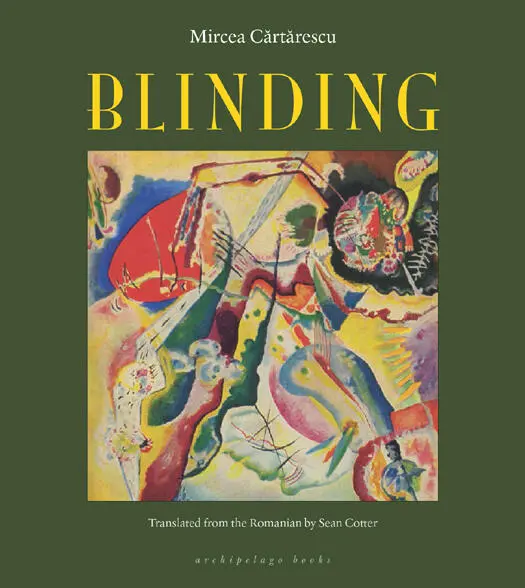
- Название:Blinding: Volume 1
- Автор:
- Издательство:Archipelago
- Жанр:
- Год:1996
- ISBN:9781935744856
- Рейтинг книги:3 / 5. Голосов: 1
-
Избранное:Добавить в избранное
- Отзывы:
-
Ваша оценка:
Blinding: Volume 1: краткое содержание, описание и аннотация
Предлагаем к чтению аннотацию, описание, краткое содержание или предисловие (зависит от того, что написал сам автор книги «Blinding: Volume 1»). Если вы не нашли необходимую информацию о книге — напишите в комментариях, мы постараемся отыскать её.
was one of the most widely heralded literary sensations in contemporary Romania, and a bestseller from the day of its release. Riddled with hidden passageways, mesmerizing tapestries, and whispering butterflies,
takes us on a mystical trip into the protagonist’s childhood, his memories of hospitalization as a teenager, the prehistory of his family, a traveling circus, secret police, zombie armies, American fighter pilots, the underground jazz scene of New Orleans, and the installation of the communist regime. This kaleidoscopic world is both eerily familiar and profoundly new. Readers of
will emerge from this strange pilgrimage shaken, and entirely transformed.
Blinding: Volume 1 — читать онлайн бесплатно полную книгу (весь текст) целиком
Ниже представлен текст книги, разбитый по страницам. Система сохранения места последней прочитанной страницы, позволяет с удобством читать онлайн бесплатно книгу «Blinding: Volume 1», без необходимости каждый раз заново искать на чём Вы остановились. Поставьте закладку, и сможете в любой момент перейти на страницу, на которой закончили чтение.
Интервал:
Закладка:
They hadn’t taken ten steps more through the transparent afternoon air, which jiggled gently at every movement, when Maria lifted her head again, surprised and confused. Over the houses (reconstructed in the same middlebrow style), just as Maria had seen it after the bombing twelve years before, rising pitch black against the motionless, clear sky between the tips of the poplar trees, rose the elevator shaft. It had remained upright after the block surrounding it turned to rubble, its wire mesh covered in grease. There was a large wheel on top of the black parallelepiped, holding a thick, greasy cable, a braid of thousands of steel wires, attached to the elevator car on the top floor and a massive, rectangular counterweight below, now hidden by houses and shrubbery. Maria could not believe her eyes: how was it possible that this chimera had survived, when everything, everything around it had been demolished and rebuilt? Maria had no knowledge then of the nuclear dome in the center of Hiroshima or of the Church of Memories in Berlin, ruins carefully maintained (as though they were relics of distant ancestors or the skulls of sanctified martyrs) in the post-industrial, steel and glass centers of great cities. And even if she had known, she wouldn’t have made the connection, because an incredible fact wiped out any analogy and intensified Maria’s impression that she was hallucinating, her awkward feeling — one that got stronger as she got older — that her mind did not belong to her, that it was only the theater for a play that was completely beyond her control or understanding, which granted her an unequaled importance in the world.
She nearly dragged Costel down two or three winding streets. They crossed a piaţa with an agoraphobic statue and found themselves, suddenly, at the base of the great monument, in front of the dark-green elevator doors. A piece of matte glass, black with years of dirt, was placed in the massive sheets of metal. To the right of the door, a brass, unctuous plate, besieged by a kind of green lichen, held an ancient and weathered ebony button. Over the button, written in curls and flourishes, was a name: MARIA. The grooves of the curls were filled with dirt and barely visible. However strange it seemed, it was not this plaque, bolted beside the elevator door, that made her heart beat and Costel’s cheeks lose their blood (he had also seen the elevator shaft, he was also perplexed, but his passion for technical design was stronger, and thus he had been admiring more the mechanical precision of works from long ago, from the “bourgeois-landowner regime,” of an elevator no longer built in factories of the present day). It was what they had seen from far away and which now, craning their necks, they saw again: a vague motion on the top of the tower, in the wood and glass car suspended twenty meters from the ground. There was someone inside, there was a glimmer and a flash, in the center of and above the abandoned neighborhood’s bloody, ghostly architecture. It was a trembling, blue light, a light that reminded Maria of the azure waters over the breast of Păunaş, the peacock in the courtyard on Silistra.
The light went around the corner of the grass by the petroleum-greased tower. Costel walked away, leaving Maria frozen, wide-eyed, in front of the door. In back of the mesh and iron rod building was a lot with stacks of car tires, and at the far end, the back wall of a yellow house with a window in the middle, right at the top. In the window was an old woman’s head. Her eyes were sunk deep in their sockets, and she sucked a round, sugary candy on a pink plastic ring. Nodding her head cheerfully, she motioned to the young man, who had turned away with disgust. Moving slightly away, in the lot, from the foot of the elevator shaft, Costel could see into the car at the top. He was sure there was a human being inside, but also something like a bird, something with wings. He went back beside Maria and put a hand behind her shoulders (she moved close to him, warm and frightened), he asked her with his eyes, and then, with her permission, he held out his other hand and pushed the elevator button. The ebony cylinder sank with a squeak into its housing, but, as though there was no electricity in the ancient shaft (and there probably wasn’t), nothing happened. The silence continued to be complete and whistling. Not even the wind, rushing toward them in warm and scented gusts, fluttering their clothes and revealing Maria’s thighs, which looked like they were made of transparent honey or liquid amber, rustled the soft leaves of the surrounding trees, as though it was only a change of light in the petrified neighborhood. Maria, her face almost red in the evening illumination, had known ahead of time that the elevator would not move. The plaque, which smelled of tarnish, had her name on it. Her finger had to touch the button, leaving a fine filigreed network of papillary ridges. She held out her hand with such grace that it seemed to cascade from her body, like a pseudopodium full of florescent corpuscles, flowing gently, undulating, pouring toward the brass plaque through the flickering delta of her five fingers (over one of the canals filled with ships, barges, and picturesque water houses, the ring of mammoth hair arched like a bridge). Her index finger — with her painted nail reflecting for a second the enormous, orange sky, with the surrounding buildings and, in the center, her face as thin as Mircea’s face bent over this page of the book, as though it were the golden space of an aquarium — delicately touched the concave surface of the button, pressing it down to the level of the yellowed plaque. Someone with the perspective of an angel (or Laplacian demon) — someone whose eyes could perceive not only the refraction of corpuscles or photonic waves across the surfaces of objects, but also the objects themselves, as they really are, suddenly given in all their details, at every level that our minds artificially separate: mathematics, physics, chemistry, biology, philosophy, poetry, as though the entire mind became an eye, one of the billion eyes of God — someone who could come closer and closer to the image of Maria’s glassy-skinned finger, branded with the design of her fingerprint, until he practically became one with it (and also with every molecule of the ebony elevator button) — he would have witnessed the strange and unexpected meeting of two universes. He would have seen that in between the two surfaces, one of flesh, the other of former flesh, there was, however strong the pressure, a miniscule space, and there, in a no man’s land , like between neuronal synapses, there were negotiations, deals were made, prisoners were traded, and sophisticated passwords were exchanged not in words, but in spatial whirls and torsions. The neurotransmitters fire in thin fountains, green-yellow like venom or florescent blue, moving chemotactically toward the receptors in the button. There, like keys in a lock, they match, displace, or block other substances, palaver endlessly in the catecholaminergic code, and in the end, are reabsorbed, dismantled, and transformed into other and yet other substances, later absorbed by the kidneys of the cosmos and eliminated from existence. Meanwhile, their oriental chattering inserts itself, through long neural pathways, into the elevator’s nervous system, transmitted from axon to axon through ring-form, demyelinated delays, the ring finger, reappearing from place to place, reaching the motor area after countless intermediaries, reconversions, distortions and retardations, to operate, for the first time after years of impasse, the petrified organism of the electric motor.
Maria jerked her finger back as though the button were hot when she saw how quickly the wheel on top turned over and began rattling and rotating, making the entire black mesh tower tremble. Sliding down rails greased with petroleum jelly and hoisting the great rectangular counterweight, the elevator started, with a magisterial slowness, to approach the ground. The lower part of the car was attached to a cable that curled like an intestine and snagged on the dusty mechanism. Passing along each of the three floors, the elevator dinged like a train reaching the end of the line. Gliding almost silently, it measured the space slowly down to the last floor. The two young people stepped back, clutching each other and afraid, when at the end of an endless descent, lasting hours or millennia, the elevator stopped, finally, behind the massive doors on the ground floor. Through the matte glass, nothing in the car was visible but a vague flickering. Whatever was inside did not want to come out, or was not able to come out under its own power. Her hair suddenly sprayed across her face by a wave of orange light, Maria released herself from the mechanic, approached the elevator again, and touched the once-shiny nickel handle in the shape of a T. She turned it toward the left and opened, with a frightening screech, the door frozen on its hinges. Not yet wanting to understand the fabulous image she saw, divided by the rhombuses of the rusty gate, she folded it to one side, and only then really looked, with her eyes widened in amazement.
Читать дальшеИнтервал:
Закладка:
Похожие книги на «Blinding: Volume 1»
Представляем Вашему вниманию похожие книги на «Blinding: Volume 1» списком для выбора. Мы отобрали схожую по названию и смыслу литературу в надежде предоставить читателям больше вариантов отыскать новые, интересные, ещё непрочитанные произведения.









Обсуждение, отзывы о книге «Blinding: Volume 1» и просто собственные мнения читателей. Оставьте ваши комментарии, напишите, что Вы думаете о произведении, его смысле или главных героях. Укажите что конкретно понравилось, а что нет, и почему Вы так считаете.