Mircea Cărtărescu - Blinding - Volume 1
Здесь есть возможность читать онлайн «Mircea Cărtărescu - Blinding - Volume 1» весь текст электронной книги совершенно бесплатно (целиком полную версию без сокращений). В некоторых случаях можно слушать аудио, скачать через торрент в формате fb2 и присутствует краткое содержание. Год выпуска: 1996, ISBN: 1996, Издательство: Archipelago, Жанр: Современная проза, на английском языке. Описание произведения, (предисловие) а так же отзывы посетителей доступны на портале библиотеки ЛибКат.
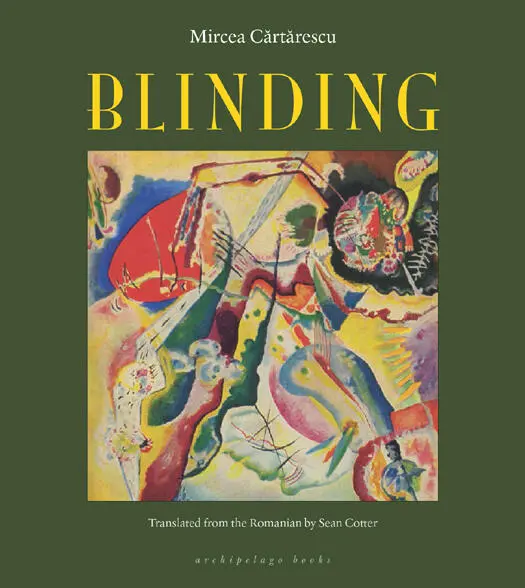
- Название:Blinding: Volume 1
- Автор:
- Издательство:Archipelago
- Жанр:
- Год:1996
- ISBN:9781935744856
- Рейтинг книги:3 / 5. Голосов: 1
-
Избранное:Добавить в избранное
- Отзывы:
-
Ваша оценка:
Blinding: Volume 1: краткое содержание, описание и аннотация
Предлагаем к чтению аннотацию, описание, краткое содержание или предисловие (зависит от того, что написал сам автор книги «Blinding: Volume 1»). Если вы не нашли необходимую информацию о книге — напишите в комментариях, мы постараемся отыскать её.
was one of the most widely heralded literary sensations in contemporary Romania, and a bestseller from the day of its release. Riddled with hidden passageways, mesmerizing tapestries, and whispering butterflies,
takes us on a mystical trip into the protagonist’s childhood, his memories of hospitalization as a teenager, the prehistory of his family, a traveling circus, secret police, zombie armies, American fighter pilots, the underground jazz scene of New Orleans, and the installation of the communist regime. This kaleidoscopic world is both eerily familiar and profoundly new. Readers of
will emerge from this strange pilgrimage shaken, and entirely transformed.
Blinding: Volume 1 — читать онлайн бесплатно полную книгу (весь текст) целиком
Ниже представлен текст книги, разбитый по страницам. Система сохранения места последней прочитанной страницы, позволяет с удобством читать онлайн бесплатно книгу «Blinding: Volume 1», без необходимости каждый раз заново искать на чём Вы остановились. Поставьте закладку, и сможете в любой момент перейти на страницу, на которой закончили чтение.
Интервал:
Закладка:
“The taxi took us to the edge of the great swamp. We stepped out into water up to our ankles, and if we hadn’t had special galoshes with wide soles, we would have sunk to our knees in the mud swarming with worms.” The women lifted their dresses and tied them with leather cords, the way you tie an umbrella closed. The Albino, who had left their house abruptly a few hours earlier, was waiting for them on a little rise of earth. A leech, through whose fatty skin you could see sacks of blood, was lazily crawling over his boot. With a torch in his hand (because night had fallen, billions of stars appeared, and only the west of the sky was colored by an eyelash of intense purple), brave and lordly in his colonial suit of beige linen, he came down slowly and offered his arm to Cecilia. Melanie walked behind them, sighing, and Cedric, after he’d sent the taxi away, paying the driver five times the fare, caught up to them, shaking his shoulders and distractedly humming “Dixie.” They wound themselves down a path with many turns, slightly above the level of the swamp. The stench was overwhelming, entering not through the nostrils, but through the skin. The grotesque croaking of frogs rose like vines around the pillars of stench, opening a florescent cacophony onto the folded vault of night. The cold became piercing. On the leaves of wild irises, rushes, and carnivorous plants, gigantic firefly larvae flashed their horrible masks, with mobile and blind maxillaries snatching at threads on the hips of those who moved through the endless swamp, desperately warding away mosquitoes.
The moon appeared, enormous and round, and rose to occupy the center of the sky. Suddenly it emitted so much frozen fire that Monsieur Monsú’s torch was not needed. Under the yellow light, billions of pools burned as furiously as gasoline, and strange ruins, covered in engravings, appeared. ‘That must be a painting of a palace,’ I first thought when I saw them, feeling a chill spread across my skin. I had only been playing once a week at Monsú’s, spending the rest of my time at the Tequila and Red Fox, but whenever I had sat on stage in the round, cherry-red salon, light like a witch’s cave, I imagined what it would be like to wander through those ghostly, shining buildings, full of statues. Here, in the swamp, in the middle of the paths with hundreds of turns, there rose — it was the first I had heard of them — buildings just like those in the painting, pale, with statues that looked like they were made of flesh, in daylight they must have had vivid colors, but now they seemed dispossessed of color and, at the same time, their life. You know, Derry Fawcet, my friend who played bass, he had a hobby of going onto the rooftop on clear nights and taking pictures of the stars through a telescope. And in his pictures, the stars were not yellow or white, like they were in the night sky, but shimmering in thousands of colors: violet, pink, jade-green, cyclamen, mahogany … He told me that’s what they were really like, but at night, our eyes could not perceive the colors, so we saw them as anemic, pathetic, stripped of their beauty. That’s how I explained to myself the sad pallor of the ruins that appeared before us. It was as though centuries had passed over the buildings in the painting. Their walls were as thin and fragile as paper, and not one was still whole. The windows were only empty holes in walls of dislocated marble. On the edges of the ruined parapets grew pitch-black trees, outlined against the moon. Transparent swamp lilies opened their receptacles like jellyfish, from inside the hip of a crumbled statue. The chimeras on the walls howled soundlessly toward equally mute stars. Here and there, a column of porphyry supported a corner of pediment, on which a hero’s foot, sculpted in high relief, still stepped toward the void, shoed in stone sandals. And all, but all, the desperate faces of the statues, columns and capitals, escarpments and embrasures and abutments — all were covered with the same type of engravings, seeming at each step to organize themselves into nuclei of images and nodes of meaning, but undoing themselves in continuous evasion and evanescence, like an allusive writing, like the writing in dreams. I squinted to decipher it, and it seemed that, between the breasts of a marble woman, I could see a butterfly with its wings spread, and on a heavy pediment a hand without an index finger. The statues, mutilated when they fell from their niches, lay scattered around, and I stumbled over one that floated, without arms, face down in the mud. I shooed a giant toad off the back of the statue’s frozen neck and turned its face toward the moon. Although it was stained with mud, I would swear, Maria, I could swear it was your face! And that’s why I noticed your face in the club, the Gorgonzola!
In short, the ruins we saw were like the pitiful remnants of a once-superb mouth with superb teeth now decayed and broken from which only the crooked and black teeth were still visible, in a reeking, repulsive smile. An immense stone portico, in the ogive, had miraculously remained standing, at the entry to a zone of even taller ruins. Shaggy vegetation grew over its crown of countless fallen blocks. We all passed under the portico, led by The Albino, and, through a rectangular opening in the pallid marble walls, soft to the touch, we sank into the moldy belly of the ruins. Before we were completey lost in the shadows I looked back. The moon, setting over the sky (it had been on our right, then our left, as we walked the convoluted path), sat directly on the portico’s apex, creating a strange symbol together, which the marrow of my spine and the nerves of my stomach understood better than I did myself.
And we went, in the end, into the belly of darkness, through the porphyry lips and the obsidian nymphs of the night. The stars disappeared, but in the torchlight, fairy-like crystals and agates caught fire. All around the walls of the granite vagina where we traveled, the crystalline façades flamed up and died out. We descended further and further, careful not to crush the translucent newts in the puddles where we stepped, and not to snag our hair on the horrible blind cave spiders of the caverns. We passed through a hall shaped like a cistern, half full of green water, through a hall with walls completely covered in fur, through a hall like a freezer, of thin, white crystals, through a rectangular hall of tile, with broken urinals on one side and, on the other side, pipes with the vestiges of calcium-crusted faucets. The Albino would sometimes say something out loud, and every time he spoke in the dripping silence, his voice sounded so brutal and obscene that it stabbed our stomachs with a sour flood of adrenalin. His colorless skin, pale eyes, and cotton hair made him seem like one of those depigmented beings in the depths of the earth, of the same lineage as the wingless insects, the crustaceans fanning their tactile organs over wet stone, and the ragged, famished bats …
We knew we were approaching the center when, suddenly in front of us, in a corridor as narrow as an animal’s trunk, and wearing the long vestments of a Catholic priest, Fra Armando appeared. When the torchlight brought him from the darkness, he was so motionless that he seemed to have been waiting for centuries, occupying and suffocating the whole corridor. On his head over his tonsure he wore a strange, steel miter, unlike anything a priest had ever worn. Out of this disturbing machinery two tubes emerged, curved and nickel-plated like syringe needles, and penetrated his skull, perforating it in the hollows behind his ear canals, as we would see when he turned around. Before he turned, and without paying any attention to Monsieur Monsú, Fra Armando approached the very young woman with large, velvety eyes under golden eyelids, touched his fingertips to her tattooed lips, and made the sign of the cross over her forehead. She smiled timidly and started to say something, but the priest stopped her. “Come,” he murmured, “Those Who Know are expecting you.”
Читать дальшеИнтервал:
Закладка:
Похожие книги на «Blinding: Volume 1»
Представляем Вашему вниманию похожие книги на «Blinding: Volume 1» списком для выбора. Мы отобрали схожую по названию и смыслу литературу в надежде предоставить читателям больше вариантов отыскать новые, интересные, ещё непрочитанные произведения.











Обсуждение, отзывы о книге «Blinding: Volume 1» и просто собственные мнения читателей. Оставьте ваши комментарии, напишите, что Вы думаете о произведении, его смысле или главных героях. Укажите что конкретно понравилось, а что нет, и почему Вы так считаете.