Mircea Cărtărescu - Blinding - Volume 1
Здесь есть возможность читать онлайн «Mircea Cărtărescu - Blinding - Volume 1» весь текст электронной книги совершенно бесплатно (целиком полную версию без сокращений). В некоторых случаях можно слушать аудио, скачать через торрент в формате fb2 и присутствует краткое содержание. Год выпуска: 1996, ISBN: 1996, Издательство: Archipelago, Жанр: Современная проза, на английском языке. Описание произведения, (предисловие) а так же отзывы посетителей доступны на портале библиотеки ЛибКат.
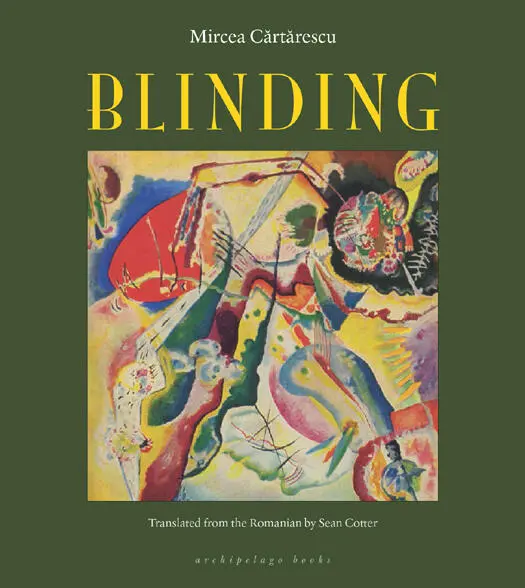
- Название:Blinding: Volume 1
- Автор:
- Издательство:Archipelago
- Жанр:
- Год:1996
- ISBN:9781935744856
- Рейтинг книги:3 / 5. Голосов: 1
-
Избранное:Добавить в избранное
- Отзывы:
-
Ваша оценка:
Blinding: Volume 1: краткое содержание, описание и аннотация
Предлагаем к чтению аннотацию, описание, краткое содержание или предисловие (зависит от того, что написал сам автор книги «Blinding: Volume 1»). Если вы не нашли необходимую информацию о книге — напишите в комментариях, мы постараемся отыскать её.
was one of the most widely heralded literary sensations in contemporary Romania, and a bestseller from the day of its release. Riddled with hidden passageways, mesmerizing tapestries, and whispering butterflies,
takes us on a mystical trip into the protagonist’s childhood, his memories of hospitalization as a teenager, the prehistory of his family, a traveling circus, secret police, zombie armies, American fighter pilots, the underground jazz scene of New Orleans, and the installation of the communist regime. This kaleidoscopic world is both eerily familiar and profoundly new. Readers of
will emerge from this strange pilgrimage shaken, and entirely transformed.
Blinding: Volume 1 — читать онлайн бесплатно полную книгу (весь текст) целиком
Ниже представлен текст книги, разбитый по страницам. Система сохранения места последней прочитанной страницы, позволяет с удобством читать онлайн бесплатно книгу «Blinding: Volume 1», без необходимости каждый раз заново искать на чём Вы остановились. Поставьте закладку, и сможете в любой момент перейти на страницу, на которой закончили чтение.
Интервал:
Закладка:
I made my parka new again, oh ho ,
I have my coat for snow or rain …
Not everyone had a receiver for the state station back then. There were only two radios in the courtyard at 67 Silistra. One moaned with workers’ songs from morning until night, upstairs in the house in back, in the room of the one who became Nenea Nicu Bă, but for now was only Nea Nicu, master carpenter, a scheming lush who wore a beret pulled down over his eyes. The other belonged to Victoriţa, and played more discreetly, well tempered by the urchin with a matchstick.
Right as she came out her door (this is when she lived on the ground floor), Maria met a variegated and contentious world, as if the whole house were a hive of parrots. Dorel the electrician shaved outside, leaning his mirror against the birds’ fence. He was naked to the waist with hairy shoulders, and his sweatpants fell in folds, showing his thick legs and his penis shoved down one side. But Maria paid no attention. Instead, she glanced at him happily, saying “Morning, Dorel,” and then dodging and giggling because he always tried to grab her and cover her face with foam. With the shaving cream on his face, his mouth looked as red as blood. “Kiss the hand, Aunt Angela,” Maria smiled to a woman upstairs, bent over the blue railing. “How’s Ionel?” “To hell with him, he just poops and pisses all day, how is he supposed to be? I change the diaper and he craps in the new one, like he was saving it special. Don’t ever have kids.” Angela also had the requisite cabbage-roll hairdo on top of her head, and a coat that spread the smell of kifte meatballs across the yard. “Are you going to the movies? Is there a good one on?” “No, I’m going into town, auntie. Isn’t it a shame about this sun?” “Go on, Maria. I’m going to see what’s up with the little one.”
The smells of the kitchens and toilets of the slums mixed with the heavy aroma of the rotten box of oleander with pointed leaves, full of lice and fluorescent grubby-pink flowers. A row of tulips glowed divinely in yellow and red flames. The warm breeze was bad for Maria’s hair. She took a kerchief from her purse and tied it under her chin. Chestnut strands, curled with an iron, were still swirling behind her, slipping out from the rayon cloth printed with images of Sinaia. Maria smiled — and Nenea Gigi, the lathe operator with streaked hair and a bad eye from an accident with a piece of scrap — watched her hips and inhaled the scent of her cologne. “She’s not pretty, but she’s still young,” he said to himself. “She’s got a guy in the city, the way she swings it.” Maria was actually smiling because she remembered a scene in “The Valley Echoes,” when the boy of ready money, dressed in a funny white suit, goes to the Bumbesti-Livezeni construction site, where young people work cheerfully, and flirts with the ordinary girls, calling them — it’s so funny — “Mademoiselle,” and they put the rich boy in his place and tell the world and even make a play about him, where the boy from ready money comes up behind a working girl in an apron, smiling and saucy, with big breasts out to here, and says:
Mademoiselle, Mademoiselle
Didn’t we meet last summer at the spa?
Actually, he doesn’t say it, he sings it, because it’s kind of a musical, and she answers him like an echo, and makes all the boys and girls in the theater fall over laughing:
What spa ,
Maybe a spaz?
Come here and I’ll show you a spa!
And she snaps something with a rag. And the real rich boy is in the theater, and the tears come, and he starts sobbing in a really funny way … Maria can’t control herself and begins to laugh out loud. Two gypsy girls at the gate, Lina and Făftica, watch her with their mouths hanging open. They’re real gypsy-gypsies, with puffy skirts and coins in their braids, the gold coins, cocoşeii , that had been confiscated by the police a while ago. They were left with the copper ones. They were short, dark, and very young, about fifteen, but they had already been with men, guys older than they were, and Săftica already had two children hiding behind her skirts. They spit sunflower seeds all day and talked about their gypsy men, who “wandered from cunt to cunt” and never came back home. Three quarters of their vocabulary consisted of “eat me” and “up yours.” You wondered why they never got tired of the same stupidity. They didn’t have anything against Maria, but they’d hassle the other girls. For example, they were always criticizing Coca, the courtyard whore, who didn’t wear a scarf on her head but a pink cap, exactly the color of the oleander, which for some reason bothered them to no end. But at least Coca never brought men to her room, which was as clean and modest as Maria’s; she just walked the streets and went with the men to their places. She would come back at dawn, when the other residents picked up boxes of sausage and boiled eggs and went to work. There was shouting and fighting all the time in in the courtyard, but it had nothing to do with Coca. Most often the landlady, Madame Catana, began the arguments herself. Madam Catana was abnormally fat and mustachioed, with wicked, slanting eyes and frightening veins crawling like purple hunching worms on her manly feet. She would prop herself in front of a tenant and start to scream her head off at him, because she saw him smoking in bed and he was going to set the house on fire, or because he didn’t say hello to her, or because she didn’t like his face … For her, all the men were “assholes” and all the women “sluts” and “hussies,” tramps. She had the habit of coming to the yard to have a bowl of soup, and then there had to be absolute quiet, because while she sat outside chomping, Madame Catana did her books. The courtyard was still full of dirty kids in cheap underpants, black from rolling around in the dirt, and she had to get up from her stool to run at them, with a curse of “damn your mamma.” As much of a bitch as Ma’am Catana was, her husband was kind, an old man who looked like the good Lord himself, lazing all day around the yard, smoking cheap cigarettes on his doorstep. Behind him, through the cracked door, you could just see the landlord’s room of wonders, the thing the whole court talked about with timidity and admiration, like it was a realm of enchantment. Maria had once been in the room of miracles, and she had been dumbfounded by all of its beauty. The old man Catana, you could tell, had done well as a merchant — he had been somebody in his time. The room was filled with old furniture, its wood decorated with garlands, roses, and Cupids. On the stained, plush bedclothes, there was a huge doll with a plaster head, wearing a dress with a pink veil. Other, smaller dolls in long pink and blue dresses, lined the nightstand and bedstead, alongside Chinese dolls made of gypsum and translucent green stone. A large rug covered the entire wall alongside the bed. It took Maria’s breath away. It showed a blue lake with water lilies, and a wide field of flowers along its shore. In the middle of the flowers and lemongrass bushes, there was a golden pavilion full of Spaniards. Two were dancing, a woman with frothy skirts and castanets, and a stiff man in a very short jacket, with knee-length trousers and white socks, with his curly hair held by the typical braid and hat of the torero. The others sat around them, on chairs, the boys flirting with the girls, some playing guitars … A flock of pigeons scurried around their feet. The other walls had paintings in heavy, worm-eaten frames. Maria liked the painting of the gray kitten best, but also the one with swans and conical mountains made of curly wool. On the table laden with macramé, vases painted different colors held dried plant tufts that seemed to float. The tablecloth had heavy silk tassels. The air was brown and smelled like cherry wine. Hundreds of icicles descended from the ceiling plaster, making the place seem like a cave of treasures. There was an old candelabrum with crepe paper shades. In the evening, a pink and palpitating light filtered through the landlords’ windows, like in a dream.
Читать дальшеИнтервал:
Закладка:
Похожие книги на «Blinding: Volume 1»
Представляем Вашему вниманию похожие книги на «Blinding: Volume 1» списком для выбора. Мы отобрали схожую по названию и смыслу литературу в надежде предоставить читателям больше вариантов отыскать новые, интересные, ещё непрочитанные произведения.











Обсуждение, отзывы о книге «Blinding: Volume 1» и просто собственные мнения читателей. Оставьте ваши комментарии, напишите, что Вы думаете о произведении, его смысле или главных героях. Укажите что конкретно понравилось, а что нет, и почему Вы так считаете.