Mircea Cărtărescu - Blinding - Volume 1
Здесь есть возможность читать онлайн «Mircea Cărtărescu - Blinding - Volume 1» весь текст электронной книги совершенно бесплатно (целиком полную версию без сокращений). В некоторых случаях можно слушать аудио, скачать через торрент в формате fb2 и присутствует краткое содержание. Год выпуска: 1996, ISBN: 1996, Издательство: Archipelago, Жанр: Современная проза, на английском языке. Описание произведения, (предисловие) а так же отзывы посетителей доступны на портале библиотеки ЛибКат.
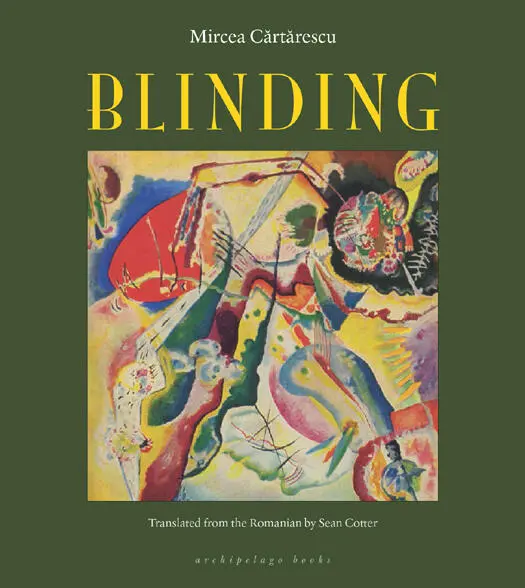
- Название:Blinding: Volume 1
- Автор:
- Издательство:Archipelago
- Жанр:
- Год:1996
- ISBN:9781935744856
- Рейтинг книги:3 / 5. Голосов: 1
-
Избранное:Добавить в избранное
- Отзывы:
-
Ваша оценка:
Blinding: Volume 1: краткое содержание, описание и аннотация
Предлагаем к чтению аннотацию, описание, краткое содержание или предисловие (зависит от того, что написал сам автор книги «Blinding: Volume 1»). Если вы не нашли необходимую информацию о книге — напишите в комментариях, мы постараемся отыскать её.
was one of the most widely heralded literary sensations in contemporary Romania, and a bestseller from the day of its release. Riddled with hidden passageways, mesmerizing tapestries, and whispering butterflies,
takes us on a mystical trip into the protagonist’s childhood, his memories of hospitalization as a teenager, the prehistory of his family, a traveling circus, secret police, zombie armies, American fighter pilots, the underground jazz scene of New Orleans, and the installation of the communist regime. This kaleidoscopic world is both eerily familiar and profoundly new. Readers of
will emerge from this strange pilgrimage shaken, and entirely transformed.
Blinding: Volume 1 — читать онлайн бесплатно полную книгу (весь текст) целиком
Ниже представлен текст книги, разбитый по страницам. Система сохранения места последней прочитанной страницы, позволяет с удобством читать онлайн бесплатно книгу «Blinding: Volume 1», без необходимости каждый раз заново искать на чём Вы остановились. Поставьте закладку, и сможете в любой момент перейти на страницу, на которой закончили чтение.
Интервал:
Закладка:
At a great depth, far ahead of her, she saw two or three silhouettes advancing in the dark green, and merging into it. The steps seemed to have no end. Maria descended them for hours and almost forgot where she was, when she saw at the extreme end of the stairs’ diagonal a small rectangle of light. No taller than insects, the last people in the funeral train flashed for a moment in the slowly advancing light and disappeared through the clear portal. Maria followed them and found herself in a huge hall, moving forward in miniscule steps over a polished, imperial mosaic floor. The hall seemed to be round, but its sides were so far away that they almost disappeared into a pearly mist. Supported by colossal porphyry columns, a golden dome stood too high for words to describe, higher than the dome of the heavens for one who labored on the earth, and higher than the quartz sphere of the constellations. Monstrous sculptures were set into niches all around the room, alternating with red-brown columns. They were male and female nudes, painted the color of flesh, the women pink, the men olive, all with the same azure eyes and the same terror on their faces. Each of their toenails was as thick as a human body, and lost in the gold fog of the vaults, their faces shone only by the lights in their dilated eyes. Each giant exhibited a different, tragic debility: one woman’s left breast was afflicted with elephantiasis, hanging like a hideous sack down to her pubis. Another sculpture’s head was sunk into her neck, her sternum stuck forward like a bird’s. The man closest to her had a poliomyelitic leg, missing the thigh and hip, with only his femur, tibia and perineum sagging in pockets of wrinkled skin. The hernia of the next one filled his testicle, its sack hanging to the ground. Cripples, dwarfs, cachexics, coxalgics, myelomeningoceliacs, the monstrously obese, cyclopedes, those with cleft lips, eleven fingers and eleven toes, bruised skin from a cardiac deformity, lepers, those scarred by anthrax, by scrofula, by vitiligo … the curved line of giant statues embraced the room with a ring of mutilations, and the funeral train advanced across its endless surface, like a parade of mites.
Maria, her mouth agape, crossed the great colored surfaces, imagining, of course, that the floor of semiprecious stone (malachite? obsidian?) contained an enormous drawing, geometric or figurative, that she was too close to see. High above, near the apex of the vault, one must be able to glimpse the fabulous mosaic in its full meaning. The tentative steps of her cheap shoes were like the untrained fingers of someone who’d been recently blinded, or of a teenager touching a woman for the first time. Slowly, the pallbearers came to the center of the hall. As the funeral train progressed, they saw other views of the mausoleum. They could see symmetrical openings in the curved wall, between the niches and columns, portals with bronze inscriptions and intricate decorations, which led to never-ending galleries. Sweet and colorful light, like in a cathedral, filled the mausoleum from nowhere with a diaphanous jelly. In the withered silence, the only sound was the tap of shoes, punctuated and harmonious as the music of a carillon.
Maria passed through the group of relatives in mourning black. She could not look away from the coffin, which was now a shell of prismatic, tinted glass that the six pallbearers struggled to carry. How the dead body had changed! His features were decomposing, his eyes looked like two huge balls under the thick skin of his face, as if his eyeballs had merged with his cerebral hemispheres, and his nose and mouth had merged into a proboscis that ran down to his chest. His hands and feet had been reabsorbed into his belly and chest, which swelled into repulsive shapes. His clothes broke apart, his beard and hair were tossed around like fluff shaken off of a dandelion, and the whitish worm of his penis, gently palpitating, now lay, passive but alive, in the coffin’s elytrons. Maria touched the hard shell of translucent chitin. Her eyes dilated and goosebumps rose on her arms.
In the center of the hall, so far away from the circular wall that the statues and columns could barely be seen through the blue haze, no more imposing than a forest on the horizon, there was a crystal tomb whose lid was pushed to one side. The pallbearers lowered their burden, people gathered in a circle, and the priest began to swing the censer and sing. Everyone crossed himself exaggeratedly and responded from time to time with an “amen.” Strange echoes returned from all sides, minutes later, creating a rose of sonic interference that seemed almost visible in the air of the hall. The pupa, wet with gelatinous secretions, was placed in the crystal house, and the lid, covered with a minute and illegible inscription, was placed over it and sealed. The crystal was so clear and transparent that without the rainbow lightening of the quartz prisms, it would have looked as if the larva floated over the floor. Maria was lost in contemplation of the slow, twisted, peristaltic movements under the skin of the chrysalis, which looked like an eyeball twitching under a sleeper’s eyelid …
When Maria finally pulled her eyes from the enormous cocoon, she found herself alone. The bereaved relatives, the hooded gypsies, the musicians and the priest had perished — they seemed to have dissolved into that corrosive air. It would take days to reach the nearest exit. Had they been reabsorbed into the light of the endless mosaic on the ground? Had they descended even deeper through a hidden trap door? Maria neither understood nor wanted to. You cannot think under vaults that are wider than the bones of your skull. Frozen in the center of the dream, alongside the tomb dug out of crystal, she suddenly felt her entire being collapse, as though she were rotting completely in a few seconds, just before her mind would die. Terror ran over her like a frozen sweat. She knew, in that precise moment, that she would never tear herself away from the fascination and the unreality of the cavern-mausoleum, that she would stay there forever, like a paralyzed grub, living prey for the monster that thumped beside her in its egg. She made the effort of her life to move away, slowly, from the grave and then to run, screaming without hearing her screams, across the multicolored tiles.
She ran at random, for hours and hours, stopping occasionally to breathe, but the walls did not seem to come any closer, or it was happening so slowly that the columns and deformed statues seemed like icebergs on the edge of the universe. Little by little, however, they emerged from the blue haze of distance, and soon she realized that she was approaching a monstrous acromegalic, his thorax surrounded by clouds, his feet so large that between the toes there were vaulted entrances to galleries that dwindled to a point in the distance. Maria entered the arched tunnel between the statue’s right little toe and the next, and she found herself inside a phantasmal brick viaduct. On the spiderweb-covered walls, here and there, hung the yellow horns of the hunting trophies. Paintings in heavy frames, bronze with floral patterns, were so blackened with time you could no longer tell what they were supposed to be. Marble hearths, with cold bronze screens and shovels, alternated with spittoons of the same slippery metal. The gallery was lighted by torches in black metal stands, high along the walls thick with spiders and moths. The silence rang louder and the light seemed to dim as Maria, who suddenly remembered she had left little Mircea alone in the house for the first time, moved forward ever more quickly between lines that united in the distance. Maria began to run again, terrified that she would never escape the phantasmal catacomb. She broke a heel and ran on, limping, until her body more than she herself perceived a gradual change. The air turned pinker, and almost imperceptibly, the gallery seemed to turn meter by meter into that same painful, crepuscular rose. Just as gently, the floor became elastic, and the tiles that had been as clearly defined as a chessboard began to spread their colors into each other, their borders dissolving, and the pictures, hearths, and trophies on the walls also slowly lost their forms, leaning into the reabsorbing pearl rose of the walls, turning flatter and more monotonous. Soon, Maria was walking through a proboscis of wet flesh that, at the edge of her sight, curved into a widening spiral. The walls were running with a yellow liquid and teeming with gelatinous creatures. They vibrated continually, snorting magical, velvet sounds into the air, braided with voices and clanging, louder and louder, until she felt like she was walking through solidified noise. She felt the dizzying spin in her liver, even though the large curves, the ninth or tenth emanating from the center, could be no smaller than Bucharest. After she had passed through the entire snail, walking crookedly across a floor as viscous as the walls, she found herself in front of a sculpture or a colossal mechanism, occupying a bony, irregular cave, on a scale to match the monstrous edifice. It consisted of three pieces, which hung above the crown of Maria’s head like summer clouds oddly knotted together in the sky. Joined by gelatinous pieces of cartilage, the bone pieces vibrated in a continuous roar, like the mechanical looms, she remembered with horror. The first and the last — strangely reminiscent of stirrups — supported the ends of two enormous, round windows, hidden by a transparent, trembling membrane, while the middle one arched between them, like the entrance to a temple, giving the whole a depth and grandeur. Maria, crushed by the inhuman dimensions of the limestone building, approached the window at the other end of the room, climbed the chalky protrusions and excrescences, and crushed the amoebic creatures underfoot, until she reached the thick, moon-colored membrane, with shining lights and fluttering shadows behind it that seemed to be from another world. She pressed her brow against the warm tendon, she pressed her palms against the temples, which were also membranes, or screens, and she tried to see something through the cloudy, hyaline substance. The howl of the exterior world became excruciating, as unbearable as a waterfall. When an indescribable form emerged suddenly from the abyss, rising all at once, green and yellow and gray, moving its — what? face? cephalothorax? tail stinger? — toward the window of flesh, Maria began to scream and ran back without hearing her own scream, just feeling the pain in her throat, losing both of her shoes — back through the hall of enigmatic sculptures, back through the wet snail and back through the viaduct, which after several hours had regained its sweet coral tiles, its brick walls, its fireplaces and its brass spittoons, its hunting trophies and its blackened paintings, finally opening again into the huge, foggy hall of statues. She crossed it again end-for-end, stopping often to sleep through the night on the polished floor. After passing the quartz tomb in the center, where the larva had already wrapped itself in a cocoon of multicolored fibers, she spotted the countless steps that led to the exit. When she saw daylight again through the melancholy cypresses in the Bellu Cemetery, Maria crossed herself. In the tram, she had to brave the crowd staring at her bare feet. She changed trams at Buzesti and took the 24 to the Circus. She passed the florist and reached the entryway of the block with the furniture store, where she had lived for over a year. Already from the entryway she could hear little Mircea screaming. At the door to apartment five, she found her neighbors gathered, trying to calm the boy who was crying as loud as he could behind the door, “My-my-mom-eee! What will I do without my-my-mom-ee!” She dashed over, unlocked the door and took the boy in her arms. He laughed while he cried, drenched in sweat and flushed with the strain.
Читать дальшеИнтервал:
Закладка:
Похожие книги на «Blinding: Volume 1»
Представляем Вашему вниманию похожие книги на «Blinding: Volume 1» списком для выбора. Мы отобрали схожую по названию и смыслу литературу в надежде предоставить читателям больше вариантов отыскать новые, интересные, ещё непрочитанные произведения.












Обсуждение, отзывы о книге «Blinding: Volume 1» и просто собственные мнения читателей. Оставьте ваши комментарии, напишите, что Вы думаете о произведении, его смысле или главных героях. Укажите что конкретно понравилось, а что нет, и почему Вы так считаете.