Mircea Cărtărescu - Blinding - Volume 1
Здесь есть возможность читать онлайн «Mircea Cărtărescu - Blinding - Volume 1» весь текст электронной книги совершенно бесплатно (целиком полную версию без сокращений). В некоторых случаях можно слушать аудио, скачать через торрент в формате fb2 и присутствует краткое содержание. Год выпуска: 1996, ISBN: 1996, Издательство: Archipelago, Жанр: Современная проза, на английском языке. Описание произведения, (предисловие) а так же отзывы посетителей доступны на портале библиотеки ЛибКат.
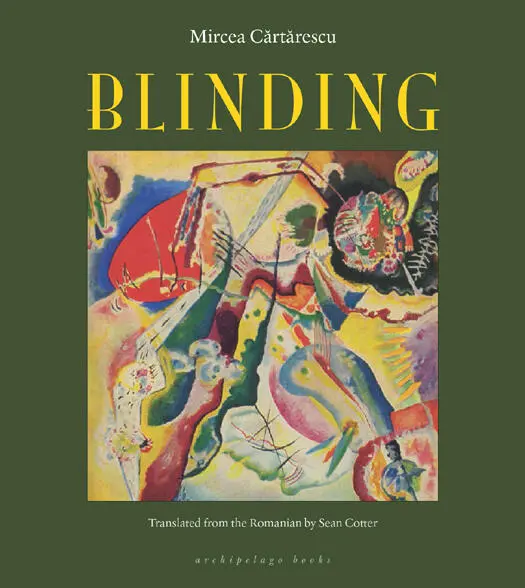
- Название:Blinding: Volume 1
- Автор:
- Издательство:Archipelago
- Жанр:
- Год:1996
- ISBN:9781935744856
- Рейтинг книги:3 / 5. Голосов: 1
-
Избранное:Добавить в избранное
- Отзывы:
-
Ваша оценка:
Blinding: Volume 1: краткое содержание, описание и аннотация
Предлагаем к чтению аннотацию, описание, краткое содержание или предисловие (зависит от того, что написал сам автор книги «Blinding: Volume 1»). Если вы не нашли необходимую информацию о книге — напишите в комментариях, мы постараемся отыскать её.
was one of the most widely heralded literary sensations in contemporary Romania, and a bestseller from the day of its release. Riddled with hidden passageways, mesmerizing tapestries, and whispering butterflies,
takes us on a mystical trip into the protagonist’s childhood, his memories of hospitalization as a teenager, the prehistory of his family, a traveling circus, secret police, zombie armies, American fighter pilots, the underground jazz scene of New Orleans, and the installation of the communist regime. This kaleidoscopic world is both eerily familiar and profoundly new. Readers of
will emerge from this strange pilgrimage shaken, and entirely transformed.
Blinding: Volume 1 — читать онлайн бесплатно полную книгу (весь текст) целиком
Ниже представлен текст книги, разбитый по страницам. Система сохранения места последней прочитанной страницы, позволяет с удобством читать онлайн бесплатно книгу «Blinding: Volume 1», без необходимости каждый раз заново искать на чём Вы остановились. Поставьте закладку, и сможете в любой момент перейти на страницу, на которой закончили чтение.
Интервал:
Закладка:
Now, while I am writing these sentences, these pages are turning so dim I can barely see them. It’s a twilight you don’t often see in spring. The sky has suddenly turned yellow and threatening, leaving dregs of gold in the craggy apartment blocks — a yellow-green sky, like cobra venom. The sky is growing darker, while light still hangs on the houses and the windows, heating their pale skin, giving them the ravaged color of memory. I myself am as white as a pillar of salt in the shadowy room. I stand up by my desk to gaze at Bucharest, my city, my alter ego. This strange block on Strada Uranus, where I have decided to live, has always looked to me like the city’s penis, red and erect, with veins and cables flowing under its skin. My skull, transparent in the twilight, my thin, fluttering body, pink in the glowing window — I am a spermatozoon, ready to shoot toward the sky. As far away as the Intercontinental Hotel, the city raises its forms and branches, its roofs and clouds. My oval window is too small for me to notice the scene’s lack of edges, as I did as a teenager on Ştefan cel Mar, before they built the block across the street. Now I am on the other side of the block, within a symmetrical and far-off chakra. I am grown up, that is, I am an idiot, that is, I am tired, I’m decidedly finished with my life, I’m doing the only thing I have left to do, that is, I’m sending lusty and feverish glances through the block-curtain, through the shutter of my body, like a voyeur peeking at his own life, as though, like a shellfish, I was female until the middle of my life and then I became male, as though I could fertilize myself through the perineal wall. I am a voyeur of my own childhood and youth, trying to understand what is happening behind the blinds, running from one window to another, misreading what I see in the shadows, mistaking an elbow for a breast, mistaking a dress thrown over the back of a chair for exposed buttocks, mistaking black branches against the window for lovers flopping onto the bed. I cannot be there, I will never be there, but still I must get there, I must try to understand.
The buildings on the horizon have turned pitch black, smeared at the edges with a gloomy orange. I don’t want to turn the light on, even though now all I can see is the oval window, the dark orange page, and a trace of the same dirty color from the tip of my pen. In the (maybe) quarter-hour of visibility left, I turn back to the word engraved in brass. PÎNCOTA. “Paunch,” I’d said immediately, moving further through the harsh and burning light, turning onto a cross street. On both sides of the street were lines of square, yellow buildings with their plaster shattered, like Etruscan tombs. Some sort of house-wagon, two stories high, with all its windows broken, sprang directly from a pile of broken toilets, flattened cans, and paper. Old gypsies poked their heads out the windows. It all seemed familiar to me, and it hurt like a wound, as if the entire neighborhood were a crust of dried blood on a child’s knee, and I, the child, picked at the scab until beads of blood appeared. I could not place anything precisely, however. I don’t know how many corners I turned, or how many strange, triangular piaţas I found, each one with a statue of a soldier surrounded by puddles as green as bile, brimming with pollywogs. How many times did I retrace those streets, how many times did I pass the house (or castle) built by a crazy old man, who decorated it with turrets, niches with statues, and mysterious emblems … In the yard, there were glass globes in pink, blue, lilac, and saffron staked on poles, pembá, like a landscape of Christmas ornaments, plaster gnomes, and tomato trellises. Pîncota. I knew it had to be the name of a street, and that it couldn’t be anywhere but this tangled neighborhood. Pîncota. Paunch. When I was looking at the ruins — and actually all the houses were ruins, ruins that smelled like laundry soap and dirty water — the poem I had written a few years before came to me, written when I saw in a dream (as I would so many times) the house where I was born. I recited it out loud to the rubble of concrete fences, to the tiny flowers growing through the stones in the pavement, to the clouds built overhead like another labyrinthine district, overwhelmingly sad:
i remember: beads of sweat growing through pavement stones
i recall: the grocery in the slums knocked over by clouds
and clouds running to my mother’s stomach, crashing into a billion snail horns
huddled there in the billions of pores .
i know: kindergartens, nurseries, roads of lamp gas
i understand: night, night with a goiter
stars, chopped chrysanthemum stuffing
chopped arteries, ponds …
i see again: i see you kneeling again, sagging breasts, black hair whirling
white arm outstretched, fingers crinkling my face
huge, terrific, bomb exploding in slow motion
big black fly buzzing in the net of my nerves .
my dear mother who never bore me!
i write these lines to you, lines that will never be born .
i still know diamond street and house number zero
where you knit my veins into a sweater for dad
i still know, i know those clouds chained like rabid dogs
rushing towards your stomach, rending it — taking me out
taking me out of there, i remember, mamma ,
and wrapping me in the blanket of your hair .
how you screamed out, how bruised you were when the clouds, your men
and gynecologist fertilized you, delivered me ,
when i, pure as milk and polite
left the shadow of my fingers upon your face .
The windows on one side of the streets had already begun to sparkle in the dusk when I found it. “PÎNCOTA (formerly Silistra)” was written on a small blue placard, nailed to a fence greased with petroleum. I cannot understand to this day why they changed the name of the street. But I know when I entered that tunnel of unsettling houses, walking with small steps, I was trying as hard as I could to recognize, to reconstruct, and to relive. I’d only glimpsed this completely walled-off part of my life in my deepest dreams, and even then as something ambiguous and surreal, something combined with disparate objects from other layers of my mind. I walked with the feeling that nothing was real, that I was entering my own brain, or entering a realm attached to reality like a denture over toothless stumps. There was an overlapping stage décor, something fabled and psychic, enchanted. I saw the balcony with oleanders, propped on the pink clay backs of the two Atlases with hairy pubises. On the balcony, so eaten away by termites that the holes could be seen from the street, a wicker rocking chair swayed gently in front of a door with rectangular windows. I passed the old grocery store, with its low entryway beneath a stone arch. I put my head into the basement where, in my mother’s arms, I must have stared with round, dumb eyes, and touched the fire-red poppies in the showcase (still there after twenty-eight years) near the primitive cash register, with rolls of paper for tickets, and the receipts and shelves of canned food and pasta glimmering in the shadows. The shopkeeper was still there, mummified, her nose eaten away, her teeth bare, wrapped in the rags that remained of her apron. Spiders scurried everywhere, caught between old wormy sacks of flour and petrified sugar, in webs so thick that they looked like pieces of felt or batting. Across the black and withered hands of the shopkeeper (with a faded bow in her hair) crawled oily cockroaches, touching their antennae in an abstract alphabet. Everything was rotten, everything stank, everything in the old grocery store was infested. I left with cobwebs in my hair, as if I had turned gray from grief, and I went on through the neural tunnel until I saw before seeing, I intuited, located or maybe constructed, digging through the day’s soap with my own eyes, the House. The old and dear house, forgotten and remembered so often, the house in the middle of my mind.
Читать дальшеИнтервал:
Закладка:
Похожие книги на «Blinding: Volume 1»
Представляем Вашему вниманию похожие книги на «Blinding: Volume 1» списком для выбора. Мы отобрали схожую по названию и смыслу литературу в надежде предоставить читателям больше вариантов отыскать новые, интересные, ещё непрочитанные произведения.








Обсуждение, отзывы о книге «Blinding: Volume 1» и просто собственные мнения читателей. Оставьте ваши комментарии, напишите, что Вы думаете о произведении, его смысле или главных героях. Укажите что конкретно понравилось, а что нет, и почему Вы так считаете.