Teju Cole - Open City
Здесь есть возможность читать онлайн «Teju Cole - Open City» весь текст электронной книги совершенно бесплатно (целиком полную версию без сокращений). В некоторых случаях можно слушать аудио, скачать через торрент в формате fb2 и присутствует краткое содержание. Год выпуска: 2011, Издательство: Random House, Жанр: Современная проза, на английском языке. Описание произведения, (предисловие) а так же отзывы посетителей доступны на портале библиотеки ЛибКат.
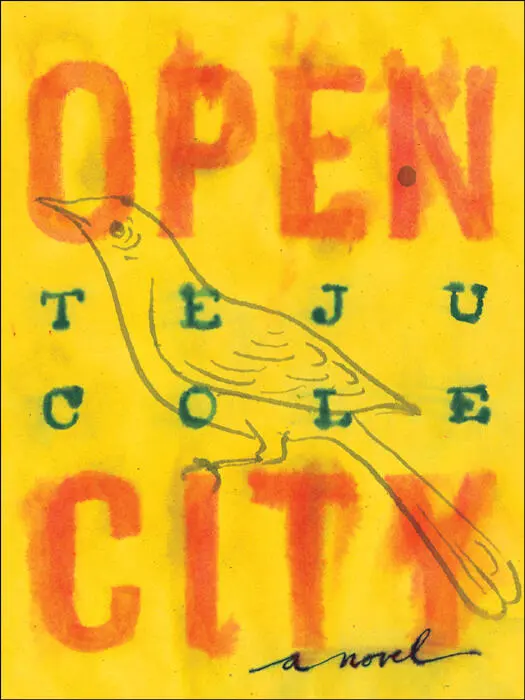
- Название:Open City
- Автор:
- Издательство:Random House
- Жанр:
- Год:2011
- ISBN:нет данных
- Рейтинг книги:5 / 5. Голосов: 1
-
Избранное:Добавить в избранное
- Отзывы:
-
Ваша оценка:
Open City: краткое содержание, описание и аннотация
Предлагаем к чтению аннотацию, описание, краткое содержание или предисловие (зависит от того, что написал сам автор книги «Open City»). Если вы не нашли необходимую информацию о книге — напишите в комментариях, мы постараемся отыскать её.
But it is not only a physical landscape he covers; Julius crisscrosses social territory as well, encountering people from different cultures and classes who will provide insight on his journey — which takes him to Brussels, to the Nigeria of his youth, and into the most unrecognizable facets of his own soul.
Open City — читать онлайн бесплатно полную книгу (весь текст) целиком
Ниже представлен текст книги, разбитый по страницам. Система сохранения места последней прочитанной страницы, позволяет с удобством читать онлайн бесплатно книгу «Open City», без необходимости каждый раз заново искать на чём Вы остановились. Поставьте закладку, и сможете в любой момент перейти на страницу, на которой закончили чтение.
Интервал:
Закладка:
While I was listening to the radio yesterday afternoon in a lull between seeing new patients, I was alerted to the performances this week at Carnegie Hall. The Berlin Philharmonic Orchestra is playing three concerts under Simon Rattle. I went online and bought myself a ticket to the evening’s performance. Tonight is the final concert of the three, Das Lied von der Erde , which I’ll miss because it is sold out. Mahler’s mind was perpetually on last things: Das Lied von der Erde , with its pained notes of farewell and its bittersweet sound world, was largely written in the summer of 1908. The year before, in 1907, vicious politics of an anti-Semitic nature saw him forced out of his directorship at the Vienna Opera. This disappointment had come on the heels of a great shock earlier, in July 1907, the death from scarlet fever of the elder of his two daughters, five-year-old Maria Anna. When the Metropolitan Opera engaged him for the 1908 season, he brought his wife, Alma, and younger daughter over to New York. There had been a respite, a moment of glory and some satisfaction. He thrilled audiences with his conducting and innovative programming until the board pushed him out in favor of Toscanini.
Last night, I attended the performance of the Ninth Symphony, which is the work Mahler wrote after Das Lied von der Erde . So strong is Mahler’s sense of an ending that his many musical stories of the end almost come to dominate what went before. He made himself a master of the ends of symphonies, the end of a body of work, and the end of his own life. Even the Ninth wasn’t his very last work; fragments of a Tenth Symphony survive, and it is even more funereal than the preceding works. From Mahler’s sketches, the work was completed in the 1960s by the British musicologist Deryck Cooke.
I found myself thinking of Mahler’s last years as I sat on the uptown-bound N train last night. All the darknesses that surrounded him, the various reminders of frailty and mortality, were lit brightly from some unknown source, but even that light was shadowed. I thought of how clouds sometimes race across the sunlit canyons formed by the steep sides of skyscrapers, so that the stark divisions of dark and light are shot through with passing light and dark. Mahler’s final works— Das Lied von der Erde , the Ninth Symphony, the sketches of the Tenth — were all first performed posthumously; all are vast, strongly illuminated, and lively works, surrounded by the tragedy that was unfolding in the life. The overwhelming impression they give is of light: the light of a passionate hunger for life, the light of a sorrowful mind contemplating death’s implacable approach.
The obsession with last things was not just apparent from his late style. It had been there right from the beginning of his composing career, as far back as the Second Symphony, which was an extended musical exploration of death and resurrection. Had he, in later years, written only Das Lied von der Erde , it would have been thought a fitting final statement, one of the great ones, to stand with Mozart’s Requiem, Beethoven’s Ninth, and Schubert’s last piano sonata. But to have followed Das Lied , as he did, with the equally immense Ninth Symphony the following summer, in 1909, was to become, through the force of his will, the genius of prolonged farewells.
The concert was part of a series celebrating the city of Berlin. I bought my ticket for yesterday’s concert too late, and I was up in the fourth tier above ground level. The hall, a beautiful conch shell of a space, with a ceiling studded with fixtures and recessed lighting, was packed. The person next to me, a beautiful woman, dressed in an expensive coat, stank; it was a strong smell, something between saliva and alcohol, and I guessed it wasn’t a matter of inadequate hygiene, but rather an overapplied perfume. It occurred to me to change my seat, but that proved impossible. She fanned herself briskly, and the smell dissipated. Her companion, a tall, tanned man in a blue suit and a checked white shirt, a European-looking type with merry gray eyes, soon arrived. The concertmaster emerged from the wings to applause, and the orchestra began to tune, first with the oboist sending out a clear A, and then the sounds of the string instruments drawing themselves out of beautiful cacophony into the unison.
The last concert Gustav Mahler himself ever conducted was in Carnegie Hall, in February 1911. It contained none of his own music: he led the New York Symphony Orchestra, which later became the New York Philharmonic, in the world premiere of Busoni’s Berceuse Élégiaque . On that day, he was in a fever, and he conducted only against the advice of his personal physician, Dr. Joseph Fraenkel; the fever must have burned unbearably within him that evening, as he conducted Busoni’s piece, set to the following words: “The child’s cradle rocks, the hazard of his fate reels; life’s path fades, fades away into the eternal distance.”
Again the oboist played an A, and this time the woodwinds tuned, and they were joined by a flurry of strings. At last a signal came from the stage, and a hush fell on the hall. Almost everyone, as almost always at such concerts, was white. It is something I can’t help noticing; I notice it each time, and try to see past it. Part of that is a quick, complex series of negotiations: chiding myself for even seeing it, lamenting the reminders of how divided our life still remains, being annoyed that these thoughts can be counted on to pass through my mind at some point in the evening. Most of the people around me yesterday were middle-aged or old. I am used to it, but it never ceases to surprise me how easy it is to leave the hybridity of the city, and enter into all-white spaces, the homogeneity of which, as far as I can tell, causes no discomfort to the whites in them. The only thing odd, to some of them, is seeing me, young and black, in my seat or at the concession stand. At times, standing in line for the bathroom during intermission, I get looks that make me feel like Ota Benga, the Mbuti man who was put on display in the Monkey House at the Bronx Zoo in 1906. I weary of such thoughts, but I am habituated to them. But Mahler’s music is not white, or black, not old or young, and whether it is even specifically human, rather than in accord with more universal vibrations, is open to question. Simon Rattle, smiling, his curly hair bouncing, came onstage to applause. He acknowledged the orchestra, and then the lights dimmed further. The silence became total and, after a moment of anticipation, Rattle gave the downbeat, and the music began.
The first movement of the Ninth Symphony is like a great ship slipping out of port: weighty but nevertheless entirely graceful in its motion. In Rattle’s hands, it began with sighs, a series of hesitations, a repeated falling figure that stretched out at the same time that it became more frenzied. I was listening, as always, both with my mind and with my body, entering into the familiar details of the music, discovering new details in the score, points of emphasis and articulation that I had not noticed before, or that had been brought to the fore, for the first time, by the conductor. Rattle, as I watched, was conducting Mahler, but he was also communicating — at least to me, as a longtime partisan of that music — with other performers of the same: Benjamin Zander, Jascha Horenstein, Claudio Abbado, John Barbirolli, Bernard Haitink, Leonard Bernstein, Hermann Scherchen, Otto Klemperer, and not least Bruno Walter, who had premiered the piece in Vienna a year after Mahler’s death, and two years before the beginning of the First World War. These were the names of mostly European men, many of them now dead, names that had, in the fifteen years since I came to the United States, come to mean so much to me, each name connected to a specific mood and inflection — balanced, extreme, sentimental, pained, consoling — on the symphony’s vast score. Simon Rattle, as he shaped the sound of the first two movements, guiding the orchestra through the frenzies and the lullabies, was staking his claim as one of the titans in this piece. The third movement, the rondo, was loud, rude, and as burlesque as it could conceivably be.
Читать дальшеИнтервал:
Закладка:
Похожие книги на «Open City»
Представляем Вашему вниманию похожие книги на «Open City» списком для выбора. Мы отобрали схожую по названию и смыслу литературу в надежде предоставить читателям больше вариантов отыскать новые, интересные, ещё непрочитанные произведения.






Обсуждение, отзывы о книге «Open City» и просто собственные мнения читателей. Оставьте ваши комментарии, напишите, что Вы думаете о произведении, его смысле или главных героях. Укажите что конкретно понравилось, а что нет, и почему Вы так считаете.