Hwang Sok-Yong - The Shadow of Arms
Здесь есть возможность читать онлайн «Hwang Sok-Yong - The Shadow of Arms» весь текст электронной книги совершенно бесплатно (целиком полную версию без сокращений). В некоторых случаях можно слушать аудио, скачать через торрент в формате fb2 и присутствует краткое содержание. Год выпуска: 2014, ISBN: 2014, Издательство: Seven Stories Press, Жанр: Современная проза, на английском языке. Описание произведения, (предисловие) а так же отзывы посетителей доступны на портале библиотеки ЛибКат.
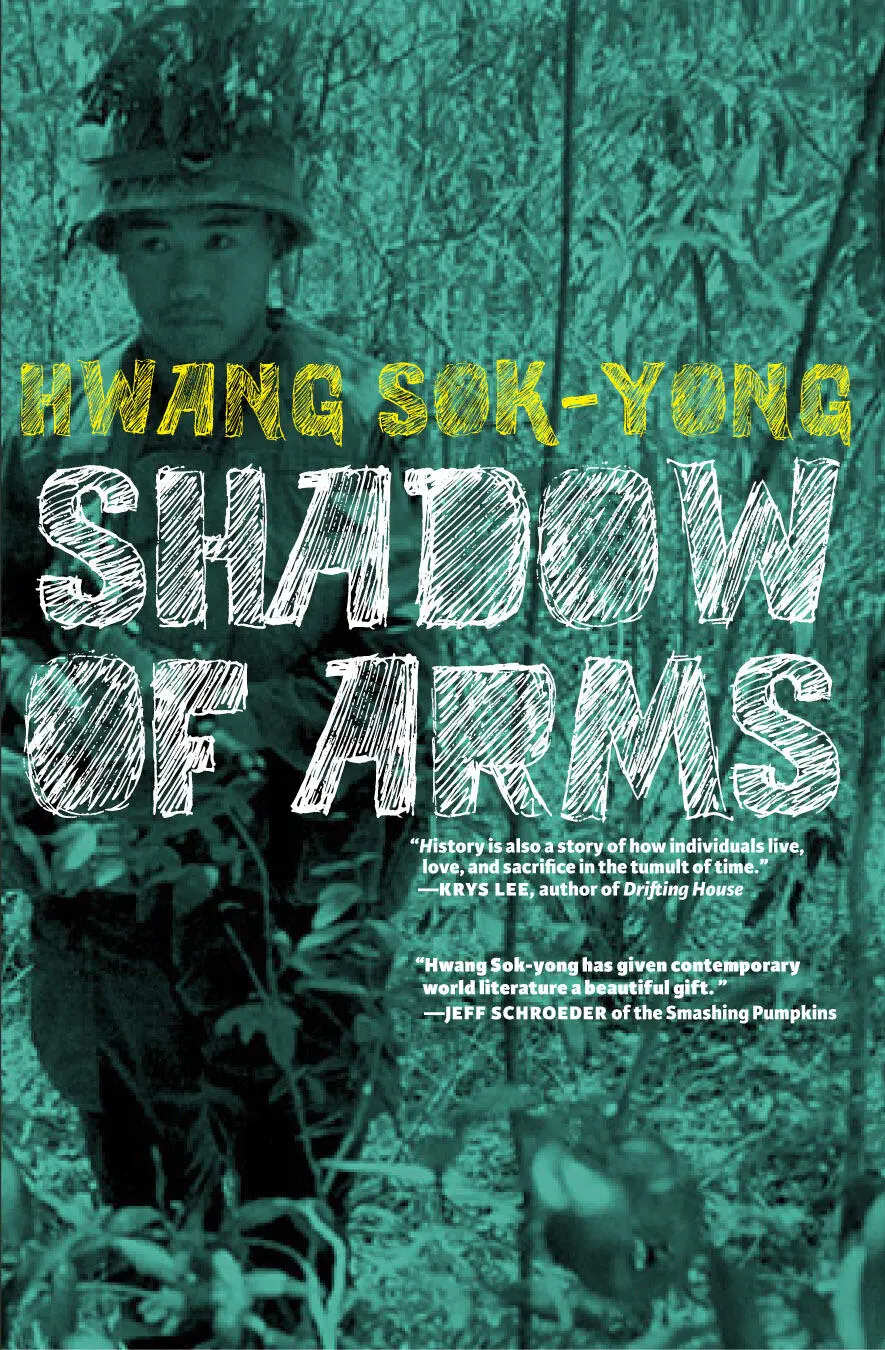
- Название:The Shadow of Arms
- Автор:
- Издательство:Seven Stories Press
- Жанр:
- Год:2014
- ISBN:9781609805081
- Рейтинг книги:5 / 5. Голосов: 1
-
Избранное:Добавить в избранное
- Отзывы:
-
Ваша оценка:
The Shadow of Arms: краткое содержание, описание и аннотация
Предлагаем к чтению аннотацию, описание, краткое содержание или предисловие (зависит от того, что написал сам автор книги «The Shadow of Arms»). Если вы не нашли необходимую информацию о книге — напишите в комментариях, мы постараемся отыскать её.
is a novel of the human condition rather than of the exploits and losses of one side or the other in war.
The Shadow of Arms — читать онлайн бесплатно полную книгу (весь текст) целиком
Ниже представлен текст книги, разбитый по страницам. Система сохранения места последней прочитанной страницы, позволяет с удобством читать онлайн бесплатно книгу «The Shadow of Arms», без необходимости каждый раз заново искать на чём Вы остановились. Поставьте закладку, и сможете в любой момент перейти на страницу, на которой закончили чтение.
Интервал:
Закладка:
“It is practically the same as giving up the entire highlands region of central Vietnam to the NLF and the North Vietnamese. It is a development of deep significance, meaning, in effect, that from now on nobody can be neutral. What you’re saying is, you will take no responsibility for whatever happens to people who have not moved into the hamlets or into our zones of control. What you’re saying is, those villages that had joined with the NLF in the past can and will be annihilated.”
The chief of the agricultural section in the local government was an ARVN major on reserve status and senior to Pham Quyen. He cautiously supported the comments of the mayor of Hoi An.
“All of this is, of course, a by-product of the agonizing war we have been through. We’ve witnessed the wretched fate of many farmers who’ve been deprived of their land and livelihood by the establishment of free-fire zones. If you go up in a helicopter and cross the metal fences at the boundary of the division defense zone, then you’ll see the parade of refugees slowly creeping along under the hot sun. No one knows where they come from and they themselves don’t know where they’re going. The old men have pots and pans on their backs, or a couple of chickens, their entire property, and the children ride in rickety wooden carts, many of them already sick. On the outskirts of all the cities, Da Nang included, tens of thousands of refugees have swarmed in, making slums of shacks on a giant scale, and they keep on growing, too.
“The Americans have provided these refugees with vast quantities of relief supplies and have tried to find jobs for them, but they couldn’t possibly have understood the various problems presented for these Vietnamese people by such transplantation. Putting aside the two most important things, carrying on permanent family life and worshiping one’s ancestors, they think of their own villages as an entire world in microcosm and their worlds are lost.”
As usual, Pham Quyen found himself cast in a sort of master-of-ceremonies role, and he felt a need to move in a direction different from their pessimistic, impractical pleas.
“Our Developmental Revolution Committee and the US — Vietnam Joint Committee are anti-war organizations founded basically to fulfill the hopes of the Vietnamese people to be free from hunger and terror. In other words, furthering self-reliance and realizing peace have been the permanent goals of the projects of our organization. So, our goal is not to expand but to end the fighting. If, as in the past, our enterprise exists and is seen merely as a derivative part of a strategy to achieve military goals, then it is bound to fail. Hence, I would very much like to focus on the fact that this self-reliance project must take the lead on all policy fronts, and the military operations policies need to be supportive of our enterprise.
“Earlier, the advisor reminded us of the characteristic intensity of headquarters’ operations in the run-up to the Tet Offensive, and we now hope that experience would help us to stabilize our project so it can take root and be transformed into a process of securing strongholds that one by one can be expanded. In that respect, General Liam, our committee chairman, upon receiving the report I submitted on the deficiencies in the old strategic hamlet project and the causes of its failure, instructed us to carry out an organizational reconstruction and recruitment of new personnel in the course of planning the phoenix hamlets project. Consequently, I hope this meeting will be devoted in large part to the differences between the strategic hamlet and the phoenix hamlet projects that are expected to improve the prospects for the new initiative. We each can voice our opinions, beginning with the divisional commander, here, please.”
The Second Division commander was from Hue. A young general in the Rangers, he won a field promotion to general when the ARVN First Army was reorganized following the ousting of General Nguyen Chanh Thi in 1966. He had no knowledge whatsoever about pacification techniques on the civilian level. Thumbing through the project plan that had been typed up and distributed, he spoke falteringly:
“To be honest with you, I know almost nothing about the strategic hamlets project. But within the limits of my knowledge, I’d like to mention a few things I think could be helpful for such a pacification project. Adjutant Pham just mentioned that as a project pursuing peace and stability, military operations should be subordinated to the project. However, we are not facing, as our main resistance line, the seventeenth parallel, which looks like the neck of a sack tightened from the sides, Laos and the ocean. There is no front line — the enemy is at our flank, in the rear, beneath us, everywhere. So, just because phoenix hamlets are being established, we cannot stop other operations and devote our forces only to protecting and securing the hamlets.
“Rather, it seems to me that the phoenix hamlets project brings various setbacks for our operations. In my view, the rural areas must be subdivided and communities drastically broken down according to the use of the land. Then, a small number of cultivators and teams of agricultural technicians should create large-scale production complexes, and the military can demarcate operations units for each such complex. And many people who are moved back onto the rural land, after going through a camp-like assembly process, can be set to work on industrial projects, with a good number of factories set up in the environs outside the cities. We have to correct and control the misdistribution of population and efficiently utilize the workforce, then military operations will be able to function better. Unless it is preceded by such a reorganization of settlement patterns, the concentration of the rural community in its present positions will bring no good practical results. Unless more effective control as well as improved security systems are introduced, it will be hard for us to expect victory.”
On the surface, the division commander’s remarks sounded quite reasonable. Pham Quyen felt this honest presentation of a rather extreme functionalism was not very far from what the Americans actually had in mind. A kind of domino theory in which, if one falls down the rest will tumble one by one; each individual domino is not likely to be seen as a distinct entity alive with its own thoughts and dreams, but just as a cube assigned a simple material value.
As though he were moving pieces and jumping squares on a black-and-white checkerboard, the division commander was talking of the land as the flat plane he was used to seeing whenever he looked down at his maps. That square frame, containing streams drawn in ballpoint pen, with the elevations of mountain ridges appearing as connecting ovals, could not show the forests, the birds or the fish, nor could it show the hearts of men stooping over in the rice paddies or their rejoicing at night in the embraces of their wives and children.
The chief of the agricultural was to the left of the commander and this position earned him the opportunity to speak next. He was slightly outraged by the general’s remarks and had been looking at him with contempt. He spoke:
“A mechanistic mentality, to be sure. Of course, I have no doubt about the division commander’s remarkable ability as a combat commander. But it was precisely such thinking that guaranteed the failure of the strategic hamlets project. As Adjutant Pham aptly explained, the establishment of free-fire zones by the US military command in the course of setting up the phoenix hamlet project has been a fundamental impediment to our enterprise. To rectify these problems is why we are meeting here today.
“We have in our possession accurate information on the startling changes that have accompanied the social revolution that has unfolded in North Vietnam since the 1950s. What is startling is how effective were the strategies and techniques they employed to acquire and hold the hearts of Vietnamese farmers. Americans must realize, first and foremost, that they have entered into a cultural sphere that has nothing in common with their own. Material support cannot be the key for solutions. As the Developmental Revolution Committee is now recognizing, the most urgent thing is the realization of social justice.
Читать дальшеИнтервал:
Закладка:
Похожие книги на «The Shadow of Arms»
Представляем Вашему вниманию похожие книги на «The Shadow of Arms» списком для выбора. Мы отобрали схожую по названию и смыслу литературу в надежде предоставить читателям больше вариантов отыскать новые, интересные, ещё непрочитанные произведения.










Обсуждение, отзывы о книге «The Shadow of Arms» и просто собственные мнения читателей. Оставьте ваши комментарии, напишите, что Вы думаете о произведении, его смысле или главных героях. Укажите что конкретно понравилось, а что нет, и почему Вы так считаете.