Joseph O'Neill - Blood-Dark Track
Здесь есть возможность читать онлайн «Joseph O'Neill - Blood-Dark Track» — ознакомительный отрывок электронной книги совершенно бесплатно, а после прочтения отрывка купить полную версию. В некоторых случаях можно слушать аудио, скачать через торрент в формате fb2 и присутствует краткое содержание. Год выпуска: 2010, ISBN: 2010, Издательство: Knopf Doubleday Publishing Group, Жанр: Современная проза, на английском языке. Описание произведения, (предисловие) а так же отзывы посетителей доступны на портале библиотеки ЛибКат.
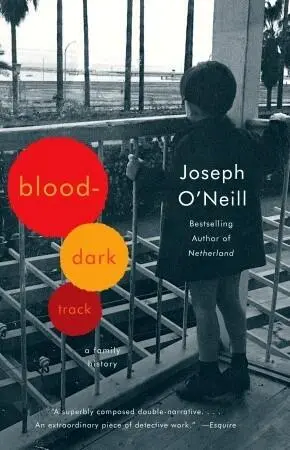
- Название:Blood-Dark Track
- Автор:
- Издательство:Knopf Doubleday Publishing Group
- Жанр:
- Год:2010
- ISBN:978-0-307-74265-0
- Рейтинг книги:4 / 5. Голосов: 1
-
Избранное:Добавить в избранное
- Отзывы:
-
Ваша оценка:
Blood-Dark Track: краткое содержание, описание и аннотация
Предлагаем к чтению аннотацию, описание, краткое содержание или предисловие (зависит от того, что написал сам автор книги «Blood-Dark Track»). Если вы не нашли необходимую информацию о книге — напишите в комментариях, мы постараемся отыскать её.
, a fascinating, personal, and beautifully crafted family history.
Joseph O'Neill's grandfathers-one Turkish, one Irish-were both imprisoned for suspected subversion during the Second World War. The Irish grandfather, a handsome rogue from a family of small farmers, was an active member of the IRA. O'Neill's other grandfather, a debonair hotelier from the tiny and threatened Turkish Christian minority, was interned by the British in Palestine on suspicion of being an Axis spy.
With intellect, compassion, and grace, O'Neill sets the stories of these individuals against the history of the last century's most inhuman events.
Blood-Dark Track — читать онлайн ознакомительный отрывок
Ниже представлен текст книги, разбитый по страницам. Система сохранения места последней прочитанной страницы, позволяет с удобством читать онлайн бесплатно книгу «Blood-Dark Track», без необходимости каждый раз заново искать на чём Вы остановились. Поставьте закладку, и сможете в любой момент перейти на страницу, на которой закончили чтение.
Интервал:
Закладка:
It so happened that there was, in the dissident faction at the Curragh, a group of internees who took a wider view of international affairs. The Connolly group was led by Neil Gould, a communist who had lived in the Soviet Union, and its members absorbed and discussed left-wing literature and closely followed developments on the Eastern Front. Following their ideas through to their logical conclusion, some even argued that the right course of action would be to help the Soviets to defeat the Nazis by signing out and joining the British army. Even for the relatively flexible IRA camp leadership on the dissident side, this went too far. Gould was refused permission to teach Russian and, eventually, removed from the Curragh. The Connolly group had a strong Cork element, and Hut C1 was pro-Soviet, and Jim O’Neill was a socialist; nonetheless, it was doubtful that my grandfather came significantly under Gould’s influence. Described by one veteran as a man with a strict sense of discipline and little interest in political development, Jim would most probably have approved of the decision to remove Gould and quash any talk of IRA men joining the British army. Certainly, he never discussed Neil Gould with his wife or even his son Brendan.
Nor did he discuss the Germans, whose presence at the Curragh was barely recorded in the reminiscences of Irish internees. To a degree, this was an understandable hiatus — after all, the men had plenty to say, and plenty that needed to be said, about their own day-to-day experiences, and it might have been that they were simply according themselves a natural historical priority. Even so, given the proximity at the Curragh of the two national groups — separated only by a trench, they were within shouting distance of each other — and the extraordinary dimensions of the world war, it seemed wrong-headed to relate the story of the internment without meaningful reference to the events occurring beyond the Irish encampment’s barbed wire: the very events, in fact, that were the cause of the men’s internment. It was remarkable how republican discourse, although influenced by the transnational principles of socialism and Roman Catholicism, was impermeable to ulterior narratives. Of course, there was an obvious reason for the non-appearance of the German internees or, for that matter, the Second World War, in the movement’s self-history: these subjects raised the issue of the IRA’s complicity with Nazi Germany.
I had no reliable idea of where Jim O’Neill stood on the IRA dealings with Nazi Germany, which very few, if any, Cork volunteers knew much about. But in the course of a conversation about Ardkitt in the old days, Grandma said to me, unprompted, ‘During the Second World War, we didn’t know how bad the Germans were; we saw it only after, on the screens, and heard it on the radio. What Hitler did … Oh, my God, what he did.’ Grandma was sitting in the front room with clasped hands, next to the photograph of her husband aged around fifty: with his smiling, chiselled face, and his white shirt, dark tie, cardigan, and checked tweed jacket, my grandfather was the very image of the hard, handsome IRA man. ‘At the time,’ Grandma said, ‘anyone that was beating the English, we were for them. We thought that way. But how wrong we were. How wrong we were.’
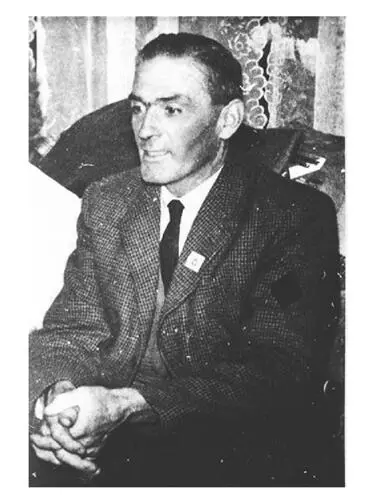
Jim O’ Neill
5
Something very wrong must have happened to make my life take so false and unnatural a turn.
Thomas Mann, Letter to the Dean of the Philosophical Faculty of the University of Bonn, 1937One evening in 1939 before the outbreak of the war, the Hittitologist John Garstang and his wife were having dinner at the Ankara Palace Hotel, in Ankara, when Franz von Papen, the recently appointed ambassador of the Third Reich to Turkey, walked into the restaurant surrounded by animated and fawning officials. The group sat at a table in full view of the Garstangs. Mrs Garstang, an excitable, disapproving Frenchwoman from Carcassonne, looked on with increasing fury as Papen was toasted and congratulated by his fellow diners. Eventually unable to restrain herself any longer, she strode across to Papen’s table and, wagging a finger at his face, berated him and the regime he represented. The famously suave Papen took the reproof with a smile. He had been in, and extracted himself from, far stickier situations before.
John Garstang, a small, elderly, burly man with a full beard, did not pay much attention to the German diplomat. Garstang took no real interest in politics. He was absorbed, to the exclusion of almost everything else, by the Hittites. He didn’t care for card-games or tea parties, and his preferred conversation — over breakfast, lunch and dinner — was archaeology. His principal diversion was methodically to practise his golf swing with the iron he always brought on his digs. Occasionally, however, the extra-Hittite world had to be reckoned with. In 1907, the year he travelled on horseback through north-east Turkey in search of Hittite monuments, Garstang’s application for a dig was frustrated by the Kaiser, who personally procured the relevant permits from the Sultan for the German orientalist Hugo Winckler. Another setback for the Englishman occurred in 1936, when the Arab Revolt obliged him and his young nephew, O.R. Gurney, to flee their dig at Jericho and escape, via Syria, to Turkey. Forced to look for something new to do, John Garstang arrived in Mersin in December 1936 to prospect for sites. He stayed at the Toros Hotel and befriended its owner, a refined and helpful man with an enthusiasm for antique civilizations. In the winter seasons of 1937–9, Garstang dug in Mersin at the ancient mound of earth called Yümüktepe, which was situated alongside the Soğuk Su (Cold Water) river that trickles through Mersin; then the world war intruded and he was forced to drop the expedition until 1946. That year, Garstang met O.R. Gurney off the boat in Bootle, Liverpool; when the two met (Professor Gurney told me with a mild smile when I saw him at his Oxford home) without pause Garstang began to talk about his latest research in Hittite geography, not once inquiring where his nephew had been for seven years.
And yet, for all of his preoccupation with work, John Garstang was distressed and embarrassed when he learned, on his return to Mersin in 1946, of Joseph Dakak’s experiences at the hands of the British; and he urged his Turkish friend to seek redress. On 9 April 1947, Garstang wrote to my grandfather from Ankara, stating that, as promised, he had spoken to the British embassy and had been heard out with some sympathy. The upshot was that Monsieur Dakak was invited to write to the Head of Chancery at the embassy. ‘Be brief, polite and direct,’ Garstang advised, ‘and don’t discuss the matter with anyone.’
As a consequence, my grandfather wrote the following letter (in English), dated 15 April 1947:
Sir
1. I left Mersin on the 24th March 1942 with a Turkish passport and British visa for Palestine in order to buy lemons.
2. After spending three weeks in Palestine and having arranged my business, I was arrested on my exit in Nakura and brought back to Jerusalem where I was detained as a suspect.
3. After spending various periods in several prisons in Palestine and Beirut I was returned in April 1943 to a special detention camp in the monastery of Emwas (between Ramleh and Jerusalem) where I remained until the middle of September 1945, 4½ months after the official declaration of the end of war in Europe and the Middle East.
4. Each time I was interrogated I requested that I should be returned to Turkey or given a trial in order that I could prove my innocence, but the answer received on each occasion was that the investigations had not finished.
Читать дальшеИнтервал:
Закладка:
Похожие книги на «Blood-Dark Track»
Представляем Вашему вниманию похожие книги на «Blood-Dark Track» списком для выбора. Мы отобрали схожую по названию и смыслу литературу в надежде предоставить читателям больше вариантов отыскать новые, интересные, ещё непрочитанные произведения.




Обсуждение, отзывы о книге «Blood-Dark Track» и просто собственные мнения читателей. Оставьте ваши комментарии, напишите, что Вы думаете о произведении, его смысле или главных героях. Укажите что конкретно понравилось, а что нет, и почему Вы так считаете.