Joseph O'Neill - Blood-Dark Track
Здесь есть возможность читать онлайн «Joseph O'Neill - Blood-Dark Track» — ознакомительный отрывок электронной книги совершенно бесплатно, а после прочтения отрывка купить полную версию. В некоторых случаях можно слушать аудио, скачать через торрент в формате fb2 и присутствует краткое содержание. Год выпуска: 2010, ISBN: 2010, Издательство: Knopf Doubleday Publishing Group, Жанр: Современная проза, на английском языке. Описание произведения, (предисловие) а так же отзывы посетителей доступны на портале библиотеки ЛибКат.
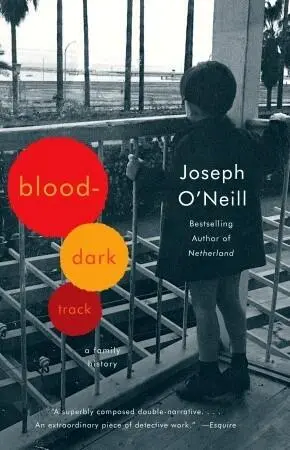
- Название:Blood-Dark Track
- Автор:
- Издательство:Knopf Doubleday Publishing Group
- Жанр:
- Год:2010
- ISBN:978-0-307-74265-0
- Рейтинг книги:4 / 5. Голосов: 1
-
Избранное:Добавить в избранное
- Отзывы:
-
Ваша оценка:
Blood-Dark Track: краткое содержание, описание и аннотация
Предлагаем к чтению аннотацию, описание, краткое содержание или предисловие (зависит от того, что написал сам автор книги «Blood-Dark Track»). Если вы не нашли необходимую информацию о книге — напишите в комментариях, мы постараемся отыскать её.
, a fascinating, personal, and beautifully crafted family history.
Joseph O'Neill's grandfathers-one Turkish, one Irish-were both imprisoned for suspected subversion during the Second World War. The Irish grandfather, a handsome rogue from a family of small farmers, was an active member of the IRA. O'Neill's other grandfather, a debonair hotelier from the tiny and threatened Turkish Christian minority, was interned by the British in Palestine on suspicion of being an Axis spy.
With intellect, compassion, and grace, O'Neill sets the stories of these individuals against the history of the last century's most inhuman events.
Blood-Dark Track — читать онлайн ознакомительный отрывок
Ниже представлен текст книги, разбитый по страницам. Система сохранения места последней прочитанной страницы, позволяет с удобством читать онлайн бесплатно книгу «Blood-Dark Track», без необходимости каждый раз заново искать на чём Вы остановились. Поставьте закладку, и сможете в любой момент перейти на страницу, на которой закончили чтение.
Интервал:
Закладка:
As the train slowly made its way south-east, my grandfather no doubt thought about Georgette, who was eight months pregnant, and the very real chance that he would come home to a second child; about the arrangements made for the care of the hotel and the racehorse in his absence; about the windfall that, all being well, he stood to make from the lemon deal, a capitalistic enrichment of a kind that running a hotel could never produce; and, of course, about the state of the war. My grandfather would have been aware that, in the words of the British Consul in Mersin, Norman Mayers (writing home on 29 March 1942), ‘The rumours are going around of a possible invasion by the Germans of Turkey, or Syria, or what not’. He would have known that the German invasion in the Soviet Union had been checked by the Red Army’s counter-offensives but that there remained a very real risk of a German advance to the oil-rich Caucasus and, from there, to Turkey and the Middle East. He would have known that Rommel had taken Benghazi in January 1942 and that a German drive across North Africa, to the Suez Canal and the Holy Land, was apparently imminent.
Nevertheless, my grandfather went ahead with his venture. When he married, Georgette had made him promise to give up taking business risks — Georgette, the gambler par excellence ! — but what possible downside was there to this once-in-a-lifetime opportunity? (Joseph had not, incidentally, kept his promise to his wife: unbeknownst to her, he’d dabbled in the tin market and furtively stored away a substantial quantity of the metal.) Moreover, it was exciting to travel to Jerusalem, a city he’d never visited, on the Taurus Express, a train that offered the vivid contrast of wild and beautiful country on the outside and, indoors, polished wood, crisp white sheets, good food and (in these interesting times) stimulating and exotic company. For Joseph Dakak, a man not fully tested by Mersin’s provincial demands, such a trip, in such a milieu, was more than a commercial outing: it represented a fulfilment of his cultural potential. Was he not, after all, a man of the world?
Joseph Dakak arrived in Beirut at 5 p.m. on 26 March 1942. He deposited his luggage at a hotel and paid a visit to a cousin, Alida Hannah. Alida immediately insisted that Joseph check out of his hotel and stay the night with her and her son, Rico.
There then occurred the first of a series of encounters between Joseph Dakak and oddly animated, oddly politicized strangers. After dinner, Alida’s neighbour, a Dr Saliba, dropped by for the evening. Dr Saliba, who worked at the American University of Beirut, made it clear in conversation that he was anti-English and pro-German. My grandfather wrote: ‘Since I didn’t care for this subject, I didn’t give Saliba’s utterances much thought; but on reflection, his insistence on manifesting his Germanophilia did seem a little strange.’
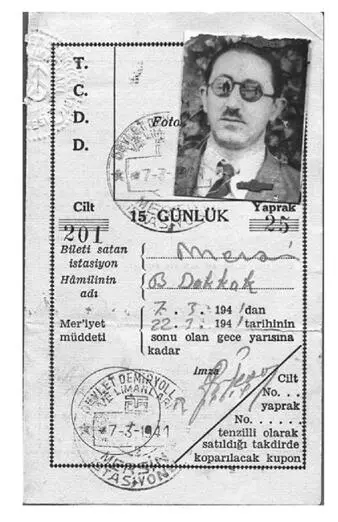
Early the next morning, Dakak travelled in a horse-drawn carriage to the train station. Rico Hannah helped him with his luggage. He advised my grandfather that the place to stay in Jerusalem was the Modern Hotel.
On train between Haifa and Jerusalem, a stranger engaged Dakak in conversation. Soon Dakak found himself being interrogated in detail about the political situation in Turkey — in such detail, in fact, that he finally promised the stranger that as soon as he returned to Turkey he would be sure to make special inquiries at the Turkish Ministry of Foreign Affairs. It dawned on the stranger that Dakak was being sarcastic, and he fell silent.
On 27 March 1942, Dakak arrived in Jerusalem. Perhaps drawn by its name, he went directly to the place recommended to him by Rico — the Modern Hotel. It was there, in the lobby, when he was checking in, that a voice loudly proclaimed, ‘Why, if it isn’t Joseph Dakak! How are you, my dear?’
Dakak turned to see a woman approaching him. ‘You don’t recognize me?’ she cried. ‘It’s me, Olga, the sister of Nicole Panayoti of Antakya!’
Dakak knew a Panayoti who ran the Tripoli branch of Catoni, the old Iskenderun shipping agency; but this woman? Then it came back to him: he had met her once in Mersin, a long time ago. She was Olga Husseini, ‘a notorious adventuress’ active in the Arab nationalist movement. Her husband, Mustapha Husseini, was a nephew of Haj Amin el-Husseini, the Mufti of Jerusalem. Dakak had heard somewhere that Olga had accompanied her husband to Iraq and even India to whip up support for the Palestinian cause.
Olga continued to behave like a long-lost friend. She organized a session of concain in Dakak’s honour (‘Maybe,’ my grandfather speculated, ‘she knew that I often played this card-game in Mersin’). The game was spoiled, my grandfather recorded, by Olga and Mustapha’s incessant talk of politics — tirades against the English, advocacy of the Arab movement, praise of the Germans. Turkey, they pronounced, had done well not to declare war on Germany and not to allow itself to become the pawn of the English. It would be better still, they said, if the Turks opened the way for the Germans to come down through Turkey and Syria to the aid of the Palestinians.
Every time Joseph Dakak tried to change the subject, Olga and her husband returned to it. This state of affairs continued for the remainder of Dakak’s stay at the Modern Hotel. For twenty days, Arab nationalists — all friends of Olga, all pro-German — gathered in the evening and spoke against the English and in favour of the Mufti, who at that time was in Germany.
In his account, my grandfather did not spell out but certainly knew the essential facts of the Mufti’s situation. Amin el-Husseini received the life appointment of Mufti of Jerusalem in 1921 from Ronald Storrs, the Governor of Jerusalem. If Storrs believed that the responsibilities of office would moderate el-Husseini’s political stance, he was wrong. The Mufti became the leading figure in the Palestinian anti-Zionist movement and was instrumental in the Arab rebellion of 1936. In 1937, facing arrest and imprisonment, he escaped to Beirut, where he continued his political activities. In 1939, he relocated to Iraq and set up a shadow Palestinian government in Baghdad. Then, in May 1941, after participating in the failed uprising against the British in Iraq, the Mufti was forced to go on the run to Teheran. In September 1941, after British and Soviet troops entered Iran and installed Mohammed Reza as Shah, the Mufti disappeared yet again, by now with a bounty of £25,000 on his head. Refused entry into Turkey, he somehow resurfaced in Italy in October 1941. The following month he was in Berlin, where he quickly assumed responsibility for notoriously virulent propaganda broadcasts to the Middle East.
At a certain point in his testimony, my grandfather suddenly veered to the subject of oranges: it was his habit, he said, always to keep a bowl of these by his bedside at the Modern Hotel. One night, he discarded an orange that had a strange and unpleasant taste. He tried a second orange but it, too, was inedible. Three more oranges were sampled and they all had the same foul taste. That night, Dakak fell violently ill. Suffering from severe stomach pain, diarrhoea and wind, his heart kicking in his chest, he vomited all night. By morning he was exhausted, and he spent the whole day in bed. The following day his stomach ache persisted and he asked Mustapha Husseini to take him to a doctor. Husseini took him to a Dr Dajani, whose surgery was only a hundred metres away. ‘Dr Dajani speaks German very well,’ Husseini said as he escorted my grandfather to the doctor. ‘He studied in Germany.’ It was Dr Dajani’s opinion that Dakak had caught a cold and he prescribed pills for stomach ache. ‘Unfortunately,’ my grandfather wrote, ‘not yet understanding the cause of my problems, I didn’t mention the oranges to the doctor. And yet it certainly was my first poisoning.’
Читать дальшеИнтервал:
Закладка:
Похожие книги на «Blood-Dark Track»
Представляем Вашему вниманию похожие книги на «Blood-Dark Track» списком для выбора. Мы отобрали схожую по названию и смыслу литературу в надежде предоставить читателям больше вариантов отыскать новые, интересные, ещё непрочитанные произведения.










Обсуждение, отзывы о книге «Blood-Dark Track» и просто собственные мнения читателей. Оставьте ваши комментарии, напишите, что Вы думаете о произведении, его смысле или главных героях. Укажите что конкретно понравилось, а что нет, и почему Вы так считаете.