Joseph O'Neill - Blood-Dark Track
Здесь есть возможность читать онлайн «Joseph O'Neill - Blood-Dark Track» — ознакомительный отрывок электронной книги совершенно бесплатно, а после прочтения отрывка купить полную версию. В некоторых случаях можно слушать аудио, скачать через торрент в формате fb2 и присутствует краткое содержание. Год выпуска: 2010, ISBN: 2010, Издательство: Knopf Doubleday Publishing Group, Жанр: Современная проза, на английском языке. Описание произведения, (предисловие) а так же отзывы посетителей доступны на портале библиотеки ЛибКат.
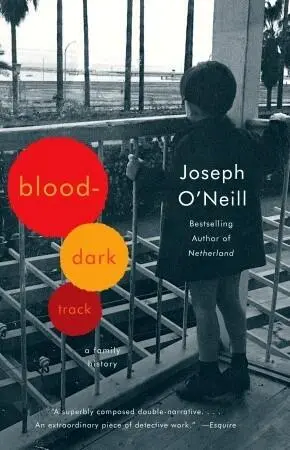
- Название:Blood-Dark Track
- Автор:
- Издательство:Knopf Doubleday Publishing Group
- Жанр:
- Год:2010
- ISBN:978-0-307-74265-0
- Рейтинг книги:4 / 5. Голосов: 1
-
Избранное:Добавить в избранное
- Отзывы:
-
Ваша оценка:
Blood-Dark Track: краткое содержание, описание и аннотация
Предлагаем к чтению аннотацию, описание, краткое содержание или предисловие (зависит от того, что написал сам автор книги «Blood-Dark Track»). Если вы не нашли необходимую информацию о книге — напишите в комментариях, мы постараемся отыскать её.
, a fascinating, personal, and beautifully crafted family history.
Joseph O'Neill's grandfathers-one Turkish, one Irish-were both imprisoned for suspected subversion during the Second World War. The Irish grandfather, a handsome rogue from a family of small farmers, was an active member of the IRA. O'Neill's other grandfather, a debonair hotelier from the tiny and threatened Turkish Christian minority, was interned by the British in Palestine on suspicion of being an Axis spy.
With intellect, compassion, and grace, O'Neill sets the stories of these individuals against the history of the last century's most inhuman events.
Blood-Dark Track — читать онлайн ознакомительный отрывок
Ниже представлен текст книги, разбитый по страницам. Система сохранения места последней прочитанной страницы, позволяет с удобством читать онлайн бесплатно книгу «Blood-Dark Track», без необходимости каждый раз заново искать на чём Вы остановились. Поставьте закладку, и сможете в любой момент перейти на страницу, на которой закончили чтение.
Интервал:
Закладка:
One effect of this calamity was a dramatic rise in the price of citrus fruit; another was a small killing for Joseph Dakak. Just before the frost set in, he and Halil Eser, a business associate, had bet against mild weather and bought six hundred cases of lemons.
Inspired by this success, Joseph Dakak noted that the war and consequent collapse of the European export market had caused a crash in the price of Palestine lemons. Whereas one lemon sold in Mersin for 25 kurus (a kurus being one hundredth of a Turkish lira), its Palestinian counterpart could be bought for only one kurus. Joseph Dakak understood what this meant: that anyone who succeeded in importing the fruit from Palestine was looking at an extraordinary return on his outlay. He decided to go to Jerusalem and buy two hundred tonnes of lemons for resale in Turkey.
However, there was an obstacle. Travel through Syria (i.e., Greater Syria, a territory covering modern-day Syria and Lebanon) and Palestine was under British control, and in order to get to Jerusalem my grandfather required visas from the British Consulate in Mersin. It was far from sure that these would be granted. As recently as the autumn of 1941, Joseph Dakak, who had just opened an import — export office, had unsuccessfully applied to Desmond Doran, the British passport officer in Mersin, for transit visas for a business trip to Egypt. No reason was given for the refusal.
Not long after this rebuff, Joseph Dakak found himself at the office of Hilmi Bey, the chief of the political section of the Mersin police, on a routine matter. On Hilmi’s desk was a photograph of Doran and a shooting licence; Dakak joked that Doran shouldn’t get the shooting licence until he granted Dakak the visas to Palestine. Hilmi Bey smiled and said nothing.
A little while later, Dakak bumped into Olga Catton at the Toros Hotel restaurant; she was dining with a friend, Togo Makzoumé. Seeing my grandfather, she snatched her British passport from her bag and taunted him with it: ‘You can’t get a visa, but I can — and a diplomatic one, at that.’
The next time Dakak visited Hilmi Bey — on another routine matter — the police chief asked why it was that Madame Olga had been able to obtain a visa for Egypt while Dakak had not. Dakak replied that he’d heard that she was off to Egypt on an important mission; and because Olga herself had freely gossiped about her activities, Dakak felt able to ask Hilmi whether it was true that her mission was on behalf of British intelligence. Hilmi Bey simply smiled. Dakak asked a second question: was Togo Makzoumé, who’d lately been Olga’s constant companion at the Toros Hotel, also working for the British? Again, Hilmi Bey gave a knowing smile and said nothing.
After the war, my grandfather learned that Olga Catton’s job in Egypt was running a women’s internment camp, a post she owed to her lover — the British passport officer, Desmond Doran.
In any event, in February 1942, my grandfather applied to the British Consulate for visas for Palestine. One morning in early March, he ran into Arthur Maltass, a consular officer, in the market. ‘Mr Doran has gone to Beirut,’ Maltass said. ‘He has asked me to tell you that he’s doing his best to procure your visas.’ A few days later Doran returned from Beirut with visas for Joseph Dakak.
On the afternoon the visas came through, Joseph Dakak was again approached in the market — this time by a Turk, Osman Emre Bey. ‘So,’ Osman Emre Bey said, ‘you’ve got what you wanted, you’re off to Palestine to make a fortune.’ Dakak made a non-committal gesture. Osman squeezed his arm. ‘It’s thanks to the good word I put in for you with Doran that he was persuaded to grant your visas.’ Osman continued to press against Dakak. ‘As you know,’ he said, ‘I’ve got a lawsuit coming up from trial, and I need to pay the lawyers. Give me money, Dakak. If you don’t, my sister will lose her orchards. You owe it to me.’ Dakak frowned and moved away. ‘I’ll think about it,’ he said. In fact he was reflecting that, far from being indebted to Osman, he was in credit to the tune of one hundred liras: Osman had yet to repay a loan fully documented by a receipt kept in Dakak’s office. But Osman wasn’t going to be fobbed off. The next day, and the day after that, he came to the hotel and repeated his demands for money. Finally, to be shot of the man, Dakak said, ‘Look, I don’t have the money at the moment. I’ll think about it when I get back from Palestine.’ Agitated, Osman said, ‘But that’s no good to me, my trial won’t wait, I need the money now.’ ‘I told you, I don’t have it,’ Dakak said brusquely. At that, Osman Emre Bey turned around and left in a fury.
On 24 March 1942, Joseph Dakak departed for Palestine. To cover his expenses he carried £150 obtained from the Ministry of Finance. He travelled, first class, on the Taurus Express.
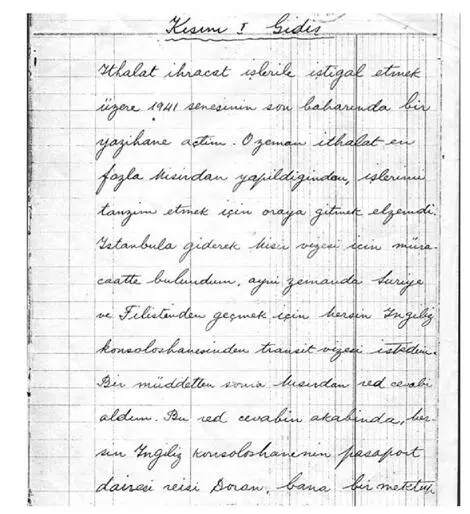
A couple of things need to be made clear. First: the incidents described above come straight out of Part I of Joseph Dakak’s written account of his arrest and imprisonment, which he entitled The Departure . Second: although I’d rediscovered and photocopied the entire testimony in the summer of 1995, it was not until January 1996 that I began to have access to its contents, and then only in instalments. From time to time I received in the post a chunk of text translated from Turkish into French by my aunt Amy — who, like her brother and sister, had never read the papers before. ‘It’s going slowly,’ Tante Amy said when she called me from her home in Geneva. ‘It isn’t easy work, you know.’ She made a throaty noise, and I realized that she was struggling with tears. ‘Anyway, you’ve got everything I’ve done so far. I’ll send the rest to you as soon as I can.’
A photograph stapled to a train pass dated 7 March 1941 (issued in the name of Joseph Dakak, and not his new name, Dakad) helped me to guess at the image my grandfather projected as he took his seat on the Taurus Express. The photograph showed a man wearing a double-breasted, chalk-striped grey suit, a white handkerchief in his breast pocket, a white shirt with a buttoned-down collar, and a tie with diagonal stripes. His hair, still not grey, was brushed immaculately back and his moustache was trim. His fellow passengers would have received the impression of a gentleman travelling on business had it not, perhaps, been for this feature: dark circular sunglasses that covered his eyes and gave him a cool, somewhat sinister look; to those of a dramatic cast of mind, the look of a spy.
This was not as fanciful as one might think. In 1942, mystique and the promise of adventure were attached to train journeys. Illicit romantic encounters, skulduggery in the dining-car, identical suitcases exchanged on steaming platforms, cat-and-mouse in the corridors of trembling wagons: how many old movies and books contained such tropes? In 1949, for example, a British soldier called Richard Pearse published an idiosyncratic memoir of his wartime experiences entitled Three Years in the Levant , and it was clear that he, at least, saw spies everywhere. A member of the Field Security Service of the Intelligence Corps, he served for a time as a security controller on board the Taurus Express. It was a crucial railway connection. Excluding the Far East, there were four frontiers between Allied-held territory and neutral states: the border in Ireland; the Russian — Turkish frontier; the Iraqi — Turkish frontier; and, last and most important by far, the Syrian — Turkish frontier. Twice a week, this line was crossed by a train from Istanbul to Baghdad via Aleppo, where another train could be caught to Tripoli, Beirut and Jerusalem. In the absence of shipping traffic, the railway served as the funnel for travel from the Far East to the West and from the Northern Mediterranean to the Gulf. As a consequence, the luxury end of the train was occupied, Pearse reported, by ‘Prime Ministers, diplomats, engineers, Arab princes, Turkish princesses, Egyptian professors, mystery men and beautiful blondes (some of the spy fiction type)’. Eastbound travellers came from Germany, Sweden, France and Holland with the latest news from Europe; westbound travellers came from China, Afghanistan, India and Iran. During its transit through northern Syria, the train was sealed and an armed British sentry stood at every door. ‘It was well known,’ Pearse explained, ‘that the Taurus Express had already carried in its luxury sleeping- and restaurant-cars more international agents and spies than any other train in the world.’
Читать дальшеИнтервал:
Закладка:
Похожие книги на «Blood-Dark Track»
Представляем Вашему вниманию похожие книги на «Blood-Dark Track» списком для выбора. Мы отобрали схожую по названию и смыслу литературу в надежде предоставить читателям больше вариантов отыскать новые, интересные, ещё непрочитанные произведения.



Обсуждение, отзывы о книге «Blood-Dark Track» и просто собственные мнения читателей. Оставьте ваши комментарии, напишите, что Вы думаете о произведении, его смысле или главных героях. Укажите что конкретно понравилось, а что нет, и почему Вы так считаете.