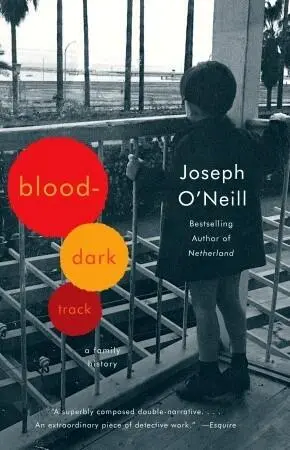
Joseph O'Neill - Blood-Dark Track
Здесь есть возможность читать онлайн «Joseph O'Neill - Blood-Dark Track» — ознакомительный отрывок электронной книги совершенно бесплатно, а после прочтения отрывка купить полную версию. В некоторых случаях можно слушать аудио, скачать через торрент в формате fb2 и присутствует краткое содержание. Год выпуска: 2010, ISBN: 2010, Издательство: Knopf Doubleday Publishing Group, Жанр: Современная проза, на английском языке. Описание произведения, (предисловие) а так же отзывы посетителей доступны на портале библиотеки ЛибКат.
- Название:Blood-Dark Track
- Автор:
- Издательство:Knopf Doubleday Publishing Group
- Жанр:
- Год:2010
- ISBN:978-0-307-74265-0
- Рейтинг книги:4 / 5. Голосов: 1
-
Избранное:Добавить в избранное
- Отзывы:
-
Ваша оценка:
Blood-Dark Track: краткое содержание, описание и аннотация
Предлагаем к чтению аннотацию, описание, краткое содержание или предисловие (зависит от того, что написал сам автор книги «Blood-Dark Track»). Если вы не нашли необходимую информацию о книге — напишите в комментариях, мы постараемся отыскать её.
, a fascinating, personal, and beautifully crafted family history.
Joseph O'Neill's grandfathers-one Turkish, one Irish-were both imprisoned for suspected subversion during the Second World War. The Irish grandfather, a handsome rogue from a family of small farmers, was an active member of the IRA. O'Neill's other grandfather, a debonair hotelier from the tiny and threatened Turkish Christian minority, was interned by the British in Palestine on suspicion of being an Axis spy.
With intellect, compassion, and grace, O'Neill sets the stories of these individuals against the history of the last century's most inhuman events.
Blood-Dark Track — читать онлайн ознакомительный отрывок
Ниже представлен текст книги, разбитый по страницам. Система сохранения места последней прочитанной страницы, позволяет с удобством читать онлайн бесплатно книгу «Blood-Dark Track», без необходимости каждый раз заново искать на чём Вы остановились. Поставьте закладку, и сможете в любой момент перейти на страницу, на которой закончили чтение.
Интервал:
Закладка:
Sometimes explosions were caused by my grandfather’s jealousy. One day he stopped the car to talk to Jimmy MacDonagh. Jimmy MacDonagh had a soft voice and, leaning into the car, he said to my grandmother, who was all made up, ‘Eileen, you’re blooming.’ Jim drove away in a rage and there was a flaming row. And if Grandma went into town she’d be cross-examined: ‘Where did you go? Who did you meet?’
In truth, my grandfather never had a jot of a cause to be jealous; and neither, for that matter, had my grandmother, although I’d heard her gently teased about Pat Buckley, the landlady of Jim’s favourite bar in Shandon. When I mentioned Jim O’Neill to Pat Buckley — a lively, attractive woman in her sixties — she had trouble placing the name, but once she’d called him to mind she remembered my grandfather clearly. ‘He was a lovely man to speak to,’ Pat Buckley said, pouring me a complimentary pint of my grandfather’s drink, which she remembered was Guinness. ‘He was very sincere. He was a hard worker, supposed to be fantastic at his job. The first time he was ever here was with Dinny Kelleher, who came with him here many times. Jim O’Neill asked for two pints and put his hand in his pocket. “I have no money,” says he. “Don’t worry,” says I, and gave him a fiver. He had an honest face, and I knew he was genuine by his eyes. He had beautiful eyebrows, like you do. From that day on he always came here. He normally wouldn’t drink during the week — he didn’t drink much, he couldn’t afford to. He was an interesting man and would speak about current affairs; he’d have opinions on things. He never mentioned his own political activities. Often he’d meet his brother-in-law Jack Lynch,’ Pat Buckley said, ‘and I heard his wife was lovely. I met her two years ago, at a funeral. He always drank here,’ Pat Buckley said, patting the bar where I stood. ‘He was not a lounge person. They weren’t lounge people,’ she said.
After my grandfather moved south of the river, to Douglas, in 1962, he also drank regularly at the Orchard Bar, on the Ballinlough Road. I went there with Terry, who remembered the times his mother waited in the car with clambering and brawling kids while his father drank a couple of pints. According to John Barrett, proprietor of the Orchard Bar since its establishment in 1961, Jim was quiet about his politics and certainly not a pub republican (a mouthy, ineffectual type). Jim would take collections for the Prisoners Dependents’ Fund in bars, not hopefully jingling the cup but charting a silent, effective course through the drinkers. ‘They’d shell out for Jim,’ John Barrett said, ‘because they knew he’d suffered.’ Terry said, ‘He’d do the same at work, to the dismay of his colleagues. His commitment to the movement was relentless,’ Terry said, ‘he wasn’t a fair-weather friend.’ When Jim had a cold, John Barrett recalled, he’d drink four hot toddies (whiskey, cloves, lemon, hot water) and the cold would clear up in a couple of days. ‘His drink of choice was Guinness,’ John Barrett said, ‘often with a shot of Paddy whiskey. Rough, but they were rough men.’
Jim O’Neill’s new home in South Cork was a detached three-bedroomed house in a new estate of privately owned houses. It had a garage, a front garden and a large back garden that gave onto a playing field. He could afford to buy it because he was in regular work and because his older sons were now working and able to contribute to the family finances. My grandfather was very proud finally to be a man of property; it made him feel independent, free. Grandma and he called the house Dún-Ard in reflection of their respective origins in Dunmanway and Ardkitt. Jim strained the soil in the front and back garden and grew vegetables. His relations with my father became more benign. Returning to Cork in his mid-twenties, my father would say, ‘I’ve been around the world but I still can’t get a proper haircut,’ and Jim would put a towel around his neck, bring out the scissors, and, putting to use a skill developed during his internment days, cut my father’s hair. As money ceased to be a real problem, my grandfather gave up poaching and drove out with his family to West Cork for blameless outings and picnics. They went out there every weekend they could. In the mid-’sixties, Jim even tried to buy a property in Ross Carbery to build a summer home but, jinxed again in the matter of land, was beaten to it by a German. He bitterly predicted that the country would be bought up by foreigners. My grandparents started to take short holidays together and to relate in an easier way. Sometimes my grandfather sang,
I’m a rambler
And a gambler
And a long way from home
And if you don’t like me just leave me alone
I’ll eat when I’m hungry
And drink when I’m dry
And if Mountjoy don’t kill me
I’ll live till I die.
Just as he was approaching retirement and just as, in aunt Marian’s words, he was realizing there is life, my grandfather became ill, and died.
In November 1995, I went on two trips in West Cork. The first, accompanied by my grandmother, was to Kilbrittain. It was a softly overcast Sunday morning, with the sun reduced to a pool of ivory in the clouds. We took a roundabout route, via Halfway and Kinsale. I’d heard it joked that it was after the defeat of Hugh O’Neill, the Earl of Tyrone, at the Battle of Kinsale (1601) that our family scattered in Cork.
In Kinsale, we stopped for Mass. It was a novena Mass and the priest urged the congregation to pray for the souls of those in purgatory who had not yet received their just reward. We, the living faithful, could assist these souls: papal indulgences could be earned by praying for the departed at certain cemeteries, and acts of mortification and intercession would also promote the transit of souls. My grandmother said prayers on her knees, her thick bottom lip wavering as she whispered with closed eyes, and of course I wondered if she was praying for the soul of my grandfather.
After Mass we drove across the immense waterway that the Bandon river forms as it flows into the ocean. We passed Our Lady’s Shrine at Ballinspittle, where a six-foot-high statue of the Virgin Mary, located in a grotto above the road, was said to move miraculously. On we drove, past sugar-beet fields and banks brimming with rusting ferns, to Kilbrittain. Kilbrittain is a small village of a strongly rural character, its buildings huddled inconsequentially on the exposed slopes of a bare valley. I followed my grandmother’s directions and soon we came to Graunriagh House, where my grandfather had been raised, a pretty, solid, two-storey farmhouse with seashells and shards of glass embedded in the dashed walls for decoration. We drove slowly into the yard behind the house. Dogs ran up barking. A man with frizzy, greying hair came out, his wind-reddened face peering at us in bafflement until he recognized Grandma. That was Dan-Joe Holland, who owned and worked the farm — eighty acres of grazing — with his wife Joan. Over tea, Joan and Dan-Joe talked to Grandma about the changing times — the lack of interest of their six children (four in London, two in Ireland) in taking on the farm, the exorbitant price of All-Ireland tickets, the decline of football and hurling in Cork, the rabble that are priests these days (a view my grandmother did not go along with) and the shower of rogues that are politicians. The house, which Dan-Joe guessed was around two hundred years old, was solidly built, with even its internal walls two feet thick. It was decorated in a typical country way: the floors were covered with bright, densely floral carpets, and the walls with patterned wallpaper that was also pasted on the top of the kitchen refrigerator. The two front rooms were packed with armchairs, and on the table of the living room I noticed an opened book about the shooting of Michael Collins.
Читать дальшеИнтервал:
Закладка:
Похожие книги на «Blood-Dark Track»
Представляем Вашему вниманию похожие книги на «Blood-Dark Track» списком для выбора. Мы отобрали схожую по названию и смыслу литературу в надежде предоставить читателям больше вариантов отыскать новые, интересные, ещё непрочитанные произведения.





Обсуждение, отзывы о книге «Blood-Dark Track» и просто собственные мнения читателей. Оставьте ваши комментарии, напишите, что Вы думаете о произведении, его смысле или главных героях. Укажите что конкретно понравилось, а что нет, и почему Вы так считаете.