Richard Ford - Independence Day
Здесь есть возможность читать онлайн «Richard Ford - Independence Day» весь текст электронной книги совершенно бесплатно (целиком полную версию без сокращений). В некоторых случаях можно слушать аудио, скачать через торрент в формате fb2 и присутствует краткое содержание. Год выпуска: 1996, Издательство: Vintage, Жанр: Современная проза, на английском языке. Описание произведения, (предисловие) а так же отзывы посетителей доступны на портале библиотеки ЛибКат.
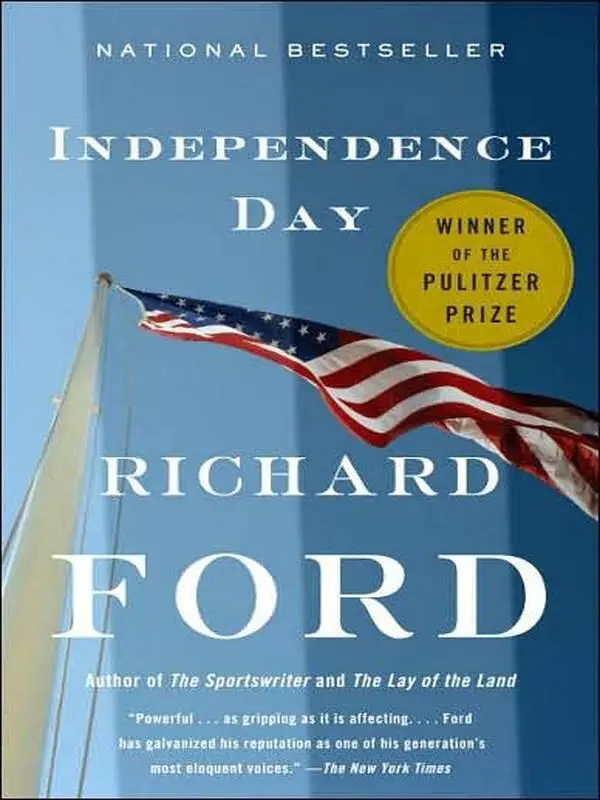
- Название:Independence Day
- Автор:
- Издательство:Vintage
- Жанр:
- Год:1996
- ISBN:нет данных
- Рейтинг книги:3 / 5. Голосов: 1
-
Избранное:Добавить в избранное
- Отзывы:
-
Ваша оценка:
Independence Day: краткое содержание, описание и аннотация
Предлагаем к чтению аннотацию, описание, краткое содержание или предисловие (зависит от того, что написал сам автор книги «Independence Day»). Если вы не нашли необходимую информацию о книге — напишите в комментариях, мы постараемся отыскать её.
, Richard Ford deepens his portrait of one of the most unforgettable characters in American fiction, and in so doing gives us an indelible portrait of America. Frank Bascombe, in the aftermath of his divorce and the ruin of his career, has entered an "Existence Period," selling real estate in Haddam, New Jersey, and mastering the high-wire act of normalcy. But over one Fourth of July weekend, Frank is called into sudden, bewildering engagement with life.
is a moving, peerlessly funny odyssey through America and through the layered consciousness of one of its most compelling literary incarnations, conducted by a novelist of astonishing empathy and perception.
Independence Day — читать онлайн бесплатно полную книгу (весь текст) целиком
Ниже представлен текст книги, разбитый по страницам. Система сохранения места последней прочитанной страницы, позволяет с удобством читать онлайн бесплатно книгу «Independence Day», без необходимости каждый раз заново искать на чём Вы остановились. Поставьте закладку, и сможете в любой момент перейти на страницу, на которой закончили чтение.
Интервал:
Закладка:
“I’m sorry,” I say. “I’m sorry I drove you crazy when we were married. If I’d known I was going to, I wouldn’t ever have married you. You’re probably right, I rely on how I make things seem. It’s my problem.”
“I thought you thought how I thought,” she says softly. “Maybe that’s mine.”
“I tried. I should’ve. I loved you very much all the time.”
“Some things just can’t be fixed later, can they?” she says.
“No, not later,” I say. “Not later they can’t.”
And that is essentially and finally that.
W hy the long face?” Paul says to his mother and also to me. He has arrived, smirking, onto the porch looking far too much like the murder boy from Ridgefield last midnight, as committed to bad luck as a death row convict. And to my surprise he’s even pudgier and somehow taller, with thick, adult eyebrows even more like his mom’s, but with a bad, pasty complexion — nothing like he looked as recently as a month ago, and not enough anymore (or ever) like the small, gullible boy who kept pigeons at his home in Haddam. (How do these things change so fast?) His hair has been cut in some new, dopey, skint-sided, buzzed-up way, so that his busted ear is evident in its bloody little bandage. Plus, his gait is a new big-shoe, pigeon-toed, heel-scrape, shoulder-slump sidle by which he seems to give human shape to the abstract concept of condescending disapproval for everything in sight (the effects of stress, no doubt). He simply stands before us now — his parents — doing nothing. “I thought of a good homonym while I was getting dressed,” he says slyly to either or both of us. “‘Meatier’ and ‘meteor.’ Only they mean the same thing.” He smirks, wishing to do nothing out here more than present himself in a way we won’t like, someone who’s lost IQ points or might be considering it.
“We were just discussing you,” I say. I’d meant to mention something about Dr. Rection, to speak to him via private code, but I don’t. I am in fact sorry to see him.
His mother, however, steps right up to him — essentially ignoring him and me — grips his chin with her strong golfer’s thumb and index finger, and turns his head to examine his split ear. (He is nearly her height.) Paul is carrying a black gym bag with Paramount Pictures — Reach Your Peak stenciled on its side in white (Stephanie’s stepfather is a studio exec, so I’m told) and is wearing big black-and-red clunker Reeboks with silver lightning bolts on the sides, long and baggy black shorts, and a long midnight-blue tee-shirt that has Happiness Is Being Single printed on the front below a painting of a bright-red Corvette. He is a boy you can read, though he also is someone you’d be sorry to encounter on a city street. Or in your home.
Ann asks him in a private voice if he has what he needs (he has), if he has money (he does), if he knows where to meet in Penn Station (yes), if he feels all right (no answer). He cuts his knifey eyes at me and screws up one side of his mouth as if we’re somehow in league against her. (We aren’t.)
Then Ann abruptly says, “So okay, you don’t look great, but go wait in the car, please. I want to have a word with your father.”
Paul wrinkles his mouth into a mirthless little all-knowing look of scorn having to do with the very notion of his mother talking to his father. He has become a smirker by nature. But how? When?
“What happened to your ear, by the way?” I say, knowing what happened.
“I punished it,” he says. “It heard a bunch of things I didn’t like.” He says this in a mechanistic monotone. I give him a little push in the direction he’s come from, back through the house and out toward the car. And so he goes.
I ’d appreciate it if you’d try to be careful with him,” Ann says. “I want him back in good shape for his court appearance Tuesday.” She has sought to lead me the way Paul has gone, “back through,” but I’m having no part of her sinister house beautiful, with its poisonous élan, spiffy lines and bloodless color scheme. I lead us (I’m still inexplicably limping) down the steps to the lawn and around via the safer grass and through the shrubberies to the pea-gravel driveway, just the way a yardman would. “I think he’s injury prone,” she says quietly, following me. “I had a dream about him having an accident.”
I step through the green-leafed, thick-smelling hydrangeas, blooming a vivid purple. “My dreams are always like the six o’clock news,” I say. “Everything happening to other people.” The sexual whir I experienced on seeing Ann is now long gone.
“That’s fine about your dreams,” she says, hands in pockets. “This one happened to be mine.”
I don’t wish to think about terrible injury. “He’s gotten fat,” I say. “Is he on mood stabilizers or neuroblockers or something?”
Paul and Clarissa are already conferring by my car. She is smaller and holding his left wrist in both her hands and trying to raise it to the top of her head in some kind of sisterly trick he’s not cooperating with. “Come on!” I hear her say. “You putz.”
Ann says, “He’s not on anything. He’s just growing up.” Across the gravel lot is a robust five-bay garage that matches the house in every loving detail, including the miniature copper weather vane milled into the shape of a squash racket. Two bay doors are open, and two Mercedeses with Constitution State plates are nosed into the shadows. I wonder where Paul’s station wagon is. “Dr. Stopler said he displays qualities of an only child, which is too bad in a way.”
“I was an only child. I liked it.”
“He’s just not one. Dr. Stopler also said”—she’s ignoring me, and why shouldn’t she? — “not to talk to him too much about current events. They cause anxiety.”
“I guess they do,” I say. I am ready to say something caustic about childhood to seal my proprietorship of this day — revive Wittgenstein about living in the present meaning to live forever, blah, blah, blah. But I simply call a halt. No good’s to come. All boats fall on a bitter tide — children know it better than anyone. “Do you think you know what’s making him worse, just all of a sudden?”
She shakes her head, grips her right wrist with her left hand, and twists the two together, then gives me a small bleak smile. “You and me, I guess. What else?”
“I guess I was wanting a more complicated answer.”
“Well, good for you.” She rubs her other wrist the same way. “I’m sure you’ll think of one.”
“Maybe I’ll have put on my tombstone ‘He expected a more complicated answer.’”
“Let’s quit talking about this, okay? We’ll be at the Yale Club just for tonight if you need to call.” She looks at me in a nose-wrinkled way and slouches a shoulder. She has not meant to be so harsh.
Ann, in amongst the hydrangeas, and for the first time today looks purely beautiful — pretty enough for me to exhale, my mind to open outward, and for me to gaze at her in a way I once gazed at her all the time, every single day of our old life together in Haddam. Now would be the perfect moment for a future-refashioning kiss, or for her to tell me she’s dying of leukemia, or me to tell her I am. But that doesn’t happen. She is smiling her stalwart’s smile now, one that’s long since disappointed and can face most anything if need be — lies, lies and more lies.
“You two have a good time,” she says. “And please be careful with him.”
“He’s my son,” I say idiotically.
“Oh, I know that. He’s just like you.” And then she turns and walks back toward the yard, continuing on, I suspect, out of sight and down to the water to have her lunch with her husband.
Читать дальшеИнтервал:
Закладка:
Похожие книги на «Independence Day»
Представляем Вашему вниманию похожие книги на «Independence Day» списком для выбора. Мы отобрали схожую по названию и смыслу литературу в надежде предоставить читателям больше вариантов отыскать новые, интересные, ещё непрочитанные произведения.





Обсуждение, отзывы о книге «Independence Day» и просто собственные мнения читателей. Оставьте ваши комментарии, напишите, что Вы думаете о произведении, его смысле или главных героях. Укажите что конкретно понравилось, а что нет, и почему Вы так считаете.