Richard Ford - Independence Day
Здесь есть возможность читать онлайн «Richard Ford - Independence Day» весь текст электронной книги совершенно бесплатно (целиком полную версию без сокращений). В некоторых случаях можно слушать аудио, скачать через торрент в формате fb2 и присутствует краткое содержание. Год выпуска: 1996, Издательство: Vintage, Жанр: Современная проза, на английском языке. Описание произведения, (предисловие) а так же отзывы посетителей доступны на портале библиотеки ЛибКат.
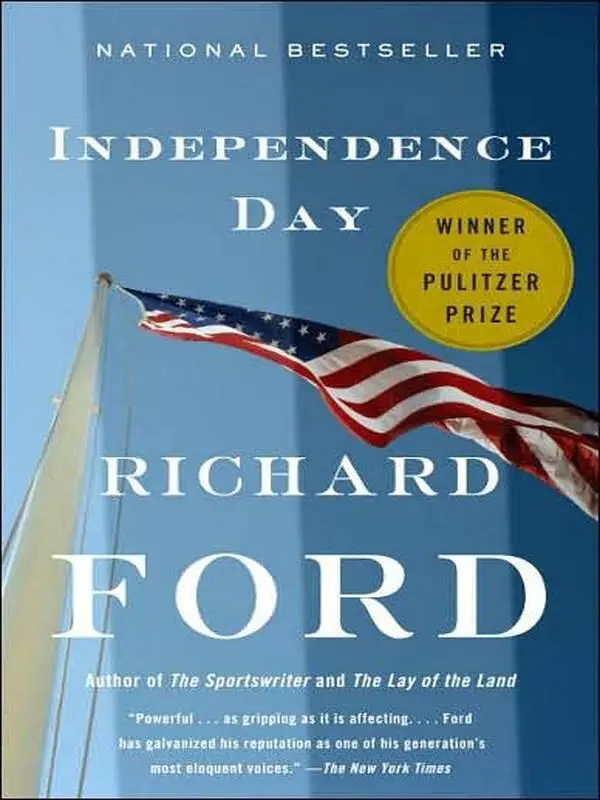
- Название:Independence Day
- Автор:
- Издательство:Vintage
- Жанр:
- Год:1996
- ISBN:нет данных
- Рейтинг книги:3 / 5. Голосов: 1
-
Избранное:Добавить в избранное
- Отзывы:
-
Ваша оценка:
Independence Day: краткое содержание, описание и аннотация
Предлагаем к чтению аннотацию, описание, краткое содержание или предисловие (зависит от того, что написал сам автор книги «Independence Day»). Если вы не нашли необходимую информацию о книге — напишите в комментариях, мы постараемся отыскать её.
, Richard Ford deepens his portrait of one of the most unforgettable characters in American fiction, and in so doing gives us an indelible portrait of America. Frank Bascombe, in the aftermath of his divorce and the ruin of his career, has entered an "Existence Period," selling real estate in Haddam, New Jersey, and mastering the high-wire act of normalcy. But over one Fourth of July weekend, Frank is called into sudden, bewildering engagement with life.
is a moving, peerlessly funny odyssey through America and through the layered consciousness of one of its most compelling literary incarnations, conducted by a novelist of astonishing empathy and perception.
Independence Day — читать онлайн бесплатно полную книгу (весь текст) целиком
Ниже представлен текст книги, разбитый по страницам. Система сохранения места последней прочитанной страницы, позволяет с удобством читать онлайн бесплатно книгу «Independence Day», без необходимости каждый раз заново искать на чём Вы остановились. Поставьте закладку, и сможете в любой момент перейти на страницу, на которой закончили чтение.
Интервал:
Закладка:
She of course called Dr. Stopler, who calmly informed her that medical science knew mighty damn little about how the old mind works in relation to the old brain — whether they’re one and the same pancake, two parts of one pancake, or just altogether different pancakes that somehow work in unison (like an automobile clutch). However, distressed family relations were pretty clear bugaboo factors leading to childhood mental illness, and from what he already knew, Paul did have some qualifying preconditions: dead brother, divorced parents, absent father, two major household moves before puberty (plus Charley O’Dell for a stepdad).
He did allow, though, that when he’d conducted his evaluative “chat” with Paul back in May, prior to his Camp Wanapi visit, Paul had failed entirely to exhibit low self-esteem, suicide ideation, neurological dysfunction; he was not particularly “oppositional” (then), hadn’t suffered an IQ nosedive and didn’t display any conduct disorders — which meant he didn’t set a fire or murder any birds. In fact, the doctor said, he’d demonstrated a “real capacity for compassion and a canny ability to put himself in another’s shoes.” Though circumstances could always change overnight; and Paul could easily be suffering any and every one of the aforementioned maladies at this very minute, and might’ve abandoned all compassion.
“I’m really just pissed off at him now,” Ann says. She is standing, looking out over the porch rail where I first saw her today, staring across the apron of shining river toward the few small white house façades catching the sun from deep in the encroachment of solid greens. Once again I steal an approving look at her new substantial-without-sacrificing-sexual-specificity womanliness. Her lips, I notice, seem fuller now, as if she might’ve had them “enhanced.” (Such surgeries can sweep through the more well-to-do communities like new kitchen appliances.) She rubs the back of one muscular calf with the top of her other shoe and sighs. “You may not know how exactly lucky you’ve had it,” she says, after a period of silent staring.
I mean to say nothing. A careful review of how lucky I am could too easily involve more airing of my “be/seem” misdeeds and tie into the possibility that I’m a coward or a liar or worse. I scratch my nose and can still smell grackle on my fingers.
She looks around at where I sit still not very comfortably silent on my lily pad.
“Would you agree to seeing Dr. Stopler?”
“As a patient?” I blink.
“As a co-parent,” she says. “And as a patient.”
“I’m really not based in New Haven,” I say. “And I never much liked shrinks. They just try to make you act like everybody else.”
“You don’t have that to worry about.” She regards me in an impatient older-sister way. “I just thought if you and I, or maybe you and I and Paul, went down, we might iron some things out. That’s all.”
“We can invite Charley, if you want to. He’s probably got some ironing out that needs doing. He’s a co-parent too, right?”
“He’ll go. If I ask him.”
I look around at the mirror window behind which sits the spectral white piano and a lot of ultra-modern, rectilinear blond-wood furniture arranged meticulously between long, sherbet-colored walls so as to maximize the experience of an interesting inner space while remaining unimaginably comfy. Reflected, I see the azure sky, part of the lawn, an inch of the boathouse roof and a line of far treetops. It is a vacant vista, the acme of opulent American dreariness Ann has for some reason married into. I feel like getting up and walking out onto the lawn — waiting for my son in the grass. I don’t care to see Dr. Stopler and have my weaknesses vetted. My weaknesses, after all, have taken me this far.
Behind the glass, though, and unexpectedly, the insubstantial figure of my daughter becomes visible crossing left to right, intending where, I don’t know. As she passes she gazes out at us — her parents, bickering — and, blithely assuming I can’t see her, flips one or both of us the bird in a spiraling, heightening, conjuring motion like an ornate salaam, then disappears through a door to another segment of the house.
“I’ll think about Dr. Stopler,” I say. “I’m still not sure what a milieu therapist is, though.”
The corners of Ann’s mouth thicken with disapproval — of me. “Maybe you could think of your children as a form of self-discovery. Maybe you’d see your interest in it then and do something a little more wholeheartedly yourself.” Ann’s view is that I’m a half-hearted parent; my view is that I do the best I know how.
“Maybe,” I say, though the thought of dread-filled weekly drives to dread-filled New Haven for expensive fifty-five dread-filled minutes of mea culpa! mea culpa! gushered into the weary, dread-resistant map of some Austrian headshrinker is enough to set anybody’s escape mechanisms working overtime.
The fact is, of course, Ann maintains a very unclear picture of me and my current life’s outlines. She has never appreciated the realty business or why I enjoy it — doesn’t think it actually involves doing anything. She knows nothing of my private life beyond what the kids snitch about in offhand ways, doesn’t know what trips I take, what books I read. I’ve over time become fuzzier and fuzzier, which given her old Michigan factualism makes her inclined to disapprove of almost anything I might do except possibly joining the Red Cross and dedicating my life to feeding starving people on faraway shores (not a bad second choice, but even that might not save me from pathos). In all important ways I’m no better in her mind than I was when our divorce was made final — whereas, of course, she has made great strides.
Only I don’t actually mind it, since not having a clear picture makes her long for one and in so doing indirectly long for me (or that’s my position). Absence, in this scheme, both creates and fills a much-needed void.
But it’s not all positive: when you’re divorced you’re always wondering (I am anyway, sometimes to the point of granite preoccupation) what your ex-spouse is thinking about you, how she’s viewing your decisions (assuming she thinks you make any), whether she’s envious or approving or condescending or sneeringly reproachful, or just indifferent. Your life, because of this, can become goddamned awful and decline into being a “function” of your view of her view — like watching the salesman in the clothing store mirror to see if he’s admiring you in the loud plaid suit you haven’t quite decided to buy, but will if he seems to approve. Therefore, what I’d prefer Ann’s view to be is: of a man who’s made a spirited recovery from a lost and unhappy union, and gone on to discover wholesome choices and pretty solutions to life’s thorny dilemmas. Failing that, I’d be happy to keep her in the dark.
Though in the end the real trick to divorce remains, given this refractory increase in perspectives, not viewing yourself ironically and losing heart. You have, on the one hand, such an obsessively detailed and minute view of yourself from your prior existence, and on the other hand, an equally specific view of yourself later on , that it becomes almost impossible not to see yourself as a puny human oxymoron, and damn near impossible sometimes to recognize who your self is at all. Only you must. Writers in fact survive this condition better than almost anyone, since they understand that almost everything — e-v-e-r-y-t-h-i-n-g — is not really made up of “views” but words, which, should you not like them, you can change. (This actually isn’t very different from what Ann told me last night on the phone in the Vince Lombardi.)
Читать дальшеИнтервал:
Закладка:
Похожие книги на «Independence Day»
Представляем Вашему вниманию похожие книги на «Independence Day» списком для выбора. Мы отобрали схожую по названию и смыслу литературу в надежде предоставить читателям больше вариантов отыскать новые, интересные, ещё непрочитанные произведения.








Обсуждение, отзывы о книге «Independence Day» и просто собственные мнения читателей. Оставьте ваши комментарии, напишите, что Вы думаете о произведении, его смысле или главных героях. Укажите что конкретно понравилось, а что нет, и почему Вы так считаете.