Richard Ford - Independence Day
Здесь есть возможность читать онлайн «Richard Ford - Independence Day» весь текст электронной книги совершенно бесплатно (целиком полную версию без сокращений). В некоторых случаях можно слушать аудио, скачать через торрент в формате fb2 и присутствует краткое содержание. Год выпуска: 1996, Издательство: Vintage, Жанр: Современная проза, на английском языке. Описание произведения, (предисловие) а так же отзывы посетителей доступны на портале библиотеки ЛибКат.
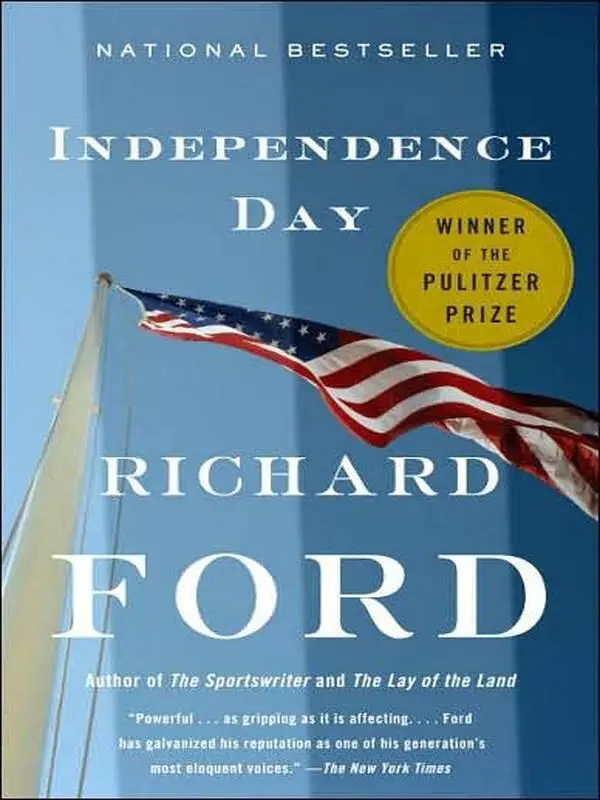
- Название:Independence Day
- Автор:
- Издательство:Vintage
- Жанр:
- Год:1996
- ISBN:нет данных
- Рейтинг книги:3 / 5. Голосов: 1
-
Избранное:Добавить в избранное
- Отзывы:
-
Ваша оценка:
Independence Day: краткое содержание, описание и аннотация
Предлагаем к чтению аннотацию, описание, краткое содержание или предисловие (зависит от того, что написал сам автор книги «Independence Day»). Если вы не нашли необходимую информацию о книге — напишите в комментариях, мы постараемся отыскать её.
, Richard Ford deepens his portrait of one of the most unforgettable characters in American fiction, and in so doing gives us an indelible portrait of America. Frank Bascombe, in the aftermath of his divorce and the ruin of his career, has entered an "Existence Period," selling real estate in Haddam, New Jersey, and mastering the high-wire act of normalcy. But over one Fourth of July weekend, Frank is called into sudden, bewildering engagement with life.
is a moving, peerlessly funny odyssey through America and through the layered consciousness of one of its most compelling literary incarnations, conducted by a novelist of astonishing empathy and perception.
Independence Day — читать онлайн бесплатно полную книгу (весь текст) целиком
Ниже представлен текст книги, разбитый по страницам. Система сохранения места последней прочитанной страницы, позволяет с удобством читать онлайн бесплатно книгу «Independence Day», без необходимости каждый раз заново искать на чём Вы остановились. Поставьте закладку, и сможете в любой момент перейти на страницу, на которой закончили чтение.
Интервал:
Закладка:
“I believe it,” I say. “A hundred percent.” And then for some reason I am enervated, as if I’d been to jail for days and had just this very moment stepped out into harsh daylight.
“Particularly on your holidays,” says Erik the sociologist. “And especially this holiday. This one brings out the psychos from all over. New York, New Jersey, Pennsylvania.” He shakes his head. Those are the states where most lunatics live if you’re him. “You old friends with Mr. O’Dell?” He smiles, protected by his door. “I like him a lot.”
“No,” I say, stepping back to my car, which has cold air still pouring out, making me feel even more enervated.
“You’re just business acquaintances, I guess,” he says. “You an architect?”
“No,” I say. “My ex-wife’s married to Mr. O’Dell, and I’m picking up my son to take him on a trip. Does that seem like a good idea?” I can easily imagine wanting to harm Erik.
“Wow, that sounds pretty serious.” He leers from behind his open blue door. He’s, of course, got me figured now: I’m a defeated, pathetic figure engaged in a demeaning and hopeless mission — not nearly as interesting as a wacko. Though even my kind can cause trouble, can have a trunkful of phosphorous grenades and plastique and be bent on neighborhood mayhem.
“It’s not that serious,” I say, pausing, looking at him. “It’s something I enjoy.”
“Is Pau l your son?” Erik says. He brings his forefinger up to his earring, a small gesture of dominion.
“Yep. You know Paul?”
“Oh yeah,” Erik says, smirking. “We’re all acquainted with Paul.”
“All who? What does that mean?” I feel my brows thicken.
“We’ve all had contact with Paul.” Erik starts lowering himself back into his stupid Yugo.
“I’m sure he hasn’t caused you any trouble,” I say, thinking that he probably has, and will again. Erik is the kind of monkey Paul would consider a barrel of laughs.
Erik is speaking from the driver’s seat now; I can’t make his words out. No doubt he’s saying something smart-assed he doesn’t intend me to hear. Or else he’s radioing messages via his shoulder. He drops the Yugo in reverse, scoots back out the drive and wheels around.
I consider saying something vicious, running over and screaming in his window. But I can’t afford to get arrested in my ex-wife’s driveway. So I only wave, and he waves back. I think he says, “Have a good day,” in his policey, insincere way, before heading slowly up Swallow Lane out of my sight.
M y daughter, Clarissa, is the first living soul I spy as I drive tired-eyed into compound O’Dell. She is far below the big house, on the ample lawn slope above the pond, committedly whacking a yellow tetherball all by her lonesome, oblivious as a sparrow to me here in my car, surveilling her from afar.
I pull up to the back of the house (the front faces the lawn, the air, the water, the sunrise and, for what I know, the path to all knowledge) and climb wearily out into the hot, chirpy morning, reconciled to finding Paul by myself.
Charley’s house is, of course, a glorious erection, chalky-blue-shingled and white-trimmed, with a complex gabled roof, tall paneless windows and a big sashaying porch around three sides that gives onto the lawn down some white steps to the very spot where Charley and I discussed Shakespeare and came to the conclusion we neither one trusted the other.
I wedge in sideways through the row of purple-blooming hydrangeas (contrast my poor dried-up remnants on Clio Street), stagger only slightly, but walk on out onto the hot shadowless grass, feeling light-legged and dazed, my eyelids flickering, my eyes darting side to side to see who might see me first (such entrances are never dignified). I have, to my eternal infamy, forgotten to buy a gift this morning, a love and peace offering to appease Clarissa for not taking her along with her brother. What I’d give for a colorful Vince Lombardi sweatband or a Four Blocks of Granite book of inspirational halftime quotes. It would be our joke. I am lost here.
Clarissa ceases larking with the tetherball when she sees me and stands eyes-shaded, averting her face and waving, though she can’t tell it’s me she sees — possibly hopes it is and not a plainclothes policeman come to ask questions about her brother.
I wave back, realizing for some reason known only to God that I have begun to limp , as though a war had intervened since I last saw my loved ones and I had returned a changed and beaten veteran. Though Clarissa will not notice. Even as rarely as she sees me — once a month nowadays — I am a timeless fixture, and nothing would seem unusual; an eye patch, a prosthetic arm, all-new teeth: none would rate a mention.
“Hi-dee, hi-dee, hi-dee,” she sings out when it’s clearly me she’s waving welcome to. She wears strong contacts and can’t see distances well, but doesn’t care. She darts and springs barefoot toward me across the dry grass, ready to deliver a big power hug around my aching neck — which every time hurts like a hammerlock and makes me groan.
“I came as soon as I heard the news,” I say. (In our makeshift, make-believe life I always arrive just in time to face some dire emergency — Clarissa and I being the responsible adults, Paul and their mother the temperamental kids in need of rescue.) I am still limping, though my heart’s going strong with simple pleasure, all tightness in my brain miraculously dispatched.
“Paul’s in the house with Mom, getting ready and probably having an argument.”
Clarissa, in brilliant red shorts over her blue Speedo suit, jumps up and gives me her hammer hug, and I swing her like a tetherball before letting her sink weak-kneed into the grass. She has a wonderful smell — dampness and girlish perfume applied hours before, now faded. Beyond us is the boathouse crime scene, the pond again dense with pink fleabane and wild callas and, farther on, the row of dense motionless tupelos and the invisible river, above which a squad of pelicans executes a slow and graceful upward soar.
“Where’s the man of the house?” I let myself down heavily beside her, my back against the tetherball pole. Clarissa’s legs are thin and tanned and golden-sheeny-haired, her bare feet milky and without a blemish. She arranges herself belly-down, chin-propped, her eyes clear behind her contacts and fastened on me, her face a prettier version of my own: small nose, blue eyes, cheekbones more obvious than her mother’s, whose broad, Dutch forehead and coarse hair match Paul’s looks almost completely.
“He’s work-ing now in his studi-o-o.” She looks at me knowingly and without much irony. It’s life to her, all of this — few tragedies, few great singing victories, everything pretty much good or okay. We are well paired in our family unit.
Charley’s studio is half visible beyond a row of deep-green hardwoods that boundaries the lawn and stops at the pond’s edge. I see a glint off its tin roof, its row of cypress stilts holding up a catwalk (a project Charley and his roommate doped out as a joke freshman year, back in ’44, but that Charley “always wanted to build”).
“So how’s the weather?” I say, relieved to know where he is.
“Oh, it’s fine,” Clarissa says noncommittally. A skim of sweat is on her temples from belting the tetherball. My back’s already sweaty through my shirt.
“And how’s your brother?”
“Weird. But okay.” Maintaining her belly-down, she rotates her head around on its slender stem, some routine from dance class or gymnastics, though an unmistakable signal: she is Paul’s buen amiga; the two of them are closer than the two of us; this all could’ve been different with better parents, but isn’t; do not fail to notice it.
Читать дальшеИнтервал:
Закладка:
Похожие книги на «Independence Day»
Представляем Вашему вниманию похожие книги на «Independence Day» списком для выбора. Мы отобрали схожую по названию и смыслу литературу в надежде предоставить читателям больше вариантов отыскать новые, интересные, ещё непрочитанные произведения.





Обсуждение, отзывы о книге «Independence Day» и просто собственные мнения читателей. Оставьте ваши комментарии, напишите, что Вы думаете о произведении, его смысле или главных героях. Укажите что конкретно понравилось, а что нет, и почему Вы так считаете.