Richard Ford - Independence Day
Здесь есть возможность читать онлайн «Richard Ford - Independence Day» весь текст электронной книги совершенно бесплатно (целиком полную версию без сокращений). В некоторых случаях можно слушать аудио, скачать через торрент в формате fb2 и присутствует краткое содержание. Год выпуска: 1996, Издательство: Vintage, Жанр: Современная проза, на английском языке. Описание произведения, (предисловие) а так же отзывы посетителей доступны на портале библиотеки ЛибКат.
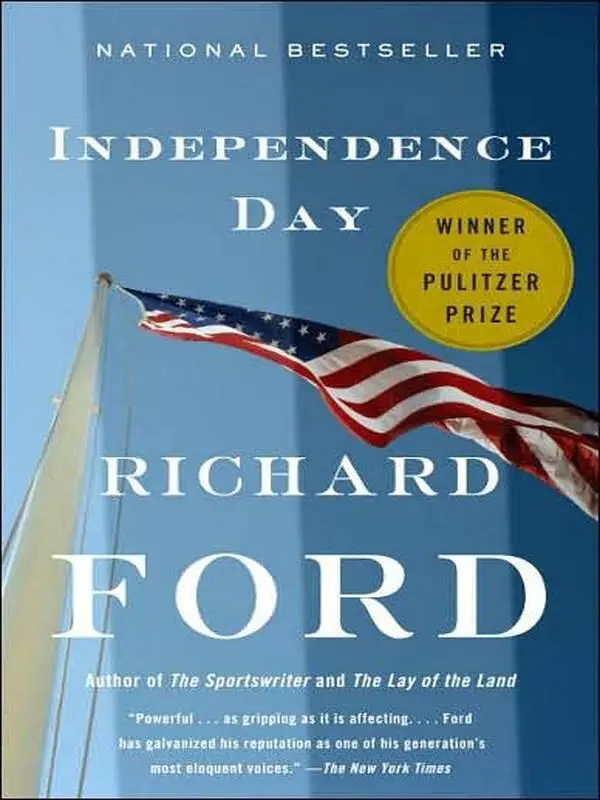
- Название:Independence Day
- Автор:
- Издательство:Vintage
- Жанр:
- Год:1996
- ISBN:нет данных
- Рейтинг книги:3 / 5. Голосов: 1
-
Избранное:Добавить в избранное
- Отзывы:
-
Ваша оценка:
Independence Day: краткое содержание, описание и аннотация
Предлагаем к чтению аннотацию, описание, краткое содержание или предисловие (зависит от того, что написал сам автор книги «Independence Day»). Если вы не нашли необходимую информацию о книге — напишите в комментариях, мы постараемся отыскать её.
, Richard Ford deepens his portrait of one of the most unforgettable characters in American fiction, and in so doing gives us an indelible portrait of America. Frank Bascombe, in the aftermath of his divorce and the ruin of his career, has entered an "Existence Period," selling real estate in Haddam, New Jersey, and mastering the high-wire act of normalcy. But over one Fourth of July weekend, Frank is called into sudden, bewildering engagement with life.
is a moving, peerlessly funny odyssey through America and through the layered consciousness of one of its most compelling literary incarnations, conducted by a novelist of astonishing empathy and perception.
Independence Day — читать онлайн бесплатно полную книгу (весь текст) целиком
Ниже представлен текст книги, разбитый по страницам. Система сохранения места последней прочитанной страницы, позволяет с удобством читать онлайн бесплатно книгу «Independence Day», без необходимости каждый раз заново искать на чём Вы остановились. Поставьте закладку, и сможете в любой момент перейти на страницу, на которой закончили чтение.
Интервал:
Закладка:
Ann has assumed a seat on the porch railing, one strong, winsome brown knee up, the other swinging. She is half facing me and half observing the red-sailed regatta, most of whose hulls have moved behind the treeline. “I’m sorry,” she says moodily. “Tell me where you two’re going, again? You told me last night. I forgot.”
“We’re heading up to Springfield this morning.” I say this cheerfully, happy to change the subject away from me. “We’re having a ‘sports lunch’ at the Basketball Hall of Fame. Then we’re driving over to Cooperstown by tonight.” No use mentioning a possible late crew addition of Sally Caldwell. “We’re touring the Baseball Hall of Fame tomorrow morning, and I’ll have him in the city at the stroke of six.” I smile a reliable, You’re in good hands with Allstate smile.
“He’s not really a big baseball fan, is he?” She says this almost plaintively.
“He knows more than you think he knows. Plus, going’s the ur- father-son experience.” I erase my smile to let her know I’m only half bluffing.
“So have you thought up some important fatherly things to say to solve his problems?” She squints at me and tugs at her earlobe exactly the way Charley does.
I, however, intend not to give away what I’ll say to Paul on our trip, since it’s too easy to break one’s fragile skein of worthwhile purpose by jousting with casual third-party skepticism. Ann is not in a good frame of mind to validate fragile worthwhile purposes, especially mine.
“My view is sort of a facilitator’s view,” I say, hopefully. “I just think he’s got some problems figuring out a good conception of himself”—to put it mildly—“and I want to offer a better one so he doesn’t get too attached to the one he’s hanging onto now, which doesn’t seem too successful. A defective attitude can get to be your friend if you don’t look out. It’s sort of a problem in risk management. He has to risk trying to improve by giving up what’s maybe comfortable but not working. It’s not easy.” I would smile again, but my mouth has gone dry as cardboard saying this much and trying to seem what I am — sincere. I drink down a gulp of ice tea, which is sweet the way a child would like it and has lemon and mint and cinnamon and God knows what else in it, and tastes terrible. Clarissa’s finger-drawn happy face has droozled down and become a scowling jack-o’-lantern in the heat.
“Do you think you’re a good person to instruct him about risk management?” Ann suddenly looks toward the river as if she’d heard an unfamiliar sound out in the summer atmosphere. A fishy breeze has in fact risen offshore and moved upriver, carrying all manner of sounds and smells she might not expect.
“I’m not that bad at it,” I say.
“No.” She is still looking off. “Not at risk management. I guess not.”
I hear a noise myself, unfamiliar and nearby, and stand up to the porch rail and peer over the lawn, hoping I’ll see Paul coming up the hill. But to the left, at the edge of the hardwoods, I can see, instead, all of Charley’s studio. As advertised, it is a proper old New England seaman’s chapel raised ten cockamamie feet above the pond surface on cypress pilings and connected to land by a catwalk. The church paint has been blasted off, leaving the lapped boards exposed. Windows are big, tall, clear lancets. The tin roof simmers in the sun of nearly noon.
And then Charley himself makes an appearance on the little back deck (happily in miniature), fresh from this morning’s sore-jawed brainstorms, cooking up super plans for some rich neurosurgeon’s ski palace in Big Sky, or a snorkeling hideaway in Cabo Cartouche — Berlioz still booming in his oversized ears. Bare-chested, tanned and silver-topped, in his usual khaki shorts, he is transporting from inside what looks like a plate of something, which he places on a low table beside a single wooden chair. I wish I could crank his big telescope down and survey the oarlock damage. That would interest me. (It’s never easy to see why your ex-wife marries the man she marries if it isn’t you again.)
I would like, however, to talk about Paul now: about the possibility of his coming down to Haddam to live, so as to stop limiting my fathering to weekends and holidays. I haven’t entirely thought through all the changes to my own private dockets that his arrival will necessitate, the new noises and new smells in my air, new concerns for time, privacy, modesty; possibly a new appreciation for my own moment and freedoms; my role : a man retuned to the traditional, riding herd on a son full time, duties dads are made for and that I have missed but crave. (I could also bear to hear about the howlers Ann and Charley have been conducting, though that isn’t my business and could easily turn out to be nothing: mischief Clarissa and Paul dreamed up to confuse everyone’s agenda.)
But I’m thwarted by what to say, and frankly inhibited by Ann. (Perhaps this is another goal of divorce — to reinstitute the inhibitions you dispensed with when things were peachy.) It’s tempting just to push off toward less controversial topics, like I did last night: my headaches with the Markhams and McLeods, rising interest rates, the election, Mr. Tanks — my most unforgettable character — with his truck, his gold-collared kitty and his Reader’s Digest condenseds, a personal docket that makes my own Existence Period look like ten years of sunshine.
But Ann suddenly says, apropos of nothing but also, of course, of everything, “It’s not really easy being an ex-spouse, is it? There isn’t much use for us in the grand plan. We don’t help anything go forward. We just float around unattached, even if we’re not unattached.” She rubs her nose with the back of her hand and snuffs. It’s as if she’s seen us outside our real bodies, like ghosts above the river, and is wishing we’d go away.
“There’s always one thing we can do.” She makes a point of rarely using my name unless she’s angry, so that most of the time I just seem to overhear her and offer a surprise reply.
“And what’s that?” She looks at me disapprovingly, her dark brows clouded, her leg twitching in a barely detectable, spasmic way.
“Get married to each other again,” I say, “just to state the obvious.” (Though not necessarily the inevitable.) “Last year I sold houses to three couples”—two, actually—“each of whom was at one time married, and who got divorced and married, then divorced, then married their original true love again. If you can say it you can do it, I guess.”
“We can put that on your tombstone,” Ann says with patent distaste. “It’s the story of your life. You don’t know what you’re going to say next, so you don’t know what’s a good idea. But if it wasn’t a good idea to be married to you seven years ago, why would it be a better idea now? You’re not any better.” (This is unproved.) “It’s conceivable you’re worse.”
“You’re happily married anyway,” I say, pleased with myself, though wondering who the “special someone” will be who’ll make decisions about my tombstone. Best if it could be me.
Ann scrutinizes Charley treading long-strided, barefooted, bare-chested back inside his studio, no doubt to see if his miso is ready and to dig the soy sauce and shallots out of the Swedish mini-fridge. Charley, I notice, walks in a decidedly head-forward, hump-shouldered, craning way that makes him look surprisingly old — he’s only sixty-one — but which makes me experience a sudden, unexpected and absolutely unwanted and impolitic sympathy for him. A good head shot with an oarlock is more telling on a man his age.
“You like thinking I ought to be sorry I married Charley. But I’m not sorry. Not at all,” Ann says, her tan shoe giving another nervous little twitch. “He’s a much better person than you are”—grossly unproved—“not that you have any reason to believe that, since you don’t know him. He even has a good opinion of you. He tries to be a pal to these children. He thinks we’ve done a better than average job with them.” (No mention of his daughter the novelist.) “He’s nice to me. He tells the truth. He’s faithful.” My ass as a bet on that, though I could be wrong. Some men are. Plus, I’d like to hear an example of some sovereign truth Charley professes — no doubt some self-congratulating GOP Euclideanism: A penny saved is a penny earned; buy low, sell high; old Shakespeare sure knew his potatoes. My unmerited sympathy for him goes flapping away.
Читать дальшеИнтервал:
Закладка:
Похожие книги на «Independence Day»
Представляем Вашему вниманию похожие книги на «Independence Day» списком для выбора. Мы отобрали схожую по названию и смыслу литературу в надежде предоставить читателям больше вариантов отыскать новые, интересные, ещё непрочитанные произведения.




Обсуждение, отзывы о книге «Independence Day» и просто собственные мнения читателей. Оставьте ваши комментарии, напишите, что Вы думаете о произведении, его смысле или главных героях. Укажите что конкретно понравилось, а что нет, и почему Вы так считаете.