Richard Ford - Independence Day
Здесь есть возможность читать онлайн «Richard Ford - Independence Day» весь текст электронной книги совершенно бесплатно (целиком полную версию без сокращений). В некоторых случаях можно слушать аудио, скачать через торрент в формате fb2 и присутствует краткое содержание. Год выпуска: 1996, Издательство: Vintage, Жанр: Современная проза, на английском языке. Описание произведения, (предисловие) а так же отзывы посетителей доступны на портале библиотеки ЛибКат.
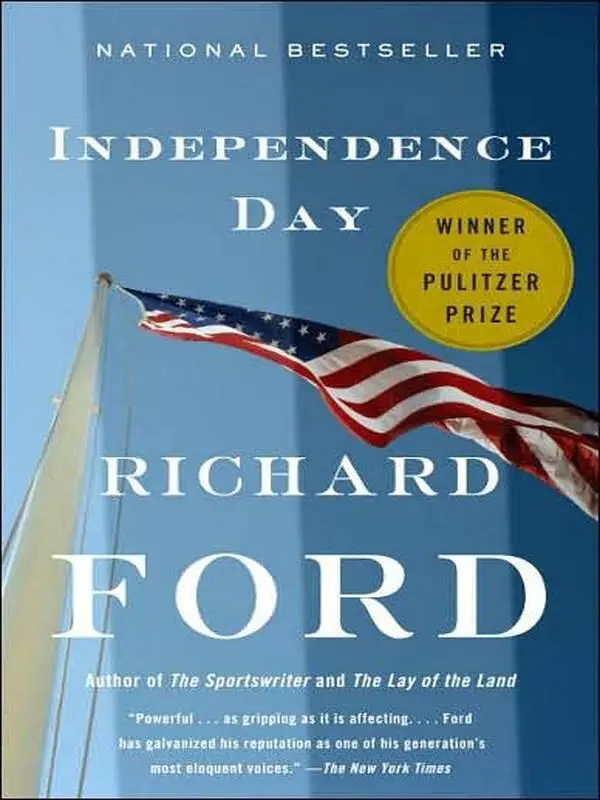
- Название:Independence Day
- Автор:
- Издательство:Vintage
- Жанр:
- Год:1996
- ISBN:нет данных
- Рейтинг книги:3 / 5. Голосов: 1
-
Избранное:Добавить в избранное
- Отзывы:
-
Ваша оценка:
Independence Day: краткое содержание, описание и аннотация
Предлагаем к чтению аннотацию, описание, краткое содержание или предисловие (зависит от того, что написал сам автор книги «Independence Day»). Если вы не нашли необходимую информацию о книге — напишите в комментариях, мы постараемся отыскать её.
, Richard Ford deepens his portrait of one of the most unforgettable characters in American fiction, and in so doing gives us an indelible portrait of America. Frank Bascombe, in the aftermath of his divorce and the ruin of his career, has entered an "Existence Period," selling real estate in Haddam, New Jersey, and mastering the high-wire act of normalcy. But over one Fourth of July weekend, Frank is called into sudden, bewildering engagement with life.
is a moving, peerlessly funny odyssey through America and through the layered consciousness of one of its most compelling literary incarnations, conducted by a novelist of astonishing empathy and perception.
Independence Day — читать онлайн бесплатно полную книгу (весь текст) целиком
Ниже представлен текст книги, разбитый по страницам. Система сохранения места последней прочитанной страницы, позволяет с удобством читать онлайн бесплатно книгу «Independence Day», без необходимости каждый раз заново искать на чём Вы остановились. Поставьте закладку, и сможете в любой момент перейти на страницу, на которой закончили чтение.
Интервал:
Закладка:
8
Clarissa Bascombe has snugged something tiny and secret into Paul’s hand as we were leaving. And on our way up to Hartford, on our way up to Springfield, on our way to the Basketball Hall of Fame, he has held it without acknowledgment while I’ve yodeled away spiritedly about what I’ve thought will break our ice, get our ball rolling, fan our coals — start, via the right foot, what now feels like our last and most important journey together as father and son (though it probably isn’t).
Once we swerve off busy CT 9 onto busier, car-clogged I-91, go past the grimy jai alai palace and a new casino run by Indians, I set off on my first “interesting topic”: just how hard it is right here, ten miles south of Hartford, on July 2, 1988, when everything seems of a piece, to credit that on July 2, 1776, all the colonies on the seaboard distrusted the bejesus out of each other, were acting like separate, fierce warrior nations scared to death of falling property values and what religion their neighbors were practicing (like now), and yet still knew they needed to be happier and safer and went about doing their best to figure out how. (If this seems completely nutty, it’s not, under the syllabus topic of “Reconciling Past and Present: From Fragmentation to Unity and Independence.” It’s totally relevant — in my view — to Paul’s difficulty in integrating his fractured past with his hectic present so that the two connect up in a commonsense way and make him free and independent rather than staying disconnected and distracted and driving him bat-shit crazy. History’s lessons are subtle lessons, inviting us to remember and forget selectively, and therefore are much better than psychiatry’s, where you’re forced to remember everything.)
“John Adams,” I say, “said getting the colonies all to agree to be independent together was like trying to get thirteen clocks to strike at the same second.”
“Who’s John Adams?” Paul says, bored — his pale, bare, beginning-to-be-hairy legs crossed in a concertedly unmanly manner, one Reebok with its Day-Glo-yellow lacing hiked up threateningly near the gearshift lever.
“John Adams was the first Vice President,” I say. “He was the first person to say it was a stupid job. In public, that is. That was in 1797. Did you bring your copy of the Declaration of Independence?”
“Nuhhhn.” This may mean either.
He is staring out at the reemerged Connecticut, where a sleek powerboat is pulling a tiny female water-skier, billowing the river’s shiny skin. In a bright-yellow life vest, the girl heels waaaaay back against her towrope, carving a high, translucent spume out of the crusty wake.
“Why are you driving so effing slow?” he says to be droll. Then, in a mocking old-granny’s voice, “Everybody passes me, but I get there just as fast as the rest of ’em.”
I, of course, intend to drive as fast as I want and no faster, but take an appraising look at him, my first since we shoved off from Deep River. His ear that wasn’t bammed by the Mercedes’s steering wheel has some gray fuzzy litter in it. Paul also doesn’t much smell good, smells in fact like unbathed, sleep-in-your-clothes mustiness. He also doesn’t seem to have brushed his teeth in a while. Possibly he is reverting to nature. “The original framers, you know,” I say hopefully, but instantly getting the Constitution’s authors muddled up with the signers of the Declaration (my persistent miscue, though Paul would never know), “they wanted to be free to make new mistakes, not just keep making the same old ones over and over as separate colonies and without showing much progress. That’s why they decided to band together and be independent and were willing to sacrifice some controls they’d always had in hopes of getting something better — in their case, better trade with the outside world.”
Paul looks at me contemptuously, as if I were an old radio tuned to a droning station that’s almost amusing. “Framers? Do you mean farmers?”
“Some of them were farmers,” I say. There’s no use trying to haul this business back. I’m not facilitating good contact yet. “But people who won’t quit making the same mistakes over and over are what we call conservatives. And the conservatives were all against independence, including Benjamin Franklin’s son, who eventually got deported to Connecticut, just like you.”
“So are conservatives farmers?” he says, feigning puzzlement but ridiculing me.
“A lot of them are,” I say, “though they shouldn’t be. What’d your sister give you?” I’m watching his closed left fist. We are quickly coming up into the Hartford traffic bottleneck. Elaborate road construction is on the right, between the interstate and the river — a soaring new off-ramp, a new parallel lane, arrows flashing, yellow behemoths full of Connecticut earth rumbling along beside us, white men in plastic hats and white shirts standing out in the snappy hot breeze, staring at thick scrolls of plans.
Paul looks at his fist as if he has no idea of what it contains, then slowly opens it, revealing a small yellow bow, the twin of the red one Clarissa gave me. “She gave you one,” he mutters. “A red one. She said you said you wanted to be her bow, but it was spelled another way.” I’m shocked at what a shady, behind-the-scenes conniver my daughter is. Paul holds the two loose ends of his yellow bow and pulls them tight so the two loops daintily involute and make a knot. Then he puts the whole in his mouth and swallows it. “Umm,” he says, and smiles at me evilly. “Good ribbance.” (He’s constructed this event, including the change in his sister’s story, just for a punch line.)
“I guess I’ll save mine till later.”
“She gave me another one for later.” He gives me his slant-eyed look. He is far ahead of me and will, I know, be a struggle.
“So okay, what’s the problem with you and Charley?” I am maneuvering us past the Hartford downtown, the little gold-domed capital nearly lost in among big insurance high-rises. “Can’t you two be civilized?”
“I can. He’s an asshole.” Paul is watching out his side as a squad of befezzed Shriners on Harleys comes alongside us. The Shriners are big, overstuffed, fat-cheeked guys dressed in gold-and-green silk harem guard getups with goggles and gloves and motorcycle boots. On their giant red Electra Glides they’re as imposing as real harem guards, and of course are riding in safety-first staggered formation, their motor noise even through the closed window loud and oppressive.
“Does braining him with an oarlock seem like a good solution to his being an asshole?” This will be my lone, unfelt concession to Charley’s welfare.
The lead Shriner has spied Paul and given him a grinning, gloved thumbs-up. He and his crew are all big, jolly cream puffs, no doubt on their way to perform figure eights and seamless circles within circles for happy, grateful, shopping-center crowds, then hurry off to lead a parade down some town’s Main Street.
“It’s just a solution,” Paul says, returning the lead harem guard’s thumbs-up, putting his forehead to the window and grinning back sarcastically. “I like these guys. Charley should be one. What do you call them?”
“Shriners,” I say, returning a thumbs-up from my side.
“What do they do?”
“It’s not that easy to explain,” I say, keeping us in our lane.
“I like their suits.” He makes a muffled and unexpected little bark, a clipped Three Stooges, testy-terrier bark. He doesn’t seem to want me to hear it but can’t resist doing it again. One of the Shriners seems to catch on and makes what looks like a barking gesture of his own, then gives another thumbs-up.
Читать дальшеИнтервал:
Закладка:
Похожие книги на «Independence Day»
Представляем Вашему вниманию похожие книги на «Independence Day» списком для выбора. Мы отобрали схожую по названию и смыслу литературу в надежде предоставить читателям больше вариантов отыскать новые, интересные, ещё непрочитанные произведения.

Обсуждение, отзывы о книге «Independence Day» и просто собственные мнения читателей. Оставьте ваши комментарии, напишите, что Вы думаете о произведении, его смысле или главных героях. Укажите что конкретно понравилось, а что нет, и почему Вы так считаете.