Richard Ford - Independence Day
Здесь есть возможность читать онлайн «Richard Ford - Independence Day» весь текст электронной книги совершенно бесплатно (целиком полную версию без сокращений). В некоторых случаях можно слушать аудио, скачать через торрент в формате fb2 и присутствует краткое содержание. Год выпуска: 1996, Издательство: Vintage, Жанр: Современная проза, на английском языке. Описание произведения, (предисловие) а так же отзывы посетителей доступны на портале библиотеки ЛибКат.
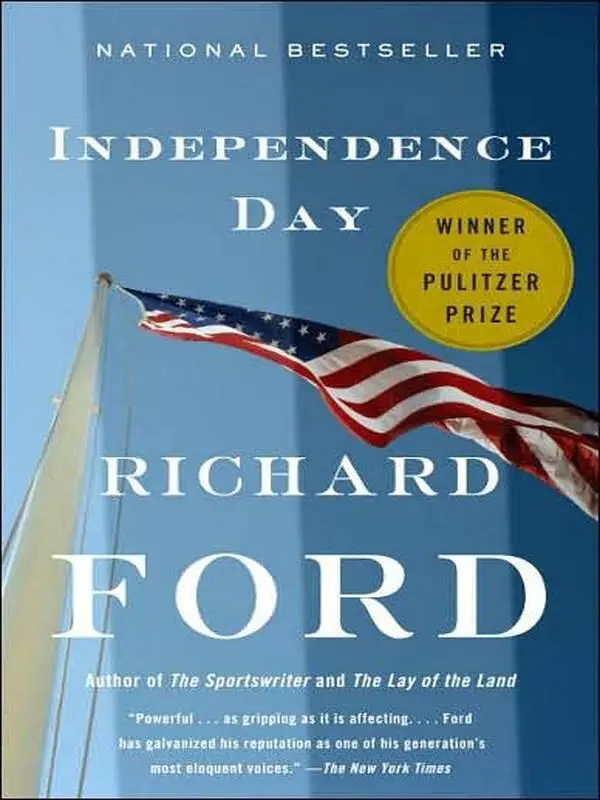
- Название:Independence Day
- Автор:
- Издательство:Vintage
- Жанр:
- Год:1996
- ISBN:нет данных
- Рейтинг книги:3 / 5. Голосов: 1
-
Избранное:Добавить в избранное
- Отзывы:
-
Ваша оценка:
Independence Day: краткое содержание, описание и аннотация
Предлагаем к чтению аннотацию, описание, краткое содержание или предисловие (зависит от того, что написал сам автор книги «Independence Day»). Если вы не нашли необходимую информацию о книге — напишите в комментариях, мы постараемся отыскать её.
, Richard Ford deepens his portrait of one of the most unforgettable characters in American fiction, and in so doing gives us an indelible portrait of America. Frank Bascombe, in the aftermath of his divorce and the ruin of his career, has entered an "Existence Period," selling real estate in Haddam, New Jersey, and mastering the high-wire act of normalcy. But over one Fourth of July weekend, Frank is called into sudden, bewildering engagement with life.
is a moving, peerlessly funny odyssey through America and through the layered consciousness of one of its most compelling literary incarnations, conducted by a novelist of astonishing empathy and perception.
Independence Day — читать онлайн бесплатно полную книгу (весь текст) целиком
Ниже представлен текст книги, разбитый по страницам. Система сохранения места последней прочитанной страницы, позволяет с удобством читать онлайн бесплатно книгу «Independence Day», без необходимости каждый раз заново искать на чём Вы остановились. Поставьте закладку, и сможете в любой момент перейти на страницу, на которой закончили чтение.
Интервал:
Закладка:
“A-balone,” Paul says. I stand and gaze over the hot roof of my car, over the Connecticut, over the green west of Massachusetts, where soon we’ll be driving. I feel for some reason lonely as a shipwreck. “How do you say ‘I’m hungry’ in Italian?” he says.
“Ciao,” I say. This is our oldest-timiest, most reliable, jokey way of conducting father-son business. Only today, due to technical difficulties beyond all control, it doesn’t seem exactly to work. And our words get carried off in the breeze, with no one to care if we speak the intricate language of love or don’t. Being a parent can be the worst of discontents.
“Ciao,” Paul says. He has not heard me. “Ciao. How soon they forget.” He is climbing out now, ready for our trip inside.
O nce in, Paul and I wander like lost souls who have paid five bucks to enter purgatory. (I have finally quit limping.)
Strategically placed, widely modern staircases with purple velvet crowd-control cords move us and others, herd-like, all the way up to Level 3, where the theme is basketball-history-in-a-nutshell. The air, here, is hypercleaned and frigid as Nome (to discourage lingering), everyone whispers like funeral-parlor guests, and lights are low to show off various long corridors of spotlit mummy-case artifacts preserved behind glass only a multiple-warhead missile could penetrate. Here is a thumbnail bio of inventor Naismith (who turns out to have been a Canadian!), alongside a replica of the old Doc’s original scrawled-on-an-envelope basketball master plan: “To devise a game to be played in a gymnasium.” (Success was certainly his.) Farther on is a black-and-white picture display featuring Forrest “Phogg” Allen, beloved old Jayhawks chalkboard wizard from the Twenties, and next to that, a replica of the “original” peach basket, along with a tribute to YMCAs everywhere. On all the walls there are grainy, treasured period photos of “the game” being played in shadowy wire-window gyms by skinny unathletic white boys, plus two hundred old uniform jerseys hung from the dark rafters like ghosts in a spook house.
A few listless families enter a dark little Action Theatre, which Paul avoids by hitting the can, though I watch from the doorway as the history of the game unfolds before our preprandial eyes, while the action sounds of the game are piped in.
In eight minutes we progress briskly down to Level 2, where there’s more of the same, though it’s more up-to-date and recognizable, at least to me. Paul expresses a passing spectator’s interest in Bob Lanier’s size 22 shoe, a red-and-yellow plastic cross-section model of an as-yet-unmangled human knee, and a film viewable in another little planetarium-like theater, dramatizing how preternaturally large basketball players are and what they can all “do with the ball,” in contrast to how minuscule and talentless the rest of us have to suffer through life being. In this way it is a true shrine — devoted to making ordinary people feel like insignificant outsiders, which Paul seems not to mind. (The Vince was in fact more welcoming.)
“We played at camp,” he says flatly as we pause outside the amphitheater, both of us looking in as huge, muscular, uniformed black men ram ball after ball through hoop after hoop on a mesmerizing four-sided screen, to the crowd’s rapt amazement and smattered applause.
“And so were you a major force,” I ask. “Or an intimidator, possibly a franchise or an impact player?” I’m happy to have unfreighted exchange on any subject, though I stare at his shorts, tee-shirt and skinthead and don’t like any of it. He seems to me to be in disguise.
“Not really,” he says, absolutely earnest. “I can’t jump. Or run. Or shoot, and I’m a lefty. And I don’t give a shit. So I’m not really cut out for it.”
“Lanier was a lefty,” I say. “So was Russell.” He may not know who they are, even though he’d recognize their shoes. The audience in the jam-o-rama amphitheater makes a low “Ooooo” of utter reverence. Other men with their boys stand beside us, looking in, uninterested in sitting down.
“We weren’t really playing to win anyway,” Paul says.
“What were you playing for? Fun?”
“Thur-uh-py,” he says to make a joke of it, though he seems unironic. “Some of the kids would always forget what month it was, and some of them talked too loud or had seizures, which was bad. And if we played basketball, even stupid basketball, they all got better for a while. We had ‘share your thoughts’ after every game, and everybody had a lot better thoughts. For a while at least. Not me. Chuck played basketball at Yale.” Paul’s hands are in his shorts pockets as he stares at the ceiling, which is industrial modern and shadowy, with metal girders, trusses, rafters, sprinkling-system pipes, all painted black. Basketball, I think, is American’s postindustrial national pastime.
“Was he any good?” I may as well ask.
“I don’t know,” he says, digging a finger into his mossy ear and creasing the corner of his mouth like a country hick. A second loud “Ooooo” comes from inside. Someone, a woman, shouts out, “Yes! I swear to God. Look at that!” I don’t know what she saw.
“You know the one thing you can do that’s truly unique to you and that society can’t affect in any way?” he says. “We learned this in camp.”
“I guess not.” People out here with us are starting to stray away.
“Sneeze. If you sneeze in some stupid-fuck way, or in a loud way that pisses people off in movies, they just have to go along with it. Nobody can say, ‘Sneeze a different way, asshole.’”
“Who told you that?”
“I don’t remember.”
“Does that seem unusual?”
“Yes.” Gradually he lets his eyes come down from the ceiling but not to me. His finger quits excavating his ear. He is now uncomfortable for being unironic and a kid.
“Don’t you know that’s the way everything is when you get to be old? Everybody lets you do anything you want to. If they don’t like it, they just don’t show up anymore.”
“Sounds great,” Paul says, and actually smiles, as if such a world where people left you alone was an exhibit he’d like to see.
“Maybe it is,” I say, “maybe it isn’t.”
“What’s the most misunderstood automotive accessory?” He’s ready to derail serious talk, alert to the dangers inherent in my earnest voice.
“I don’t know. An air filter,” I say, as the dunk-o-rama film gets over in the auditorium. I have seen no big cutout of Milt the Stilt, as was promised.
“That’s pretty close.” Paul nods very seriously. “It’s a snow tire. You don’t appreciate it until you need it, but then it’s usually too late.”
“Why does that make it misunderstood? Why not just underappreciated?”
“They’re the same,” he says, and starts walking away.
“I see. Maybe you’re right.” And we both walk off then toward the stairs.
O n Level 1, there’s a busy gift boutique, a small room dedicated to sports media (zero fascination for me), an authentic locker room exhibit, a vending machine oasis, plus some gimmicky, hands-on exhibits Paul takes mild interest in. I decide to make my call to Sally before we hit the road. Though I have yet to see a legitimate snack bar, so that Paul wanders off in his new heavy-gaited, pigeon-toed, arm-swinging way I hate, to the vending-machine canteen with money I’ve supplied (since his is evidently for some other uses — a possible kidnap emergency) and my order to bring back “something good.”
The phone area is a nice, secluded, low-lit little alcove beside the bathrooms, with thick, noise-muffling wall-to-wall covering everything, and the latest black phone technology — credit card slits, green computer screens and buttons to amplify sound in case you can’t believe what you’re hearing. It is an ideal place for a crank or ransom call.
Читать дальшеИнтервал:
Закладка:
Похожие книги на «Independence Day»
Представляем Вашему вниманию похожие книги на «Independence Day» списком для выбора. Мы отобрали схожую по названию и смыслу литературу в надежде предоставить читателям больше вариантов отыскать новые, интересные, ещё непрочитанные произведения.



Обсуждение, отзывы о книге «Independence Day» и просто собственные мнения читателей. Оставьте ваши комментарии, напишите, что Вы думаете о произведении, его смысле или главных героях. Укажите что конкретно понравилось, а что нет, и почему Вы так считаете.