Richard Ford - Independence Day
Здесь есть возможность читать онлайн «Richard Ford - Independence Day» весь текст электронной книги совершенно бесплатно (целиком полную версию без сокращений). В некоторых случаях можно слушать аудио, скачать через торрент в формате fb2 и присутствует краткое содержание. Год выпуска: 1996, Издательство: Vintage, Жанр: Современная проза, на английском языке. Описание произведения, (предисловие) а так же отзывы посетителей доступны на портале библиотеки ЛибКат.
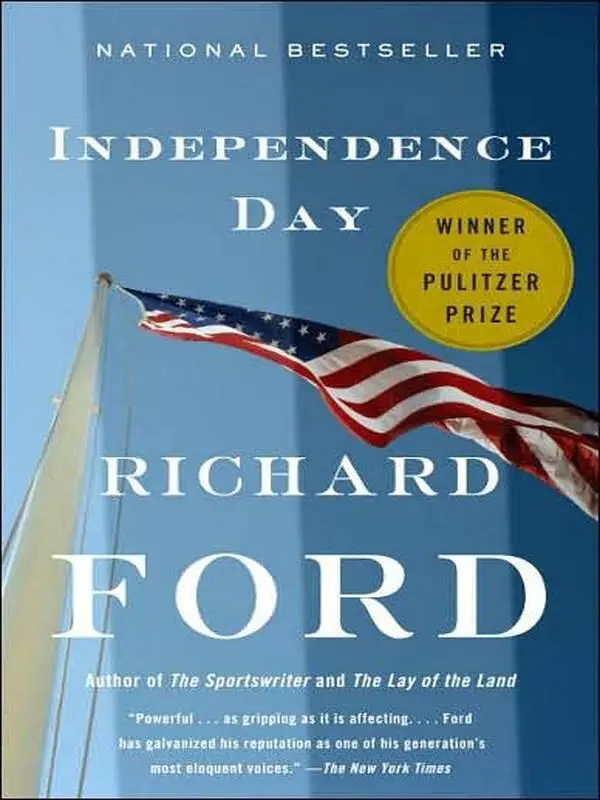
- Название:Independence Day
- Автор:
- Издательство:Vintage
- Жанр:
- Год:1996
- ISBN:нет данных
- Рейтинг книги:3 / 5. Голосов: 1
-
Избранное:Добавить в избранное
- Отзывы:
-
Ваша оценка:
Independence Day: краткое содержание, описание и аннотация
Предлагаем к чтению аннотацию, описание, краткое содержание или предисловие (зависит от того, что написал сам автор книги «Independence Day»). Если вы не нашли необходимую информацию о книге — напишите в комментариях, мы постараемся отыскать её.
, Richard Ford deepens his portrait of one of the most unforgettable characters in American fiction, and in so doing gives us an indelible portrait of America. Frank Bascombe, in the aftermath of his divorce and the ruin of his career, has entered an "Existence Period," selling real estate in Haddam, New Jersey, and mastering the high-wire act of normalcy. But over one Fourth of July weekend, Frank is called into sudden, bewildering engagement with life.
is a moving, peerlessly funny odyssey through America and through the layered consciousness of one of its most compelling literary incarnations, conducted by a novelist of astonishing empathy and perception.
Independence Day — читать онлайн бесплатно полную книгу (весь текст) целиком
Ниже представлен текст книги, разбитый по страницам. Система сохранения места последней прочитанной страницы, позволяет с удобством читать онлайн бесплатно книгу «Independence Day», без необходимости каждый раз заново искать на чём Вы остановились. Поставьте закладку, и сможете в любой момент перейти на страницу, на которой закончили чтение.
Интервал:
Закладка:
“I’m sorry you don’t think your judgment’s very sound,” Sally says, falsely perky. “That doesn’t bode very well for how you say you feel about me either, does it?”
“Whose cuff links were those on the bed table?” This, of course, is rash and against all good judgment. But I’m indignant, even though I have no good right to be.
“They were Wally’s,” Sally says, perky but not falsely. “Did you think they belonged to somebody else? I just got them out to send to his mother.”
“Wally was in the Navy, I thought. He almost got blown up in a boat. Isn’t that right?”
“He did. But he was in the Marines. Not that it matters. You just made up the Navy for him. It’s all right.”
“Okay. Yeah, I was callin’ about this house you got for rent on Friar Tuck Drive,” I hear the big man say across the alcove. His little girl is staring up at her dad/unc/abductor as if he’d told her he needed some moral support and she should focus all her thoughts his way. “What’s the rent on that one?” he says. He is a southwesterner, possibly a twangy Texan. Though he isn’t wearing dusty old Noconas but a pair of white Keds no-lace low-tops of the male-nurse/minimum-security-prisoner variety. These are Texans without a ranch. My guess is he’s busted out of the oil patch, a new-age Joad moving his precious little brood up to the rust belt to set life spinning in a new orbit. It occurs to me the McLeods may likewise be in hot financial water and be in need of a break but are too stubborn to say so. That would change my attitude about the rent, though not totally.
“Frank, did you hear what I said, or have you just drifted off into space?”
“I was watching the same guy trying to rent a house. I wish I had something I could show him in Springfield. Of course, I don’t live here.”
“Okay-yay,” Sally says, ready for our conversation to float off too. I have registered whose cuff links they were, though they aren’t any of my business. The Navy-Marine mixup I can’t explain. “Is it pretty up there?” she asks brightly.
“Yeah, it’s beautiful. But really,” I say, suddenly picturing Sally’s face, a winning face, worth wanting to kiss. “Don’t you want to come up here? I’m popping for everything. Your money’s no good. All you can eat. Double stamps. Carte blanche.”
“Why don’t you just call me some other time, okay? I’ll be home tonight. You’re very distracted. You’re probably tired.”
“Are you sure? I’d really like to see you.” I should mention that I’m not beyond affection, because I’m not.
“I’m sure,” she says. “And I’m just going to say good-bye now.”
“Okay,” I say. “Okay.”
“Good-bye now,” she says, and we hang up.
The little cowgirl across the alcove gives me a fretful look. Possibly I was talking too loud again. Her big Texan daddy swivels half around to look at me. He has a big tough-jawed face, unruly dark hair and enormous pipe-fitter’s mitts. “No,” he says decisively into the phone. “No, that ain’t gonna work, that’s way outa line. Forgit that.” He hangs up, crumpling his little scratch of paper, which he drops on the carpet.
He fishes in his breast pocket, pulls out a pack of Kools, takes one out with his mouth, still holding little Suzie’s hand, lights up one-handed with a thick, mean-looking Zippo. He blows a big, frustrated, lung-shuddering drag right at the international NO SMOKING insignia attached to the carpeted ceiling, and I immediately expect to be drenched in cold chemicals, for alarms to trigger, security people to skid around the corner on the dead run. But nothing happens. He gives me an antagonistic look where I’m lost in front of my phone screen. “You got a problem?” he says, fishing back in his cigarette pocket for something he doesn’t find.
“No,” I say, grinning. “I just have a daughter about your daughter’s age”—a total fabrication, followed hard by another one—“and she just reminded me of her.”
The man looks down at the child, who must be eight and who looks up at him smiling, charmed by being noticed but unsure exactly how to be charmed. “You want me to sell this one to you?” he says, at which moment the little girl throws her head back and lets her whole self go limp so she’s hanging off his big mitt, smiling and shaking her pretty head.
“Nope, nope, nope, nope, nope,” she says.
“They’re too expensive for me,” he says in his Texas accent. He raises his child off the ground, limp as a carcass, and gives her a dainty little swing out.
“You cain’t sell me,” she says in a throaty, bossy voice. “I’m not for sale.”
“You’re for sale big time, that’s whut,” he says. I smile at his joke — a helpless fatherish way of expressing love to a stranger in a time of hardship. I should appreciate it. “You don’t have a house to rent, do you?”
“Sorry,” I say. “I’m not from Springfield. I’m just here for a visit. My son’s running around in here someplace.”
“You know how long it takes to get up here from Oklahoma?” he says, his cigarette in one side of his big mouth.
“It’s probably not that quick.”
“Two days, two nights straight. And we been in the KOA for three damn days. I got a highway job starts up in a week, and I can’t find anything. I’m gonna have to send this orphan back.”
“Not me,” the little girl says in her bossy voice and lets her knees give way, hanging on. “I’m not an orphan.”
“You!” the big guy says to his daughter and frowns, though not angrily. “You’re my whole damn problem. If I didn’t have you with me, somebody would’ve been considerate of me by now.” He gives me a big leer and a roll of the eyes. “Stand up on your feet, Kristy.”
“You’re a redneck,” his daughter says, and laughs.
“I might be, and I might be worse than that,” he says more seriously. “You think your daughter’s like this outfit?” He’s already starting to walk away, holding his daughter’s tiny hand in his great one.
“They’re both pretty sweet when they want to be, I bet,” I say, watching his child’s quick knock-kneed steps and thinking of Clarissa giving Ann and me, or possibly just me, the finger. “The holiday’ll probably change everything.” Though I don’t know how. “I’ll bet you find someplace to stay today.”
“It’s that or drastic measures,” he says, walking away toward the lobby.
“What’s that mean?” his daughter says, hanging onto his hand. “What’s drastic measures?”
“Being your ole man, for starters,” he says, as they go out of sight. Then he adds, “But it might mean a whole lot of things too.”
P aul, when I walk out to find him, is not waiting with an armload of vending-machine provisions but has taken up an observer position alongside “The Shoot-Out” exhibit, which dominates one whole wall-side of Level 1 and where a lot of visitors have already become noisy participators.
“The Shoot-Out” is nothing more than a big humming people-mover conveyor belt, just like in an airport, but built right alongside and at the same level as a spotlit arena area, full of basketball backboards, hoops and posts, at varying heights and distances from the belt — ten feet, five yards, two feet, ten yards. Along beside the moving handrail and between the little arena and the people-mover itself, a trough of basketballs is continuously being replenished through a suction tube under the floor, exactly in the manner of a bowling alley rack. A human being getting on the moving floor (as many already are) and traveling at approximately one half of one mile an hour, can simply pick up ball after ball and shoot basket after basket — jump shots, hooks, two-hand sets, over the back, one’s whole repertoire — until he reaches the other end, where he steps off. (Such a screwy but ingenious machine has undoubtedly been invented by someone with a dual major in Crowd Control and Automated Playground Management from Southern Cal, and anybody in his right mind would’ve fought to get ground-floor money in on it. In fact, if the Hall of Fame management didn’t insist that you first mull past murky old Phogg Allen pictures and replicas of Bob Lanier’s dogs, everyone would spend his whole visit right down here where the real action is, and the rest of the building could go back to being a dentist’s office.)
Читать дальшеИнтервал:
Закладка:
Похожие книги на «Independence Day»
Представляем Вашему вниманию похожие книги на «Independence Day» списком для выбора. Мы отобрали схожую по названию и смыслу литературу в надежде предоставить читателям больше вариантов отыскать новые, интересные, ещё непрочитанные произведения.


Обсуждение, отзывы о книге «Independence Day» и просто собственные мнения читателей. Оставьте ваши комментарии, напишите, что Вы думаете о произведении, его смысле или главных героях. Укажите что конкретно понравилось, а что нет, и почему Вы так считаете.