Richard Ford - Independence Day
Здесь есть возможность читать онлайн «Richard Ford - Independence Day» весь текст электронной книги совершенно бесплатно (целиком полную версию без сокращений). В некоторых случаях можно слушать аудио, скачать через торрент в формате fb2 и присутствует краткое содержание. Год выпуска: 1996, Издательство: Vintage, Жанр: Современная проза, на английском языке. Описание произведения, (предисловие) а так же отзывы посетителей доступны на портале библиотеки ЛибКат.
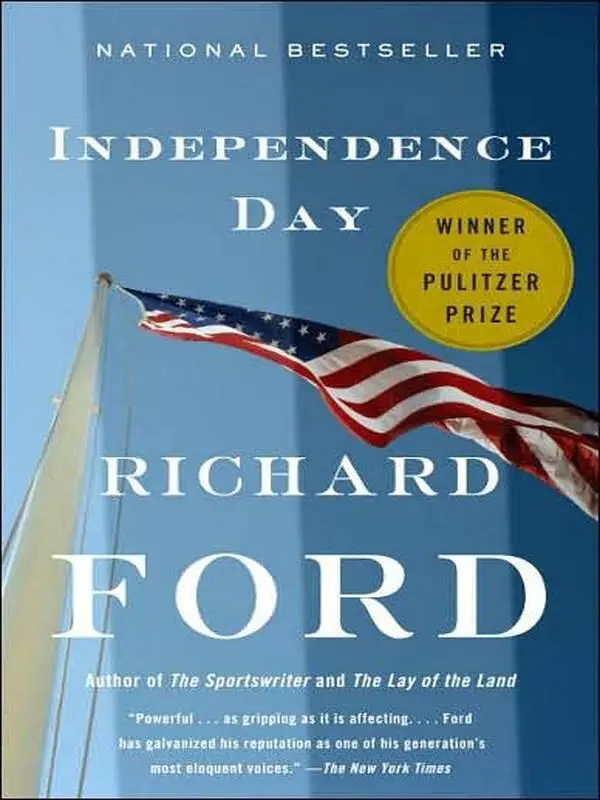
- Название:Independence Day
- Автор:
- Издательство:Vintage
- Жанр:
- Год:1996
- ISBN:нет данных
- Рейтинг книги:3 / 5. Голосов: 1
-
Избранное:Добавить в избранное
- Отзывы:
-
Ваша оценка:
Independence Day: краткое содержание, описание и аннотация
Предлагаем к чтению аннотацию, описание, краткое содержание или предисловие (зависит от того, что написал сам автор книги «Independence Day»). Если вы не нашли необходимую информацию о книге — напишите в комментариях, мы постараемся отыскать её.
, Richard Ford deepens his portrait of one of the most unforgettable characters in American fiction, and in so doing gives us an indelible portrait of America. Frank Bascombe, in the aftermath of his divorce and the ruin of his career, has entered an "Existence Period," selling real estate in Haddam, New Jersey, and mastering the high-wire act of normalcy. But over one Fourth of July weekend, Frank is called into sudden, bewildering engagement with life.
is a moving, peerlessly funny odyssey through America and through the layered consciousness of one of its most compelling literary incarnations, conducted by a novelist of astonishing empathy and perception.
Independence Day — читать онлайн бесплатно полную книгу (весь текст) целиком
Ниже представлен текст книги, разбитый по страницам. Система сохранения места последней прочитанной страницы, позволяет с удобством читать онлайн бесплатно книгу «Independence Day», без необходимости каждый раз заново искать на чём Вы остановились. Поставьте закладку, и сможете в любой момент перейти на страницу, на которой закончили чтение.
Интервал:
Закладка:
The new shirt is Xtra large, long and white, with nothing but a big super-real orange basketball on its front and the words The Rock underneath in red block letters. It smells new and starched and chemically clean and, I’m hoping, will mask Paul’s unwashed, gunky aroma until we check into the Deerslayer Inn, he can take a forced bath and I can throw his old one away on the sly.
For a while after our Whalers, Paul again grows moodily silent, then heavy-eyed, then slips off to a snooze while green boilerplate Massachusetts countryside scrolls past on both sides. I turn on the radio for a holiday weather and traffic check and conceivably to learn the facts of last night’s murder, which, for all the time and driving that’s elapsed, occurred only eighty miles south, still well within the central New England area, the small radar sweep of grief, loss, outrage. But nothing comes in on AM or FM, only the ordinary news of holiday fatality: six for Connecticut, six for Mass., two for Vermont, ten for NY; plus five drownings, three boating per se , two falls from high places, one choking, one “fireworks related.” No knifings. Evidently last night’s death was not charged to the holiday.
I “seek” around then, happy to have Paul out of action and for my mind to find its own comfort level: a medical call-in from Pittsfield offers “painless erection help;” a Christian money-matters holiday radiothon from Schaghticoke is interpreting the The Creator’s views on Chapter 13 filings (He thinks some are okay). Another station profiles lifers in Attica selling Girl Scout cookies “in the population.” “We do think we shouldn’t be totally prevented from adding to the larger good”—laughter from other cons—“but we don’t go around knocking on each other’s cells wearing little green outfits either.” Though a falsetto voice adds, “Not this afternoon anyway.”
I turn it off as we get into the static zone at the New York border. And with my son beside me, his scissored and gouged head against his cool window glass, his mind in some swarming, memory-plagued darkness which causes his fingers to dance and his cheek to twitch like a puppy’s in a dream of escape, my own mind bends with unexpected admiration toward meisterbuilder O’Dell’s big blue house on the knoll; and to what a great, if impersonal, true-to-your-dreams home it is — a place any modern family of whatever configuration or marital riggery ought to feel lamebrained not to make a reasonably good go of life in. A type of “go” I could never quite catch the trick of, even in the most halcyon days, when we all were a tidy family in our own substantial house in Haddam. I somehow could never create a sufficiently thick warp and woof, never manufacture enough domestic assumables that we could get on to assuming them. I was always gone too much with my sportswriting work; never felt owning was enough different from renting (except that you couldn’t leave). In my mind a sense of contingency and the possibility of imminent change in status underlay everything, though we stayed for more than a decade, and I stayed longer. It always seemed to me enough just to know that someone loved you and would go on loving you forever (as I tried to convince Ann again today, and she rejected again), and that the mise-en-scène for love was only that and not a character in the play itself.
Charley of course is of the decidedly other view, the one that believes a good structure implies a good structure (which is why he’s so handy with plain truth: he has the mind of a true Republican). It was fine with him, as I happen to know via discreet inquiries, that his old man owned a seat on the commodities exchange, kept an unadvertised pied-à-terre on Park Avenue, supported an entire Corsican second family in Forest Hills, was barely a gray eminence whom young Charles hardly ever saw and referred to only as “Father” when he happened to catch a glimpse (never Dad or Herb or Walt or Phil). All was jake as long as there was a venerable old slate-roofed, many-chimneyed, thickly pillared, leaded-glass-windowed, deep-hedged, fieldstone Georgian residence reliably there in Old Greenwich, reeking of fog and privet and boat varnish, brass polish, damp tennies and extra trunks you could borrow in the pool-house. This, in Charley’s view, constitutes life and no doubt truth: strict physical moorings. A roof over your head to prove you have a head. Why else be an architect?
And for some reason now, tooling along westward with my son in tow — and not because either of us gives a particular shit about baseball, but because we simply have no properer place to go for our semi-sacred purposes — I feel Charley might just not be wrong in his rich-boy’s manorial worldview. It might be better if things were more anchored. (Vice President Bush, the Connecticut Texan, would certainly agree.)
Though there’s something in me that’s possibly a little off and which I’m sure would make finding firm anchorage a problem. I’m not, for instance, as optimistic as one ought to be (relations with Sally Caldwell are a good example); or else I’m much too optimistic (Sally qualifies again). I don’t come back from bad events as readily as one should (or as I used to); or else the reverse — I’m too adept at forgetting and don’t remember enough of what it is I’m supposed to resume (the Markhams serve here). And for all my insistent prating that they — the Markhams — haul themselves into clearer view, I’ve never seen myself all that exactly, or as sharing the frame with those others I might share it with — causing me often to be far too tolerant to those who don’t deserve it; or, where I myself am concerned, too little sympathetic when I should be more. These uncertainties contribute, I’m sure, to my being a classic (and possibly chickenshit) liberal, and may even help to drive my surviving son nutty and set him barking and baying at the moon.
Though specifically where he is concerned, I dearly wish I could speak from some more established place —the way Charley would were he the father of the first part — rather than from this constellation of stars among which I smoothly orbit, traffic and glide. Indeed, if I could see myself as occupying a fixed point rather than being in a process (the quiddity of the Existence Period), things might grow better for us both — myself and barking son. And in this Ann may simply be right when she says children are a signature mark of self-discovery and that what’s wrong with Paul is nothing but what’s wrong with us. Though how to change it?
S piriting on across the Hudson and past Albany — the “Capital Region”—I am on the lookout now for I-88, the blue Catskills rising abruptly into view to the south, hazy and softly solid, with smoky mares’ tails running across the range. Following his nap Paul has fished into his Paramount bag and produced a Walkman and a copy of The New Yorker . He’s inquired moodily about the availability of tapes, and I’ve offered my “collection” from the glove compartment: Crosby, Stills and Nash from 1970, which is broken; Laurence Olivier reading Rilke, also broken; Ol’ Blue Eyes Does the Standards , Parts I and II, which I bought one lonely night from an 800 number in Montana; two sales motivation speeches all agents were given in March and that I have yet to listen to; plus a tape of myself reading Doctor Zhivago (to the blind), given as a Christmas gift by the station manager who thought I’d done a bang-up job and ought to get some pleasure from my efforts. I’ve never put it on either, since I’m not that much for tapes. I still prefer books.
Paul tries the Doctor Zhivago , tunes it in on his Walkman for approximately two minutes, then begins looking at me with an expression of phony, wide-eyed astoundment and eventually says, his earphones still on, “This is very revealing: ‘Ruffina Onissimovna was a woman of advanced views, entirely unprejudiced and well disposed toward everything that she called positive and vital.’” He smiles a narrow, belittling smile, though I say nothing, since for some reason it embarrasses me. He clicks in the Sinatra then, and I can hear Frank’s tiny buzzy-bee voice deep inside his ear jacks. Paul picks up his New Yorker and begins reading in stony silence.
Читать дальшеИнтервал:
Закладка:
Похожие книги на «Independence Day»
Представляем Вашему вниманию похожие книги на «Independence Day» списком для выбора. Мы отобрали схожую по названию и смыслу литературу в надежде предоставить читателям больше вариантов отыскать новые, интересные, ещё непрочитанные произведения.






Обсуждение, отзывы о книге «Independence Day» и просто собственные мнения читателей. Оставьте ваши комментарии, напишите, что Вы думаете о произведении, его смысле или главных героях. Укажите что конкретно понравилось, а что нет, и почему Вы так считаете.