Richard Ford - Independence Day
Здесь есть возможность читать онлайн «Richard Ford - Independence Day» весь текст электронной книги совершенно бесплатно (целиком полную версию без сокращений). В некоторых случаях можно слушать аудио, скачать через торрент в формате fb2 и присутствует краткое содержание. Год выпуска: 1996, Издательство: Vintage, Жанр: Современная проза, на английском языке. Описание произведения, (предисловие) а так же отзывы посетителей доступны на портале библиотеки ЛибКат.
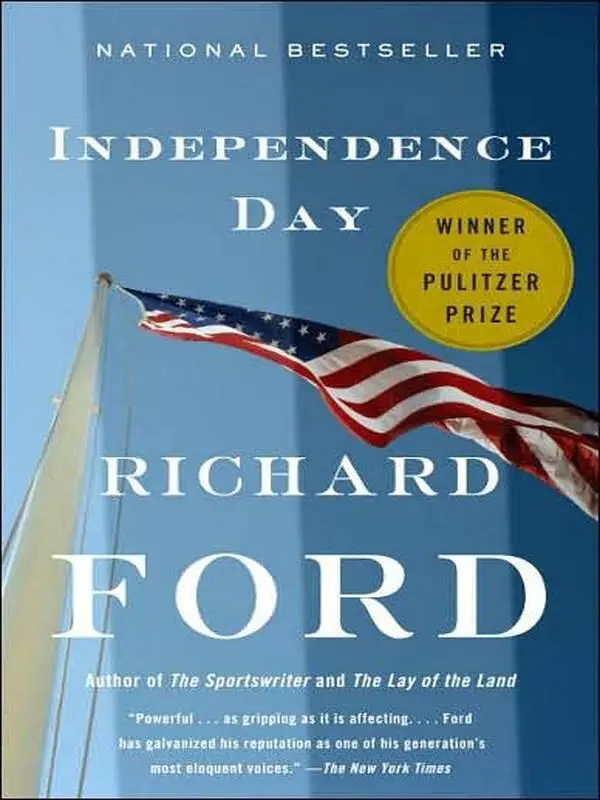
- Название:Independence Day
- Автор:
- Издательство:Vintage
- Жанр:
- Год:1996
- ISBN:нет данных
- Рейтинг книги:3 / 5. Голосов: 1
-
Избранное:Добавить в избранное
- Отзывы:
-
Ваша оценка:
Independence Day: краткое содержание, описание и аннотация
Предлагаем к чтению аннотацию, описание, краткое содержание или предисловие (зависит от того, что написал сам автор книги «Independence Day»). Если вы не нашли необходимую информацию о книге — напишите в комментариях, мы постараемся отыскать её.
, Richard Ford deepens his portrait of one of the most unforgettable characters in American fiction, and in so doing gives us an indelible portrait of America. Frank Bascombe, in the aftermath of his divorce and the ruin of his career, has entered an "Existence Period," selling real estate in Haddam, New Jersey, and mastering the high-wire act of normalcy. But over one Fourth of July weekend, Frank is called into sudden, bewildering engagement with life.
is a moving, peerlessly funny odyssey through America and through the layered consciousness of one of its most compelling literary incarnations, conducted by a novelist of astonishing empathy and perception.
Independence Day — читать онлайн бесплатно полную книгу (весь текст) целиком
Ниже представлен текст книги, разбитый по страницам. Система сохранения места последней прочитанной страницы, позволяет с удобством читать онлайн бесплатно книгу «Independence Day», без необходимости каждый раз заново искать на чём Вы остановились. Поставьте закладку, и сможете в любой момент перейти на страницу, на которой закончили чтение.
Интервал:
Закладка:
Paul has stashed his Walkman back in his bag and set his New Yorker on the dash, where it reflects distractingly in the windshield, but he has also grabbed up the slender green-jacketed Emerson off the back seat, where it’s been on top of my red REALTOR windbreaker, and begun giving it a look. This is better than I could’ve planned, though it’s clear he hasn’t cracked the copy I mailed him.
“Do you think you’d rather have a child with Down’s syndrome or a child with just regular mental illness?” he says, leafing casually backward through Self-Reliance as if it were Time .
“I’m pretty pleased with how you and Clarissa turned out. So I guess I’d rather have neither one.” A mental mug shot of the little feral Mongoloid back in Friendly’s hours ago opens a cruel vein of awareness that Paul may think he’s that or heading that way.
“Choose,” Paul says, still leafing. “Then give me your reasons.”
On the right, outside pretty little Federalist Milford, we cruise by the Corvette Hall of Fame, a shrine Paul, if he saw it, would vigorously insist on touring since, for reasons of Charley’s Old Greenwich tastes, he’s claimed the Corvette as his favorite car. (He likes them, he says, because they’ll melt.) Only he doesn’t see it because he’s looking through Emerson! (Plus, I’m now headed for the barn and a tall, stiff drink and an evening in a big wicker rocker made by native artisans working with local materials.)
“Ordinary mental illness, then,” I say. “You can sometimes cure that. Down’s syndrome you’re pretty much stuck with.”
Paul’s eyes, his mother’s slate-gray ones, flicker at me astutely, acknowledging something — I’m not certain what. “Sometimes,” he says in a dark voice.
“Do you still want to be a mime?” We have passed out along the little Susquehanna again — more postcard corn patches, blue and white silos, more snowmobile repairs.
“I didn’t want to be a mime. That was a joke at camp. I want to be a cartoonist. I just can’t draw.” He scratches his scalp with the warty side of his hand and sniffs, then makes a seemingly involuntary little eeeck noise back in his throat, grimaces, then stations both hands in front of his face, palms out, doing the man-in-the-glass-box and, looking over at me, still grimacing, silently mouthing “Help me, help me.” He then quits and immediately begins flipping Emerson pages backward again. “What’s this supposed to be about?” He stares down at the page he happens to have opened. “Is it a novel?”
“It’s a terrific book,” I say, uncertain how to promote it. “It’s got—“
“You’ve got a lot of things underlined in it,” Paul says. “You must’ve had it in college.” (A rare reference to my having had a life prior to his. For a boy in the clench of the past, he has little interest in life before his own. My or his mother’s family history, for instance, lack novelty. Not that I entirely blame him.)
“You’re welcome to read it.”
“Wel-come, welcome,” he says to mock me. “And that’s the way it is, Frank,” he says, reverting to his Cronkite voice again, staring down at Self-Reliance on his lap as though it interested him.
Then almost surprisingly we are on the south fringes of Cooperstown, coming in past a fenced sale lot packed with used speedboats, another lot with “bigfoot” trucks, a prim white Methodist church with a VACATION BIBLE SCHOOL sign, right in line with a smattering of neat, overpriced, Forties-vintage mom and pop motels with their lots already full of luggage-crammed sedans and station wagons. At the actual village limits sign, a big new billboard demands the passerby “Vote Yes!” However, I see no signs for the Deerslayer or the Hall of Fame, which simply means to me that Cooperstown doesn’t put its trust in celebrity or glamour but prefers standing on its own civic feet.
“‘The great man,’” Paul reads in a pseudo-reverent Charlton Heston voice, “‘is he who in the midst of the crowd keeps with perfect sweetness the independence of solitude.’ Blah, blah, blah, blah-blah, blah, blah. Glub, glub, glub. ‘The objection to conforming to usages that have become dead to you is that it scatters your force. It loses your time and blurs the impression of your character.’ Quack, quack, quack, quack. I am the great man, the grape man, the grapefruit, I am the fish stick—“
“To be great is usually to be misunderstood,” I say, watching traffic and looking for signs. “That’s a good line for you to remember. There’re some other good ones.”
“I’ve got enough things I remember already,” he says. “I’m drowning. Glub, glub, glub.” He raises his hands and makes swimming-drowning motions, then makes a quick, confidential eeeck like an old gate needing oiling, then grimaces again.
“Reading it’s good enough, then. There’s not going to be a test.”
“Test. Tests make me really mad,” Paul says, and suddenly with his dirty fingers rips out the page he’s just read from.
“Don’t do that!” I make a grab for it, crunching the green cover so that I dent its shiny paper. “You have to be a complete nitwit asshole to do that!” I stuff the book between my legs, though Paul still has the torn page and is folding it carefully into quarters. This qualifies as oppositional.
“I’ll keep it instead of remembering it.” He maintains his poise, while mine’s all lost. He sticks the folded page into his shorts pocket and looks out his window the other way. I am glaring at him. “I just took a page from your book.” He says this in his Heston voice. “Do you by the way see yourself as a complete failure?”
“At what?” I say bitterly. “And get this fucking New Yorker off the dashboard.” I grab it and wing it in the back. We’re now encountering increased vehicular traffic, entering shady little bendy-narrow village streets. Two paperboys sit side by side on a street corner, folding from stacks of afternoon papers. Outside, the air — which of course I can’t feel — looks cool and moist and inviting, though I’m sure it’s hot.
“At anything.” He makes his little eeeck sound far down his throat, as if I’m not supposed to hear it.
My chest feels emptied with outrage and regret (over a page in a book?), but I answer because I’m asked. “My marriage to your mother and your upbringing. These haven’t been the major accomplishments in my current term. Everything else is absolutely great, though.” I am gaunt with how little I want to be in the car alone with my son, only barely arrived upon the storied streets of our destination. My jaw has gone steely, my back aches again and the interior feels thick and airless, as if I’m being gassed by fearsome dread. I wish to a lonely, faraway and inattentive god that Sally Caldwell were in this car with us; or better yet, that Sally was here and Paul was back in Deep River, torturing birds, inflicting injuries and dispensing his smoky dread within the population there. (The Existence Period was patented to ward off such unwelcome feelings. Only it isn’t working.)
“Do you remember how old Mr. Toby would be if he hadn’t gotten run over?”
I’m just about to ask him if he’s been snuffing grackles for fun. “Thirteen, why?” My eyes are fast seeking any DEERSLAYER INN sign.
“That’s something I can’t quit thinking about,” he says for possibly the thirtieth time, as we come to the center-of-town intersection, where some kids dressed exactly like Paul are slouching delinquently on the corner curb, playing idiotic Hacky Sack right in among the passersby. Town seems to be a little brick and white-shuttered village, shaded by big scarlet oaks and hickories, all as charming and snappily tended to as a well-kept cemetery.
Читать дальшеИнтервал:
Закладка:
Похожие книги на «Independence Day»
Представляем Вашему вниманию похожие книги на «Independence Day» списком для выбора. Мы отобрали схожую по названию и смыслу литературу в надежде предоставить читателям больше вариантов отыскать новые, интересные, ещё непрочитанные произведения.

Обсуждение, отзывы о книге «Independence Day» и просто собственные мнения читателей. Оставьте ваши комментарии, напишите, что Вы думаете о произведении, его смысле или главных героях. Укажите что конкретно понравилось, а что нет, и почему Вы так считаете.