Richard Ford - Independence Day
Здесь есть возможность читать онлайн «Richard Ford - Independence Day» весь текст электронной книги совершенно бесплатно (целиком полную версию без сокращений). В некоторых случаях можно слушать аудио, скачать через торрент в формате fb2 и присутствует краткое содержание. Год выпуска: 1996, Издательство: Vintage, Жанр: Современная проза, на английском языке. Описание произведения, (предисловие) а так же отзывы посетителей доступны на портале библиотеки ЛибКат.
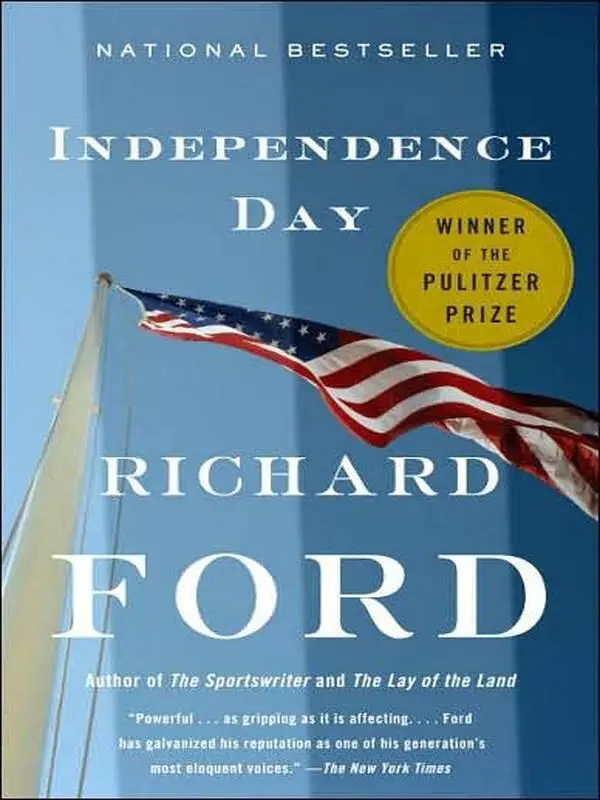
- Название:Independence Day
- Автор:
- Издательство:Vintage
- Жанр:
- Год:1996
- ISBN:нет данных
- Рейтинг книги:3 / 5. Голосов: 1
-
Избранное:Добавить в избранное
- Отзывы:
-
Ваша оценка:
Independence Day: краткое содержание, описание и аннотация
Предлагаем к чтению аннотацию, описание, краткое содержание или предисловие (зависит от того, что написал сам автор книги «Independence Day»). Если вы не нашли необходимую информацию о книге — напишите в комментариях, мы постараемся отыскать её.
, Richard Ford deepens his portrait of one of the most unforgettable characters in American fiction, and in so doing gives us an indelible portrait of America. Frank Bascombe, in the aftermath of his divorce and the ruin of his career, has entered an "Existence Period," selling real estate in Haddam, New Jersey, and mastering the high-wire act of normalcy. But over one Fourth of July weekend, Frank is called into sudden, bewildering engagement with life.
is a moving, peerlessly funny odyssey through America and through the layered consciousness of one of its most compelling literary incarnations, conducted by a novelist of astonishing empathy and perception.
Independence Day — читать онлайн бесплатно полную книгу (весь текст) целиком
Ниже представлен текст книги, разбитый по страницам. Система сохранения места последней прочитанной страницы, позволяет с удобством читать онлайн бесплатно книгу «Independence Day», без необходимости каждый раз заново искать на чём Вы остановились. Поставьте закладку, и сможете в любой момент перейти на страницу, на которой закончили чтение.
Интервал:
Закладка:
The conveyor moves him seemingly much more slowly than I myself was moved, and certainly leisurely enough to get off six or seven good shots and even to dribble before he shoots. The ball boy takes a casually demeaning look to where Paul is moving along in his garbage-pail shoes and sinister haircut, hands fixed oddly on his hips. He cracks a nasty grin, says something to his girlfriend so she’ll look, which she does, though in a kinder, more indulgent older-girl’s way at the goony boy who can’t help being goony but has a big heart and racks up top math scores (which he doesn’t).
When he comes to the end — having faced the baskets the whole way, never once looking at me, just staring into the little arena like a mesmerist, never taking a shot or even touching a ball, only gliding — he just wobbles off on the carpet and walks over and stands by me, where I’ve been watching like any other dad.
“High fives,” a straggler shouts in a ridiculing voice from the grandstand.
“Next time think about trying a shot,” I say, ignoring the shout, since I’m happy with his efforts.
“Are we coming back here anytime soon?” He looks at me, his small gray eyes showing concern.
“No,” I say. “You can come back with your son.” Another batch of adults is invading the bleachers, with more sons and daughters plus a few dads beginning to line up at the gate, checking out how the whole gizmo works, calculating the fun they’re about to have.
“I liked that,” Paul says, looking at the stage-lit posts and baskets. I hear the surprising voice of some boy he once was (seemingly only a month ago, now disappeared). “I’m thinking I’m thinking all the time, you know? Except when I was on that thing I quit. It was nice.”
“Maybe you should do it again,” I say, “before it gets crowded.” Unhappily, there’s no way for him to stay on The Shoot-Out for the rest of his days.
“No, that’s okay.” He’s watching new kids glide away from the gate, new balls arching into the vivid air, the first inevitable misses. “I don’t usually like things like that. This was an exception. I don’t usually like things I’m supposed to like.” He stares at the other kids empathetically. This cannot be a simple truth to admit to your father — that you don’t like the things you’re supposed to like. It is adult wisdom, though most grown men would fail of it.
“Your ole man isn’t very good at it either. If it makes you feel any better. He’d like to be. Maybe you can tell me what you liked about it that made you quit thinking you’re thinking.”
“You’re not that old.” Paul looks at me peevishly.
“Forty-four.”
“Umm,” he says — a thought possibly too fretsome to speak. “You could still improve.”
“I don’t know,” I say. “Your mother doesn’t think so.” This doesn’t qualify as a current event.
“Do you know the best airline?”
“No, let’s hear it.”
“Northwest,” Paul says seriously. “Because it flies to the Twin Cities of Minneapolis and Saint Paul.” And suddenly he’s trying to suppress a big guffaw. For some reason this is funny.
“Maybe I’ll take you out there sometime on a camping trip.” I watch basketballs fill the interior air like bubbles.
“Do they have a hall of fame in Minnesota?”
“Probably not.”
“Okay, good,” he says. “We can go anytime, then.”
O n our way out we make a fast foray through the gift boutique. Paul, at my instruction, picks out tiny gold basketball earrings for his sister and a plastic basketball paperweight for his mother — gifts he feels uncertain they’ll like, though I tell him they will. We discuss a rabbit’s foot with a basketball attached as an olive branch gesture for Charley, but Paul goes balky after staring at it a minute. “He has everything he wants,” he says grudgingly, without adding “including your wife and your kids.” So that after buying two tee-shirts for ourselves, we pass back out into the parking lot with Charley ungifted, which suits both of us perfectly.
On the asphalt it is full, hot Massachusetts afternoon. New cars have arrived. The river has gone ranker and more hazy. We’ve spent forty-five minutes in this hall of fame, which pleases me since we got our fill, exchanged words of hope, encountered specific subjects of immediate interest and concern (Paul thinking he’s thinking) and seem to have emerged a unit. A better start than I expected.
The big, jumpsuited Oklahoman is sprawled out with his tiny daughter under one of the linden saplings by the river’s retaining wall. They are enjoying their lunch from tinfoil packets spread on the ground, and drinking out of an Igloo cooler, using paper cups. He has his Keds and socks off and his pants rolled up like a farmer. Little Kristy is as pristine as an Easter present and talking to him in a confidential, animated way, wiggling one of his toes with her two hands while he stares at the sky. I’m tempted to wander over and offer a word of parting, talk to them twice because I’ve talked to them once, act as a better welcome committee for the Northeast Corridor, dream up some insider dope “I just thought about” and am glad to find him still here to share — something in the realty line. As always, I’m moved by the displacement woes of other Americans.
Only there’s nothing I know that he doesn’t (such is the nature of realty lore), and I decide against it and just stand at my car door and watch them respectfully — their backs to me, their modest picnic offering this big, panoramic, foreign-seeming river as comfort and company, all their hopes focused on a new settlement. Some people do nicely on their own and by the truest reckoning set themselves down where they’ll be happiest.
“Care to guess how hungry I am?” Paul says over the hot car roof, waiting for me to unlock his side. He is squinting in the sun, looking unsavory as a little perpetrator.
“Let’s see,” I say. “You were supposed to get us something from the fucking vending machines.” I say “fucking” just to amuse him. The freeway pounds along behind us — cars, vans, U-Hauls, buses — America on a move-in Saturday afternoon.
“I guess I just facked up,” he says to challenge me back. “But I could eat the asshole out of a dead Whopper.” An insolent leer further disfigures his pudgy kid’s features.
“Soup’d be better on an empty brain,” I say, and pop his door lock.
“Okay, doc-taaah! Doc-tah, doc-tah, doc-tah,” he says, snapping open his door and ducking in. I hear him bark in the car. “Bark, bark, bark, bark.” I don’t know what this is to signify: happiness (like a real dog)? Happiness’s defeat at the hands of uncertainty? Fear and hope, I seem to remember from someplace, are alike underneath.
From the linden tree shade, Kristy hears something in the afternoon breeze — a dog barking somewhere, my son in our car. She turns and looks toward me, puzzled. I wave at her, a fugitive wave her bumpkin father doesn’t see. Then I duck my own head into the hot-as-an-oven car with my son and we are on our way to Cooperstown.
A t one o’clock, we pull in for a pit stop, and I send Paul for a sack of Whalers and Diet Pepsis while I wash dead grackle off my hand in the men’s. And then we’re off spinning again down the pike, past the Appalachian Trail and through the lowly Berkshires, where not long ago Paul was a camper at Camp Unhappy, though he makes no mention of it now, so screwed down is he into his own woolly concerns — thinking he’s thinking, silently barking, his penis possibly tingling.
After a half hour of breathing Paul’s sour-meat odor, I make a suggestion that he take off his Happiness Is Being Single shirt and put on his new one for a change of scenery and as an emblematic suiting-up for the trip. And to my surprise he agrees, skinning the old fouled one off right in the seat, unabashedly exposing his untanned, unhairy and surprisingly jiggly torso. (Possibly he’ll be a big fatty, unlike Ann or me; though it doesn’t make any difference if he will simply live past fifteen.)
Читать дальшеИнтервал:
Закладка:
Похожие книги на «Independence Day»
Представляем Вашему вниманию похожие книги на «Independence Day» списком для выбора. Мы отобрали схожую по названию и смыслу литературу в надежде предоставить читателям больше вариантов отыскать новые, интересные, ещё непрочитанные произведения.

Обсуждение, отзывы о книге «Independence Day» и просто собственные мнения читателей. Оставьте ваши комментарии, напишите, что Вы думаете о произведении, его смысле или главных героях. Укажите что конкретно понравилось, а что нет, и почему Вы так считаете.