Richard Ford - Independence Day
Здесь есть возможность читать онлайн «Richard Ford - Independence Day» весь текст электронной книги совершенно бесплатно (целиком полную версию без сокращений). В некоторых случаях можно слушать аудио, скачать через торрент в формате fb2 и присутствует краткое содержание. Год выпуска: 1996, Издательство: Vintage, Жанр: Современная проза, на английском языке. Описание произведения, (предисловие) а так же отзывы посетителей доступны на портале библиотеки ЛибКат.
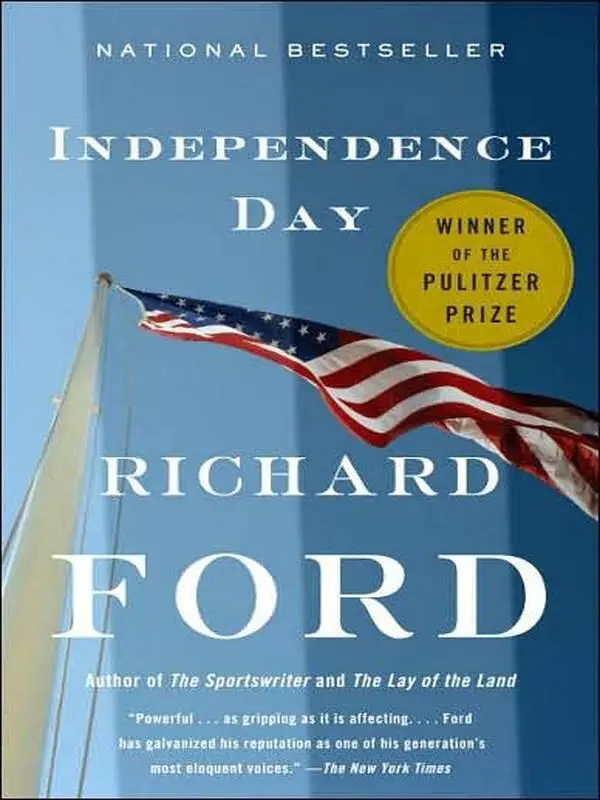
- Название:Independence Day
- Автор:
- Издательство:Vintage
- Жанр:
- Год:1996
- ISBN:нет данных
- Рейтинг книги:3 / 5. Голосов: 1
-
Избранное:Добавить в избранное
- Отзывы:
-
Ваша оценка:
Independence Day: краткое содержание, описание и аннотация
Предлагаем к чтению аннотацию, описание, краткое содержание или предисловие (зависит от того, что написал сам автор книги «Independence Day»). Если вы не нашли необходимую информацию о книге — напишите в комментариях, мы постараемся отыскать её.
, Richard Ford deepens his portrait of one of the most unforgettable characters in American fiction, and in so doing gives us an indelible portrait of America. Frank Bascombe, in the aftermath of his divorce and the ruin of his career, has entered an "Existence Period," selling real estate in Haddam, New Jersey, and mastering the high-wire act of normalcy. But over one Fourth of July weekend, Frank is called into sudden, bewildering engagement with life.
is a moving, peerlessly funny odyssey through America and through the layered consciousness of one of its most compelling literary incarnations, conducted by a novelist of astonishing empathy and perception.
Independence Day — читать онлайн бесплатно полную книгу (весь текст) целиком
Ниже представлен текст книги, разбитый по страницам. Система сохранения места последней прочитанной страницы, позволяет с удобством читать онлайн бесплатно книгу «Independence Day», без необходимости каждый раз заново искать на чём Вы остановились. Поставьте закладку, и сможете в любой момент перейти на страницу, на которой закончили чтение.
Интервал:
Закладка:
But almost the instant we’re south of Albany and out of sight of its unlovely civic skyscrapers, all vistas turn wondrous and swoopingly dramatic and as literary and history-soaked as anything in England or France. A sign by a turnout announces we have now entered the CENTRAL LEATHERSTOCKING AREA, and just beyond, as if on cue, the great corrugated glacial trough widens out for miles to the southwest as the highway climbs, and the butt ends of the Catskills cast swart afternoon shadows onto lower hills dotted by pocket quarries, tiny hamlets and pristine farmsteads with wind machines whirring to undetectable winds. Everything out ahead suddenly says, “A helluva massive continent lies this way, pal, so you better be mindful.” (It’s the perfect landscape for a not very good novel, and I’m sorry I didn’t bring my four-in-one Cooper to read aloud after dinner and once we’re staked out on the porch. It would beat being taunted about Doctor Zhivago.)
In my official view, absolutely nothing should be missed from here on, geography offering a natural corroboration to Emerson’s view that power resides in moments of transition, in “shooting the gulf, in darting to an aim.” Paul could do himself a heap of good to set aside his New Yorker and try contemplating his own status in these useful terms: transition, jettisoning the past. “Life only avails, not having lived.” I should’ve bought a tape of it and not a book.
But he’s locked down in a bit-lip sound cocoon of “Two sweethearts in the summer wind,” and reading “Talk of the Town” with his lips moving, and couldn’t give a sweet rat’s fart about what interesting movie’s playing outside his window. Traveling is finally a fool’s paradise.
I make a brief scenic turnout below Cobleskill to stretch my back (my coccyx has now begun aching). Leaving Paul in the seat, I climb out into the little breezy lot and walk to the sandstone parapet beyond which the luminous Pleistocene valley leaps out stark and vast and green and brown-peaked with the animal grandeur of an inland empire any bona fide pioneer would’ve quaked before trying to tame. I actually climb onto the wall and take several deep clean breaths, do several strenuous jumping jacks and squat thrusts, touch my toes, pop my fingers, rotate my neck as the sweet odors float in on the watery air. Beyond me hawks soar, martins dip, a tiny airplane buzzes, a distant hang glider like a dragonfly wheels and sways in the rising molecules. A door in a far-off, invisible house slams audibly shut, a car horn blows, a dog barks. And visible on the hillside opposite, where the sun paints a yellow square upon the western gradient, a tractor, tiny but detectably red, halts its progress in an emerald field; a tiny, hatted figure climbs down, pauses, then starts on foot back up the hill he’s tractored down. He moves for a long, slow ways above and away from his machine, turns and goes a distance along a curved rim top, then resolutely, undramatically goes over, disappears at his own pace to whatever world’s beyond. It is a fine moment to savor, even alone, though I wish my son could break loose and share it. You can lead a horse to water, but you can’t make him sing opera.
I stand and stare a while at nothing in particular, my exercise ended, my back loosened, my son entombed in the car reading a magazine. The yellow square begins gradually to fade on the opposite hillside, then moves mysteriously left, darkens the green hayfield instead of lighting it, and I decide — satisfied and palpably enlivened — to pack it in.
Somebody has left a plastic bag of Styrofoam “popcorn” half out of the trash can — the pale-green kernels that Christmas wreaths or your repaired Orvis reel comes boxed in. A new warm afternoon breeze is shifting wispy kernels here and there around the lot. I stop before climbing in to jam the bag down farther and to police up what bits I can with two hands.
Paul looks up from his New Yorker and stares at me where I’m tidying up the asphalt around the car. I merely look back at him from my side of the window, my hands full of clingy green stuff. He fingers his cut ear under his Walkman, blinks, then slowly makes his fingers into a pistol, points it at his temple, produces a silent little “boom” sound with his lips, throws his head back in terrible mock death, then goes back to reading. It’s scary. Anyone would think so. Especially a father. But it’s also funny as hell. He is not so bad a boy.
S hort-term destinations are by far the best.
Paul and I skirt the outskirts of Oneonta a little past five, turn north on Route 28 along the newly rose Susquehanna, and in truth are almost there. (Geography, while instructive, is also the Northeast’s soundest selling point and best-kept secret, since in three hours you can stand on the lapping shores of Long Island Sound, staring like Jay Gatz at a beacon light that lures you to, or away from, your fate; yet in three hours you can be heading for cocktails damn near where old Natty drew first blood — the two locales as unalike as Seattle is to Waco.)
Route 28 takes a pretty hickory-and-maple-shaded course straight upriver through tiny postcard villages, past farms, woodlots and single-family roadside split-levels and ranches. Here is a cut-ur-own Xmas tree lot, a pick-ur-own raspberry patch and apple orchard, a second-echelon B&B tucked into a hillside sugarbush; an attack-dog academy, an ugly clear-cut bordered by a low-yield hay meadow with Guernsey cows grazing to the edge of a gravel pit.
Here you’d expect to find no planning boards, PUDs, finicky building codes, septic standards, sidewalk ordinances or ridgetop laws; just an as yet unspoilt place to site your summer cabin or mobile home where and exactly how you want it, right down the road from a good Guinea restaurant, with its own marinara and Genesee on tap, and where a 10 a.m. night owl’s mass is still celebrated Sundays at St. Joe’s in Milford. It’s the perfect mix, in other words, of small-scale Vermont atmospherics with unpretentious, upstate hardscrabble, all an afternoon’s drive from the G.W. Bridge. (Dark rumors may now and then surface that it’s also a prime location for big-city muscle to off-load their mistakes, but no place is without a downside.)
Meanwhile, my spirits have taken a strong upward turn and I’d now like to try hauling Paul into a planned off-the-cuff give-and-take squarely on the notion of Independence Day itself, and to point out that the holiday isn’t just a moth-bit old relic-joke with men dressed up like Uncle Sam and harem guards on hogs doing circles within circles in shopping-mall lots; but in fact it’s an observance of human possibility, which applies a canny pressure on each of us to contemplate what we’re dependent on (barking in honor of dead basset hounds, thinking we’re thinking, penis tingling, etc.) and after that to consider in what ways we’re independent or might be; and finally how we might decide — for the general good — not to worry about it much at all.
This may be the only way an as-needed parent can in good faith make contact with his son’s life problems; which is to say sidereally, by raising a canopy of useful postulates above him like stars and hoping he’ll connect them up to his own sightings and views like an astronomer. Anything more purely parental — wading in and doing some stern stable-cleaning about stealing rubbers, wrecking cars, kicking security personnel, braining stepfathers (who might even deserve it), torturing innocent birds, eventually hauling up his court appearance and how that might correlate inversely with coming to Haddam to live with me and after that with his chances of ever getting into Williams on a “need scholarship”—simply wouldn’t work. In the dizzyingly brief time we have together, he would only retreat into raucous barking, furtive smiles and sullener silences, ending up with me in a fury and in all likelihood ferrying him back to Deep River, feeling myself to be (and being) a ruinous failure. I don’t, after all, know what’s wrong him, am not even certain anything is, or that wrong isn’t just a metaphor for something else, which may itself already be a metaphor. Though probably what’s amiss, if anything, is not much different from what’s indistinctly amiss with all of us at one time or another — we’re not happy, we don’t know why, and we drive ourselves loony trying to get better.
Читать дальшеИнтервал:
Закладка:
Похожие книги на «Independence Day»
Представляем Вашему вниманию похожие книги на «Independence Day» списком для выбора. Мы отобрали схожую по названию и смыслу литературу в надежде предоставить читателям больше вариантов отыскать новые, интересные, ещё непрочитанные произведения.

Обсуждение, отзывы о книге «Independence Day» и просто собственные мнения читателей. Оставьте ваши комментарии, напишите, что Вы думаете о произведении, его смысле или главных героях. Укажите что конкретно понравилось, а что нет, и почему Вы так считаете.