Richard Ford - Independence Day
Здесь есть возможность читать онлайн «Richard Ford - Independence Day» весь текст электронной книги совершенно бесплатно (целиком полную версию без сокращений). В некоторых случаях можно слушать аудио, скачать через торрент в формате fb2 и присутствует краткое содержание. Год выпуска: 1996, Издательство: Vintage, Жанр: Современная проза, на английском языке. Описание произведения, (предисловие) а так же отзывы посетителей доступны на портале библиотеки ЛибКат.
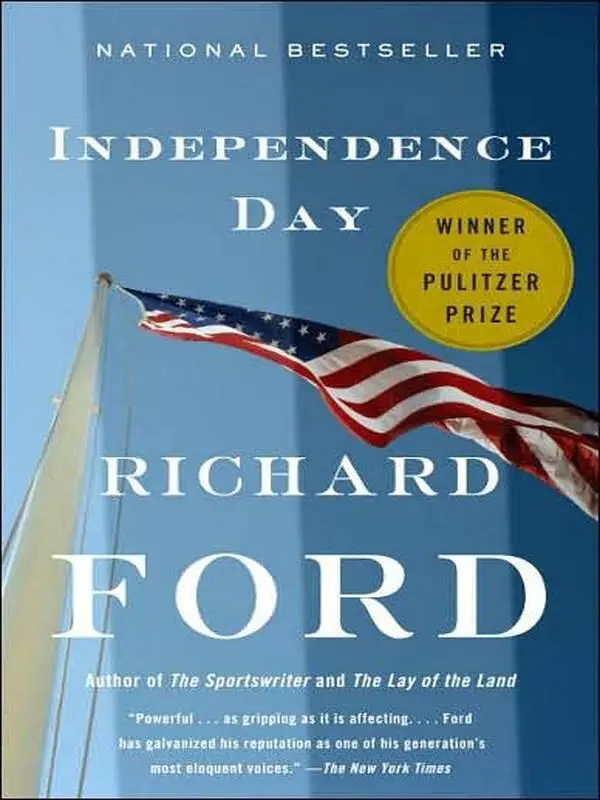
- Название:Independence Day
- Автор:
- Издательство:Vintage
- Жанр:
- Год:1996
- ISBN:нет данных
- Рейтинг книги:3 / 5. Голосов: 1
-
Избранное:Добавить в избранное
- Отзывы:
-
Ваша оценка:
Independence Day: краткое содержание, описание и аннотация
Предлагаем к чтению аннотацию, описание, краткое содержание или предисловие (зависит от того, что написал сам автор книги «Independence Day»). Если вы не нашли необходимую информацию о книге — напишите в комментариях, мы постараемся отыскать её.
, Richard Ford deepens his portrait of one of the most unforgettable characters in American fiction, and in so doing gives us an indelible portrait of America. Frank Bascombe, in the aftermath of his divorce and the ruin of his career, has entered an "Existence Period," selling real estate in Haddam, New Jersey, and mastering the high-wire act of normalcy. But over one Fourth of July weekend, Frank is called into sudden, bewildering engagement with life.
is a moving, peerlessly funny odyssey through America and through the layered consciousness of one of its most compelling literary incarnations, conducted by a novelist of astonishing empathy and perception.
Independence Day — читать онлайн бесплатно полную книгу (весь текст) целиком
Ниже представлен текст книги, разбитый по страницам. Система сохранения места последней прочитанной страницы, позволяет с удобством читать онлайн бесплатно книгу «Independence Day», без необходимости каждый раз заново искать на чём Вы остановились. Поставьте закладку, и сможете в любой момент перейти на страницу, на которой закончили чтение.
Интервал:
Закладка:
Downstairs there’s a long, slumberous living room with ancient-smelling slipcovered couches, a scabbed-up old Kimball spinet, a “take one, leave one” library, with dinner served in the shadowy dining room between 5:30 and 7:00 (“No late diners please!”). There is, however and unfortunately, no bar, no complimentary cocktails, no canapés, no TV. (I have embellished it some, but who could blame me?) And yet it still seems to me a perfect place where a man can sleep with a teenage boy in his room and arouse no suspicions.
Drinkless, then, I stretch out on the too-soft mattress while Paul goes “exploring.” I relax my jaw sinews, twist my back a little, unlimber my toes in the table-fan breeze and wait to let sleep steal upon me like a bushman out of the twilight. To this end I again braid together new nonsense components, which seep into my mind like anesthesia. We better dust off our Sally Caldwell … I’m sorry I drove your erection you putz … Phogg Allen, the long face … eat your face … You musta been a beautiful Doctor Zhivago, you stranger in the Susquehanna … And I’m gone off into tunneling darkness before I can even welcome it.
And then, sooner than I wanted, I’m emerged — lushly, my head spinning in darkness, alone, my son nowhere near me.
For a time I lie still, as a cool lake breeze circulates thickly around the spruce and elms and into the room through the soft fan whir. Somewhere nearby a bug zapper toasts one after another of the big north-woods Sabre-jet mosquitoes, and above me on the ceiling a smoke detector beams its little red-eye signal out of the dark.
Floors below I hear fork and plate noises, chairs scraping, muffled laughter followed by footfalls trudging up the stairs past my door, the sound of a door closing and soon a toilet-flush — water skittering, splashing through pipes. Then the door reopens and more heavy footfalls fade into night.
Through a wall I hear someone sawin’ ’em off just the way I must’ve been — stertorous, diligent, thorough-sounding breaths. Someone’s playing “Inchworm” on the spinet. I hear a car door open in the gravel lot below my window — the muffled ping, ping, ping of the interior “door open” bell — then a man and a woman talking in low voices, affectionately. “It’s dirt cheap here, really,” the male says in a whisper, as if others needed to be kept in the dark.
“Yeah, but then what?” the female says, and giggles. “What would we do?”
“What d’ya do anywhere?” he says. “Go fishing, play golf, eat dinner, fuck your wife. Just like home.”
“I choose window number four,” she says. “There’s not enough of that back home.” She giggles again. Then thump, the trunk is slammed; chirp, a car alarm activated; crunch, their feet cross the gravel headed toward the lake. They are talking houses. I know. Tomorrow they’ll do some window-browsing, check with an agent, look through some listing books, see one house, maybe two, to get a feel, discuss a feasible “down,” then wander dreamily off down Main Street and never think one thought of it again. Not that it’s always that way. Some guys write out whopper checks, ship their furnishings, establish whole new lives in two weeks — and then think better of it all, after which they list the house again with the same realtor, take a beating on the carrying charges, shell out a penalty for early pay-off, and in this way, in the process of mistake and correction, the economy remains vibrant. In that sense real estate is not about finding your dream house but getting rid of it.
I give a wistful thought to Paul and wonder where he could be in a strange but peril-free town after dark. Possibly he and the Hacky Sack gang from Main and Chestnut have forged lifelong bonds and removed to a dingy diner for cottage fries, waffles and burgers at his expense. He may, after all, lack precise peer grouping in Deep River — where everyone’s at least old enough to be an adult. In Haddam he’ll do better.
“Jeepers,” I hear someone — a woman’s nasally voice say, mounting the creaky stairs to floor three. “I told Mark”—Merk—“why can’t she just move to the Cities, where we can keep an eye on her, then Dad won’t have to drive so far for his dialysis? He’s completely helpless without her.”
“So then what’d Mark say to that?” another woman’s equally nasally voice says without true interest — heavy treading down the hall away from my door.
“Oh, you know Mark. He’s such a clod.” A key in a lock, a door opening back. “He didn’t say too much.” Slam.
S ince I have napped in my clothes (an irresistible luxury), I change only my shirt, slip on shoes, stretch my spine backward and forward, tramp woozily down to the communal bathroom for a visit and a face washing, then amble downstairs to have a look at things, locate Paul and get a tip on dinner; I’ve by now missed the inn’s: spaghetti, salad, garlic bread, tapioca, all highly praised on the “Weekly Score Card” left on my dressertop (“Mmmmmm,” one penciled-in comment by a previous guest).
In the long, brown-carpeted parlor all the old parchment lamps are burning cheerily and several guests are engrossed in gin games or Clue or reading newspapers or books out of the library, but saying little. A too-strong cinnamon candle is somewhere smoldering, and above the cold fireplace hangs a shadowy six-foot-tall portrait of a man in full leather gear with a silly, compromised expression on his U-shaped face. This is the Deerslayer himself. A big, elderly, long-eared, ham-handed Swede-looking guy is yakking away to a Japanese man in confidential tones about “invasive surgeries” and the extremes he’d be willing to suffer to avoid them. And across the room a horsey, middle-aged southern-sounding woman in a red-and-white polka-dot dress is seated at the piano, talking too loudly to another woman, in a foam neck brace. The polka-dot woman’s eyes roam the long room, wanting to know who might be listening and being wildly entertained by what she’s yammering about, which is whether you can ever trust a handsome man married to a not-so-pretty woman. “Clampin’ a big padlock on my china cabinet’d be my first official move,” she says in a loud voice. She spies me in the doorway contentedly watching the tableau of easygoing inn life (exactly how any prospective proprietor would fantasize it: every room filled, everybody’s credit card slip salted away in the safe, no refunds offered, everybody in bed by ten). Her eyes snap at me. She offers me a long-toothed, savage stare and waves my way as if she knew me from Bogalusa or Minter City — maybe she simply recognizes a fellow southerner (something in the submissive, shruggy set of my shoulders). “Hey, you! All right! Come on down here, I see you,” she shouts toward the door, rings flashing, bracelets banging, dentures a-twinkle. I wave good-naturedly, but fearing I’ll end up piano-side having my brains turned to suet, I step discreetly back and out of the doorway, then hustle down the front under-the-stairs hallway to make some calls.
I would certainly like to call Sally and should call for messages. The Markhams could’ve come back from around the bend, and there might be an all-clear from Karl. These subjects have blessedly slipped my mind for several hours, but I haven’t noticed much relief in the bargain.
Someone (no doubt the old southern number) has begun playing “Lullaby of Birdland” at a slow, lugubrious pace, so that the whole atmosphere on floor one suddenly feels calculated to drive everyone to bed.
I wait for messages, staring at a diagram illustrating the five steps that will save someone from choking, and fingering a stack of pink tickets from a dinner theater in Susquehanna, PA. Annie Get Your Gun is playing this very night, and the stack of playbills on the telephone table rings with the critics’ kudos: “Everybody’s first rate”—Binghamton Press & Sun Bulletin; “Move over ‘Cats’ “—Scranton Times; “This baby’s got legs under her”—Cooperstown Republican . I can’t help conjuring up Sally’s review: “My team of death’s-door opening-nighters simply couldn’t get enough of it. We laughed, we cried, we damn near died”— Curtain Call Newsletter .
Читать дальшеИнтервал:
Закладка:
Похожие книги на «Independence Day»
Представляем Вашему вниманию похожие книги на «Independence Day» списком для выбора. Мы отобрали схожую по названию и смыслу литературу в надежде предоставить читателям больше вариантов отыскать новые, интересные, ещё непрочитанные произведения.






Обсуждение, отзывы о книге «Independence Day» и просто собственные мнения читателей. Оставьте ваши комментарии, напишите, что Вы думаете о произведении, его смысле или главных героях. Укажите что конкретно понравилось, а что нет, и почему Вы так считаете.