Adam Levin - The Instructions
Здесь есть возможность читать онлайн «Adam Levin - The Instructions» весь текст электронной книги совершенно бесплатно (целиком полную версию без сокращений). В некоторых случаях можно слушать аудио, скачать через торрент в формате fb2 и присутствует краткое содержание. Год выпуска: 2011, Издательство: Perseus Books Group, Жанр: Современная проза, на английском языке. Описание произведения, (предисловие) а так же отзывы посетителей доступны на портале библиотеки ЛибКат.
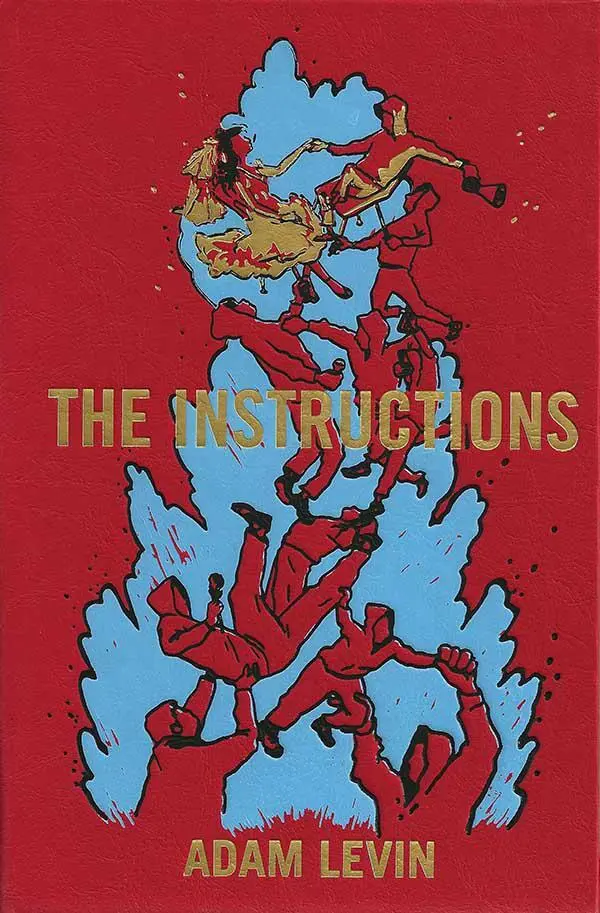
- Название:The Instructions
- Автор:
- Издательство:Perseus Books Group
- Жанр:
- Год:2011
- ISBN:нет данных
- Рейтинг книги:3 / 5. Голосов: 1
-
Избранное:Добавить в избранное
- Отзывы:
-
Ваша оценка:
The Instructions: краткое содержание, описание и аннотация
Предлагаем к чтению аннотацию, описание, краткое содержание или предисловие (зависит от того, что написал сам автор книги «The Instructions»). Если вы не нашли необходимую информацию о книге — напишите в комментариях, мы постараемся отыскать её.
The Instructions
The Instructions — читать онлайн бесплатно полную книгу (весь текст) целиком
Ниже представлен текст книги, разбитый по страницам. Система сохранения места последней прочитанной страницы, позволяет с удобством читать онлайн бесплатно книгу «The Instructions», без необходимости каждый раз заново искать на чём Вы остановились. Поставьте закладку, и сможете в любой момент перейти на страницу, на которой закончили чтение.
Интервал:
Закладка:
Kinneret said, “Gurion, do you know how to play sheishbeish?” Sheishbeish is backgammon, and Kinneret was the kindest and eldest of the Rabbi’s seven daughters. She had purple eyes and always bit her lip while squinting at me nicely from across the table at dinner whenever I asked Esther to pass me food and got ignored.
A little, I told her. I’ve played a couple times.
“Have you played with the cube?”
What cube? I said.
“What cube?” mumbled Esther, eyes on the board. “The doubling cube,” she mumbled. “It’s only half the game.” She was talking to herself as if she didn’t really want to say anything, as if not knowing about the doubling cube was so stupid to her that no matter how hard she tried, she couldn’t hold the contempt back — like the contempt was so fierce that it was able to force its way out of her mouth against her will.
“I know the cube!” Ayelet said. She didn’t say it mean, though — she said it excited and, right after she said it, she touched her right cheek to her right shoulder and made a pop-eyed crazyface and a hissing sound. Ayelet was seven, and very shy, and that was what she’d do when her voice came out louder than she’d planned. Esther used to do the crazyface hissing, too, but not because she’d been loud — Esther was never loud. She’d do it whenever we were alone, staring at each other and saying nothing, wondering what we were supposed to do next, which would have been kiss if she wasn’t Hasidic.
“When you play with the doubling cube,” said Kinneret, “you can form strategies of intimidation. Do you want to learn?”
“It’s fun,” said Ayelet.
“There’s no time to teach about the doubling cube,” said Esther. Teach about— she wouldn’t even put the him between the words. “Ema said five minutes til dinner.”
“Ema said ten minutes,” said Ayelet.
“Yes,” said Esther. “She said ten five minutes ago.”
“Ten means twenty when it’s dinner, anyway,” said Kinneret, and then she taught me about the doubling cube, and I saw that Esther was right — it was half the game. At the beginning, the cube didn’t belong to anyone, and either of the players could pick it up and use it. You used it to double the stakes. The best time was when you were at a slight advantage. If your opponent accepted the double you offered, the cube belonged to her, unless she decided to re-double. If she decided to redouble and you accepted, the cube became yours again. If at any point a double was offered and the player it was offered to didn’t take it, that player had to forfeit the game. I liked the cube.
We had dinner.
“She said ten five minutes ago,” was the last thing Esther had said that evening, one week earlier, six days before I fell in love with June.
I arrived at the stoop before I could decide which kind of love was truer. I arrived at the stoop and saw Esther looked pretty — Portman-pretty, not Mathilda-pretty — and I saw that the truer love was the kind where you don’t want to be with any other girls even when they’re pretty like Natalie Portman.
Because Esther had already called me the night before and I didn’t care anymore whether she wanted to get back together, I started a conversation with her. I said, You’re shivering.
“I’m cold,” she said.
I said, Why aren’t you wearing a jacket?
She said, “Can I wear yours?”
What’s wrong with yours? I said, taking mine off.
“It’s inside,” she said.
I said, Why don’t you just get it? I said, I’ll get it for you. I said, Wear this while I get it.
I held my jacket out to her.
“Why are you so mean to me?” she said.
Mean what? I said. I just offered to get your jacket for you, I said. And I offered to let you wear my jacket while I got yours. I said, Why don’t you just wear my jacket?
I blinkered my jacket.
“I can get my own jacket,” she said, leaving me holding my jacket out for no one.
I waited a minute for Esther to return before giving up and going inside. I hung my jacket on the coat tree.
Rabbi Salt sat at his table in the study, poring over Zohar. “You too, Gurion?” he said. I thought of the loss of faith in me he’d revealed in his letter to Brodsky, but then he rose and squeezed my shoulders and by the time he’d let go, the thought had disappeared. And that’s how I preferred it, for everything between us to be as it seemed. “I’m asking you,” he said. “Have you been conspiring with my wife? Are you being used? It only takes two, you know — a conspiracy — and she’s already got my doctor in her pocket. She wants to make a conspiracy, she doesn’t need you , boychic. So what? Is she trying to make a patsy of you? Does she think she can make of Gurion Maccabee a patsy? How dare she even.”
I didn’t know what he was talking about, but he wanted a straightman, so I played one.
I said, I’m no patsy!
“And the coffee?” he said.
Usually I brought a carafe to the study with me, but on the way to the study I’d heard Esther in the kitchen and skipped it.
I don’t know from nothing about no coffee, I said.
“Exactly,” said the Rabbi.
That was the end of the routine.
The Rabbi said, “Seriously — do you not want any coffee? I tell my wife I drink coffee with you so late in the day because it would be rude to leave you drinking it by yourself, and that used to be true — that used to be why I drank coffee so late, but now, come Wednesday at six-thirty, I find that I hanker for coffee. It’s like the story of the Shabbos Non-Smoker, but in reverse… You know that story?”
Yes, I said.
“Yes you want coffee or yes you know the story?”
Both, I said.
“Let me hear you tell it,” he said. “In the kitchen.”
We went to the kitchen for coffee, and Esther was at the counter eating grapes. Her father said, “What a nice-looking bunch of grapes.”
“Try one,” she said. She plucked a single grape from the bunch, handed it to him, then went to the living room with the rest.
“Do you want it?” said Rabbi Salt.
No, I said. Then we fixed coffee and I told him the story he’d asked for:
The Shabbos Non-Smoker was a Hasidic tzadik who smoked two packs a day, except on Shabbos, when he smoked no packs a day, because lighting fires is a kind of work and working breaks the Sabbath. Because the man never smoked on Shabbos, he never craved nicotine on Shabbos. One day he was arrested in Eastern Europe. He was held alone in a basement cell for years, awaiting execution. Every so often, a guard would bring him his meals, but none of the guards would tell him what time it was, let alone what day. The guards wouldn’t speak to him at all. To stay sane while awaiting his execution, he needed faith, but to maintain faith he needed to observe the Sabbath. To observe the Sabbath, he needed to first know when it was, and because he didn’t crave cigarettes on Shabbos, he knew when it was, so he stayed sane til they hung him.
The story was a bobe-mayse, but it got told a lot. There were two different, conflicting, points the storyteller could use the story to make. The first point was that the Sabbath is one of the greatest gifts Adonai gives us, and we should never forget it — that even while you await execution, the Sabbath, if you honor it, will provide you with a level of peace and dignity that you couldn’t otherwise experience.
The second point the story could be used to make is that it’s foolish, possibly even sinful, to place the Sabbath, or any religious practice, ahead of your life — the storyteller who wants to make this point stresses that the Shabbos Non-Smoker was executed despite keeping the Sabbath; that had the man not been so faithful to the Sabbath, peace would not have come upon him; that had peace not come upon him, he might have taken a guard out and tried to escape, which would have, even if the escape were unsuccesful, at least depleted the number of enemies of Israel. The implications of this second point are that it is not sane to strive for the kind of sanity that will allow you to await your own execution peacefully; that if faith brings you peace and comfort, you’re a sucker — that you must struggle to make sense of faith; that Adonai would prefer killing you Himself to having you die at the hands of men, and that he wants you to fight for the privilege to be killed by Him; that to risk likely death at the hands of men in order to save yourself from assured death at the hands of men is to act the way Adonai wants you to act — that He will like you better if you risk your life to save your life, and He will therefore be more likely to help you if you do so.
Читать дальшеИнтервал:
Закладка:
Похожие книги на «The Instructions»
Представляем Вашему вниманию похожие книги на «The Instructions» списком для выбора. Мы отобрали схожую по названию и смыслу литературу в надежде предоставить читателям больше вариантов отыскать новые, интересные, ещё непрочитанные произведения.











Обсуждение, отзывы о книге «The Instructions» и просто собственные мнения читателей. Оставьте ваши комментарии, напишите, что Вы думаете о произведении, его смысле или главных героях. Укажите что конкретно понравилось, а что нет, и почему Вы так считаете.