Adam Levin - The Instructions
Здесь есть возможность читать онлайн «Adam Levin - The Instructions» весь текст электронной книги совершенно бесплатно (целиком полную версию без сокращений). В некоторых случаях можно слушать аудио, скачать через торрент в формате fb2 и присутствует краткое содержание. Год выпуска: 2011, Издательство: Perseus Books Group, Жанр: Современная проза, на английском языке. Описание произведения, (предисловие) а так же отзывы посетителей доступны на портале библиотеки ЛибКат.
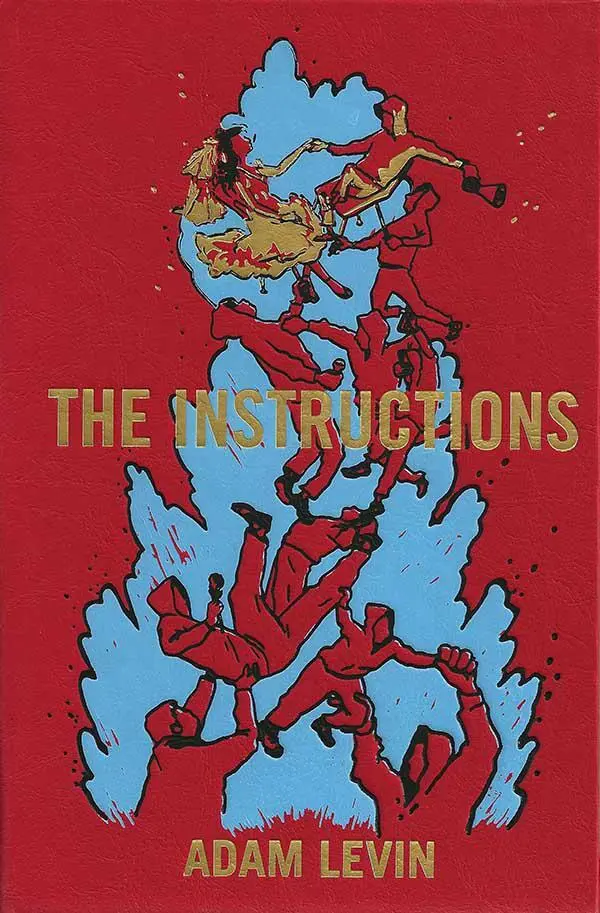
- Название:The Instructions
- Автор:
- Издательство:Perseus Books Group
- Жанр:
- Год:2011
- ISBN:нет данных
- Рейтинг книги:3 / 5. Голосов: 1
-
Избранное:Добавить в избранное
- Отзывы:
-
Ваша оценка:
The Instructions: краткое содержание, описание и аннотация
Предлагаем к чтению аннотацию, описание, краткое содержание или предисловие (зависит от того, что написал сам автор книги «The Instructions»). Если вы не нашли необходимую информацию о книге — напишите в комментариях, мы постараемся отыскать её.
The Instructions
The Instructions — читать онлайн бесплатно полную книгу (весь текст) целиком
Ниже представлен текст книги, разбитый по страницам. Система сохранения места последней прочитанной страницы, позволяет с удобством читать онлайн бесплатно книгу «The Instructions», без необходимости каждый раз заново искать на чём Вы остановились. Поставьте закладку, и сможете в любой момент перейти на страницу, на которой закончили чтение.
Интервал:
Закладка:
The anchor said, “Inside the courthouse, however, things weren’t so calm,” and three drawings appeared onscreen for a few seconds each — the first of a group of white-haired audience members on their feet, their mouths open wide, their fists in the air, while my father, in the corner of the drawing, leans on the jurybox, hanging his head (“Here we see an artist’s rendition of Judah Maccabee being shouted down during closing arguments by a group of several elderly Jewish protesters,” narrated the anchor); the second drawing was of the frowning judge banging his gavel (“…our artist’s rendition of the Honorable Michael Hall calling for order”); and the third was of the shouters being led out of the courtroom in zip-tie handcuffs (“…officers arresting the protesters on contempt-of-court charges…”).
The screen switched. It showed a pair of vans, cops holding the doors open.
Flowers said, “Whoah. This not exactly common.”
The anchor was saying, “…live broadcast of the jurors boarding — are we allowed to show this? Well… What you’re seeing is a rare, live broadcast of the jurors boarding the vehicles that will return them to their motel, where they’ll deliberate the fate of Patrick Drucker and his pamphlets.” Approaching the van, the jurors hunched their shoulders and turned their faces from the camera like red-handed felons. “Good luck to them,” said the anchor. “We’ll return with the weather.”
Flowers hit the POWER button just as a used car commercial started jingling.
“You dad gonna win,” he said, “and quickfast.”
I said, Those jurors didn’t look happy.
“You wouldn’t look happy neither, you had to hand down a verdict favor Drucker.”
So why do you look happy? I said. It came out of me like an accusation. I wasn’t pissed at Flowers, but the way I asked the question, it seemed like I was. Who I was pissed at was Adonai for making men who hated Israelites, and at the Israelites for hating my father, and at my father for defending men who hated Israelites. Why was the world always uniting against the Israelites? Why were the Israelites always uniting against Israelites? Why was each question the only answer I could ever come up with for the other?
So why do you look happy? I said to Flowers. I said, I don’t think Drucker loves black people much, either.
“I’m happy cause you dad an old friend about to win something he been fighting for. And I’m sure Drucker don’t love black people, but that don’t mean he should be outlawed from saying so in Wilmette… click click click… Now, how you said that — that’s bothering me. Drucker don’t love black people either —what’s that? What’s that either ? You ain’t black youself the sudden?”
It was the start of a conversation that I didn’t want to have, but it was important to Flowers that we have it every couple weeks.
Only bancers care if I’m black, I said.
“I guess you calling me a bancer then, ever the hell that means.”
I said, You don’t really care about the color of my skin, Flowers. I said, You just think you’re supposed to. I said, I’m your friend Judah’s son who writes and that’s what matters to you. That’s why you’re my friend.
“That don’t change that you black.”
I said, I’m an Israelite.
“You a black Israelite.”
And I’m an Israelite with detached earlobes and I’m an Israelite born in Chicago and I’m an Israelite who usually wears a hoodie and an Israelite who ate chicken last night. An Israelite is an Israelite, I said.
“Black is black,” said Flowers.
I said, Only because you say so.
“A lot of people would say so,” Flowers said. “And from what you tell me, ain’t no shortage of Israelites who’d reduce you to only black.”
You and them — you’re all just people, though, I said.
That cracked him up. “Oh, I guess I misunderstood — you’re like a hippie, now,” he said. “That girl from yesterday must be doing some job on you, man. Good for her. Good for you. It’s a healthier way for you to be.”
Good teachers are so busy listening for a sign that you’ve learned what they’ve tried to teach that they almost can’t help but eventually hear it, even when it isn’t there, even when it’s the opposite of what you’re really saying. Flowers heard we where I’d said you . He heard “We’re all just people,” as in, “If we could only get over our superficial differences, we’d all love each other,” when that wasn’t what I meant at all. What I meant was that I was the Israelite Gurion ben-Judah, so I didn’t have to answer to people. What I meant was Adonai doesn’t care what color my skin is, but He does care that I have the soul of an Israelite — He treats me differently because of it.
“So how is that girl?” said Flowers. “June, right?”
I kissed her, I said.
Saying that, my mouth remembered the push of June’s tongue, and I shivered. I knew the memory would wear out with use, and I saw I had to be careful not only about how many times I used it, but when I used it, too. If I hadn’t remembered June’s tongue, I would have stayed pissed about Adonai and my father and the Israelites, and I should have stayed pissed — it was important to stay pissed about those kinds of things, to hold onto the pissedness until it thickened and became useful — but the shiver thinned the pissedness, made the pissedness seem less important. I felt warm, but less dangerous.
“Kissed her!” Flowers said.
We banged fists.
“You figure out what’s the Side of Damage?” he said.
A thing I lead, I said.
“You’re talkin’ like a koan. Got something to show me?”
It’s on the music stand, I said, but it’s only three lines long.
“Don’t say only ,” said Flowers. He said, “Right three lines — specially they the openers — that’s big. They the right ones?”
I think so, I said.
But I was mistaken. I hadn’t even swapped love for damage yet, let alone made forever not always.
The right ones follow the table of contents, 496 pages ago.

Esther Salt sat alone on her stoop without a jacket. From a block away, I could make our her shape, but her face was blurry — I couldn’t tell whether or not she looked pretty. Nor could I decide if I wanted her to. It seemed to be an important thing to decide in advance, so even though I was running a few minutes late for my meeting with her dad, I slowed my pace by 50 % and kept my eyes on the sidewalk. The problem was I didn’t know which kind of love was truer: the kind where some girls would look pretty to me but I wouldn’t try to be with them because I loved June, or the kind where no one but June would look pretty.
The last I’d seen Esther was seven days earlier and she’d been pretty in the way Natalie Portman would be pretty if I took a time machine to the set of The Professional in 1994, when Portman was young enough to be my girlfriend, yet I somehow failed to realize Portman wasn’t Mathilda, budding schoolgirl assassin, but rather the actress playing Mathilda. I.e., the last I’d seen Esther, I’d believed she was meant to mother my sons. I had just finished studying in the study with the Rabbi and there were still a few minutes to kill before dinner. Esther was playing backgammon with a couple of her sisters, Kinneret and Ayelet, at the dining room table. I pulled up a chair and, quick as a slap, I felt like a shmendrick who’d screwed up his life — Esther wouldn’t look at me, or even say hi.
It is true that I’d quit having conversations with her ever since she’d broken up with me, but it wasn’t because I hadn’t wanted to have conversations with her — I had only quit on my mom’s advice. She’d told me Esther would feel how gone from her I was and then decide to get back together with me. I didn’t understand how that plan could work if Esther didn’t try to talk to me first — if she didn’t even try, how could she know for sure that I refused to have a conversation with her? — but I trusted my mom and I’d stuck to the plan.
Читать дальшеИнтервал:
Закладка:
Похожие книги на «The Instructions»
Представляем Вашему вниманию похожие книги на «The Instructions» списком для выбора. Мы отобрали схожую по названию и смыслу литературу в надежде предоставить читателям больше вариантов отыскать новые, интересные, ещё непрочитанные произведения.











Обсуждение, отзывы о книге «The Instructions» и просто собственные мнения читателей. Оставьте ваши комментарии, напишите, что Вы думаете о произведении, его смысле или главных героях. Укажите что конкретно понравилось, а что нет, и почему Вы так считаете.