H. Adler - Panorama
Здесь есть возможность читать онлайн «H. Adler - Panorama» весь текст электронной книги совершенно бесплатно (целиком полную версию без сокращений). В некоторых случаях можно слушать аудио, скачать через торрент в формате fb2 и присутствует краткое содержание. Год выпуска: 2011, Издательство: Random House, Жанр: Современная проза, на английском языке. Описание произведения, (предисловие) а так же отзывы посетителей доступны на портале библиотеки ЛибКат.
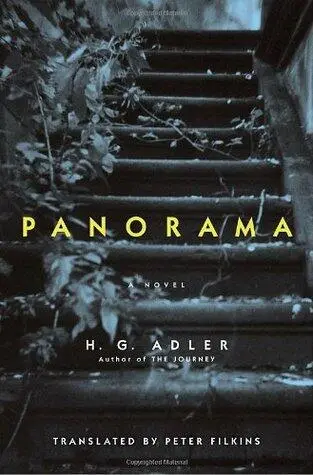
- Название:Panorama
- Автор:
- Издательство:Random House
- Жанр:
- Год:2011
- ISBN:нет данных
- Рейтинг книги:4 / 5. Голосов: 1
-
Избранное:Добавить в избранное
- Отзывы:
-
Ваша оценка:
Panorama: краткое содержание, описание и аннотация
Предлагаем к чтению аннотацию, описание, краткое содержание или предисловие (зависит от того, что написал сам автор книги «Panorama»). Если вы не нашли необходимую информацию о книге — напишите в комментариях, мы постараемся отыскать её.
, and a direct literary descendant of Kafka.
When
was discovered in a Harvard bookshop and translated by Peter Filkins, it began a major reassessment of the Prague-born H. G. Adler by literary critics and historians alike. Known for his monumental
, a day-by-day account of his experiences in the Nazi slave-labor community before he was sent to Auschwitz, Adler also wrote six novels. The very depiction of the Holocaust in fiction caused furious debate and delays in their publication. Now
, his first novel, written in 1948, is finally available to convey the kinds of truths that only fiction can.
A brilliant epic,
is a portrait of a place and people soon to be destroyed, as seen through the eyes of young Josef Kramer. Told in ten distinct scenes, it begins in pastoral Word War I — era Bohemia, where the boy passively witnesses the “wonders of the world” in a thrilling panorama display; follows him to a German boarding school full of creeping xenophobia and prejudice; and finds him in young adulthood sent to a labor camp and then to one of the infamous extermination camps, before he chooses exile abroad after the war. Josef’s philosophical journey mirrors the author’s own: from a stoic acceptance of events to a realization that “the viewer is also the participant” and that action must be taken in life, if only to make sure the dead are not forgotten.
Achieving a stream-of-consciousness power reminiscent of James Joyce and Gertrude Stein, H. G. Adler is a modern artist with unique historical importance.
is lasting evidence of both the torment of his life and the triumph of his gifts.
Panorama — читать онлайн бесплатно полную книгу (весь текст) целиком
Ниже представлен текст книги, разбитый по страницам. Система сохранения места последней прочитанной страницы, позволяет с удобством читать онлайн бесплатно книгу «Panorama», без необходимости каждый раз заново искать на чём Вы остановились. Поставьте закладку, и сможете в любой момент перейти на страницу, на которой закончили чтение.
Интервал:
Закладка:
First the victims are gathered together in each country, all of them not being able to come here at the same time, exhaustive plans needing to be worked out, for the most loyal of the conspirators have many worries, it all needing to go faster, always faster, there being so many obstacles to overcome in order to get the lost ones onto the trains, it requiring epic battles with the army, with the railroad administration, with the opposition of the church, with the hatred of the saboteurs, with the ignorance of the stubborn, with the recalcitrance of the Italians, with the mawkishness of the Germans. Not everyone knows about the Conqueror’s plans for extermination, he cannot make it public and explain it such that every last dimwit is assured that murder isn’t taking place here, and mercifully not in any mass manner, and so the Conqueror must hide it all, the people cannot know the truth, everything is secret and almost invisible, but not everything can remain hidden, and that’s what leads to difficulties that make the most loyal of the conspirators groan. The victims have no idea where they are being brought, nor do many of the collaborators know as they help round up the lost ones and load them onto the trains, for while it’s clear that the lost ones are being sent off to work, and thus have to be resettled, most don’t know the name of the place to which they are being taken. In France it was called Pitchipoi, *the children robbed of their parents having coined the name, such that whenever a train left from there for the east, both large and small said it was headed to Pitchipoi as goodbyes were said, hope and sadness mixing together among those leaving as well as those remaining behind, everyone believing that the journey will be easier than staying, it won’t last much longer, the Conqueror will be defeated, then they will return from Pitchipoi, everyone will celebrate and they will be celebrated, then the brotherhood of all mankind will arise, the Conqueror, however, having to appear before a court of the people, in which they will raise the brazen charge, “Why didn’t you let us stay in our houses? Why did you drag us off to Pitchipoi?”
That will certainly be the last trial that humankind will hold, for it will be followed by eternal peace, which can already be clearly seen as it expands, it being seen whenever the iron rails ring and clatter, Pimmm-Pimmm-Pimmm-tititititititittititi-Pimmm! Peace is at hand when one’s gaze reaches out toward the Beskydy Range, whose gray-blue waits in the distance, ourselves already on the threshold of freedom, the furnaces that consume their victims today extinguished forever, no one yelling “Hats off!” and “Out of your bunks!” no roll call taken, no section elder reporting, “Section 23 present with 327!” Then all of this will be just a phantom, it never having existed, just the spawn of a disturbed mind, there never having been a Conqueror, not even a war, people were not chased into slaughterhouses but simply remained at home and went about their peaceful business, it having been a golden age then as it will be again. Josef does not despair completely, a confidence having been granted him, although reason would seem to rule out any positive expectation, yet his trust is not completely destroyed, it is still there and has even strengthened somewhat in the camp of the lost, though he’s somewhat ashamed to admit it, but he still wants to maintain it and believe in it, it being a thick coat that protects his wounded nakedness, he not totally lost even when he is surrounded by filth and vermin when he lies with Milan and Étienne under a blanket, for perhaps it’s even worse in Mordechai’s quarters, where there is hardly anything to take one’s mind off how things are in the Gypsy camp.
Josef’s group waits for fourteen days under the smoke clouds of the chimneys, their imminent departure often postponed and rescheduled, but then it’s announced that several groups will be transported together. Then the lost ones are shoved once again into the baths, though it’s not a large sauna but instead a small one in the Gypsy camp, the lost ones having to stand outside for many hours in the rain, all of them freezing in their rags, until finally they are pressed into the rooms, commanded to take off everything in the front room, until they are left with only a pair of shoes that they carry in their hands, while everything they have accumulated in the camp, except that which they can always carry on their person, has to be abandoned, spoons and cigarette butts, all of it yanked away from them under the threat of blows. The naked are herded with heckling calls into the sauna, nothing visible except steam and murk, an ear-shattering noise ripping through the room, everyone wailing and thrashing about, Josef never having witnessed such bellowing in Birkenau, everyone senselessly lashing out at everyone else, senselessly shoving one another around, all without reason, even without intent, no one even wanting to blame the other. Finally the showerheads are turned on, the water is too hot and burns their naked skin, though most are happy, it’s the first shower they’ve had in weeks, despite each hut being outfitted with a latrine that doubles as a washroom, though no one would think of using it as such, for you can only stand it there for a while and only on the rare occasion, there being hardly enough time to wash your hands and face, as in general there are too few wash-stands, the water pressure is poor, and there is no soap or towels. In the small sauna the lost ones can scrape the dirt off their skin with their fingernails, their backs and limbs turning red from this and from the hot water, though there’s no way to dry off, so they all stand there barefoot on a cold stone floor with their shoes in their hands, the water dripping from their heads and shoulders. The lost ones continue to scream without ceasing, even though they still have no reason to, it perhaps being the horror of it all that is indeed abysmal and continually gives rise to new terrors, the room seeming ready to burst with the chain of screams that continue without end. To the collaborators it all seems so stupid, for they are just trying to do their job, and with horsewhips they flog the naked, who want to avoid the blows, thus causing each to trample on the other, the floor slippery and painful for anyone who falls, while if care isn’t taken they can be trampled, the blows bringing no end to it all, but rather only worsening the puzzlement and confusion of this carnival, which takes on its first bit of orderliness the minute one of the conspirators appears and waves his pistol about. Then clothes are handed out, which goes about the same as it would in the big sauna, as plunder is taken from them with their having no choice in the matter, though the clothes they are given are not the same as what they had on before, because after bathing and disinfection in the Gypsy camp they don’t get their stuff back, but instead the lost ones get something better, the working slaves destined soon to be transported receiving underwear and winter coats, which is more than what they had in quarantine, even though it’s no better in quality. Josef is somewhat lucky to get a miserable pair of shoes made of torn linen, none of the stuff is made from the wool of a prayer shawl, instead a narrow pair of leggings and stained pants are made from thin cloth, which was once brown, though he does get a good green vest, the black jacket having no doubt been part of a good suit, while the hand-sewn winter coat was once quite fine, Josef reading on a sewn-on silk strip the name and address of a Jewish tailor in Lodz.
They are not allowed to dawdle while dressing, “Hurry! Hurry!” shouted at them continually, as if the train were already waiting for them above on the ramp, where each of them arrived sometime in recent weeks, but there appears to be no train waiting anxiously, for next the lost ones are forced to stand and wait for hours more in front of the sauna. Then they file into rows and the entire group marches to the yard, where the prison scribes appear with their lists and begin to count the number of lost ones in each group, counting them again and again, two groups missing a couple of men, Josef’s group having one too many, which causes a lot of squabbling and complaint, though neither gentle talk nor threats seems to work, the numbers don’t add up, and so each one has to be asked who he is and which group he belongs to, though in the chaos of the Gypsy camp it simply isn’t possible to maintain such control, the names of the lost ones often falsely given or written down wrong, no one having any papers, for all their possessions were taken from them by force in the big sauna. Thus it takes over two hours before the count is right for each group, too many having snuck in, for they want to get out of the camp, some of them beaten as a result, but then sent on without further punishment, they even allowing some to be exchanged between different groups so that fathers and sons and brothers can stick together, until finally the groups are formed, everyone takes a breath, though once again it is announced that the journey has been postponed, everyone back in the huts.
Читать дальшеИнтервал:
Закладка:
Похожие книги на «Panorama»
Представляем Вашему вниманию похожие книги на «Panorama» списком для выбора. Мы отобрали схожую по названию и смыслу литературу в надежде предоставить читателям больше вариантов отыскать новые, интересные, ещё непрочитанные произведения.











Обсуждение, отзывы о книге «Panorama» и просто собственные мнения читателей. Оставьте ваши комментарии, напишите, что Вы думаете о произведении, его смысле или главных героях. Укажите что конкретно понравилось, а что нет, и почему Вы так считаете.