H. Adler - Panorama
Здесь есть возможность читать онлайн «H. Adler - Panorama» весь текст электронной книги совершенно бесплатно (целиком полную версию без сокращений). В некоторых случаях можно слушать аудио, скачать через торрент в формате fb2 и присутствует краткое содержание. Год выпуска: 2011, Издательство: Random House, Жанр: Современная проза, на английском языке. Описание произведения, (предисловие) а так же отзывы посетителей доступны на портале библиотеки ЛибКат.
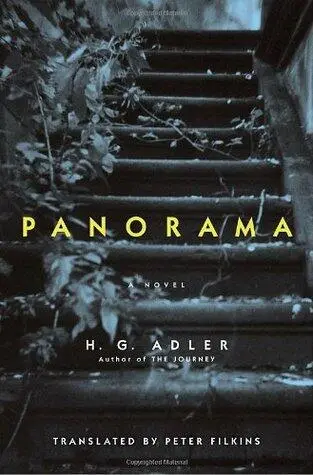
- Название:Panorama
- Автор:
- Издательство:Random House
- Жанр:
- Год:2011
- ISBN:нет данных
- Рейтинг книги:4 / 5. Голосов: 1
-
Избранное:Добавить в избранное
- Отзывы:
-
Ваша оценка:
Panorama: краткое содержание, описание и аннотация
Предлагаем к чтению аннотацию, описание, краткое содержание или предисловие (зависит от того, что написал сам автор книги «Panorama»). Если вы не нашли необходимую информацию о книге — напишите в комментариях, мы постараемся отыскать её.
, and a direct literary descendant of Kafka.
When
was discovered in a Harvard bookshop and translated by Peter Filkins, it began a major reassessment of the Prague-born H. G. Adler by literary critics and historians alike. Known for his monumental
, a day-by-day account of his experiences in the Nazi slave-labor community before he was sent to Auschwitz, Adler also wrote six novels. The very depiction of the Holocaust in fiction caused furious debate and delays in their publication. Now
, his first novel, written in 1948, is finally available to convey the kinds of truths that only fiction can.
A brilliant epic,
is a portrait of a place and people soon to be destroyed, as seen through the eyes of young Josef Kramer. Told in ten distinct scenes, it begins in pastoral Word War I — era Bohemia, where the boy passively witnesses the “wonders of the world” in a thrilling panorama display; follows him to a German boarding school full of creeping xenophobia and prejudice; and finds him in young adulthood sent to a labor camp and then to one of the infamous extermination camps, before he chooses exile abroad after the war. Josef’s philosophical journey mirrors the author’s own: from a stoic acceptance of events to a realization that “the viewer is also the participant” and that action must be taken in life, if only to make sure the dead are not forgotten.
Achieving a stream-of-consciousness power reminiscent of James Joyce and Gertrude Stein, H. G. Adler is a modern artist with unique historical importance.
is lasting evidence of both the torment of his life and the triumph of his gifts.
Panorama — читать онлайн бесплатно полную книгу (весь текст) целиком
Ниже представлен текст книги, разбитый по страницам. Система сохранения места последней прочитанной страницы, позволяет с удобством читать онлайн бесплатно книгу «Panorama», без необходимости каждый раз заново искать на чём Вы остановились. Поставьте закладку, и сможете в любой момент перейти на страницу, на которой закончили чтение.
Интервал:
Закладка:
Nothing else is here, no nails on the walls, no stools, no table, no bench, nothing, nothing at all, no beds, no straw mattresses, nothing but the bodies of the lost, clothed in rags of many colors, a few blankets scattered about, under which are bodies, as well as caps, ragged pieces of cloth without shape, a couple of tin bowls, some spoons, perhaps some other possessions gathered from the rubble and rubbish, otherwise nothing else, except fear, layer upon layer thickly packed together, living fear manifest within dried-up and evaporated bodies consumed by hatred and despair, though most of all fear, which will not die, even when they are whipped, as a sneer transforms itself into sleeplessness, and hope arises amid the decay, though perhaps hope cannot eradicate decay but instead struggles against fear. From outside there is a glimmer of light, while in a wide circle around the huts a network of barbed wire stretches through which electricity flows, cement pillars holding up the wire as it quietly runs along, separating fear from fear, since everywhere there is fear. There is no longer any difference between inside and out, fear cannot be checked by the wire, fear is on this side and that, as well as in the wire itself, powerful lamps attached to the concrete pillars that light up the night and stand there in the stillness of their own light, a light that shines on no one, nor does anyone think it real. But this light has a protective quality that cannot be destroyed by fear. It conquers fear as the light shines on the armed young men who crouch in the watchtower without rest. Yet there is no fear of attack, no one wants to defeat the fear inside, that which is well hidden away, no one wants to diminish it. The weapons in the tower are not aimed outward in order to protect fear from external threat, but instead peer inward so that the fear here remains constantly the same fear, the light illuminates fear, and those saddled with fear remain the enemies enclosed by the Conqueror with barbed wire in order that none flee, as they might be all that he has left to save him, since the Conqueror stands afraid and in dire straits. He has lost almost everything he has fought for on all fronts, everything now destroyed and laid to waste, and fear knows that the despot has gambled it all away, although he still has a hold of the fear he has robbed from almost every country, and since these countries are already freed of the Conqueror the fear hauled off from them waits behind the wire, hears the train rail struck, sees the wretched blood of life mixed with decay, feels the festering abscesses and the oozing streaks caused by the whip, tastes the bitter saliva and smells the corrosive dust of the stones, all of them knowing that it is the end, time long ago having dissolved, though now the end is near.
Now the sirens sound, from near and far they sound, an oscillating wail, slowly it gathers from below and climbs high, then sinks down once again and is muffled, then it swells once again and repeats again and again, then voices call out, “Douse the lights!” Then it’s even darker in the room. As the lights on the concrete pillars go out there is even more night, everyone asleep and gurgling in his sleep, no one stirs inside the lockdown of the cold that holds sway over an endless weariness, nothing else but weariness. Josef, however, strains to listen, still under the blanket, only his head sticking out when the iron rail was struck, and now he is completely awake, never a heavy sleeper, only getting a few hours, lengthy sleep never possible here, though Josef himself doesn’t completely utilize the shortened time that is reluctantly granted them, something drawing him awake while the others try to catch another couple of minutes, themselves insatiable and risking a beating as they sleep on into the day watch, which was long ago forbidden, long ago, that’s what their couple of stolen minutes are, since every moment stretches out endlessly and no one knows what day or night means here.
Josef doesn’t want to be woken if he can avoid it. He wants to wake up when he needs to, he wants to live, and nowhere is sleep more like death, when the bodies are packed as close as they are here, as they try to protect one another and not freeze, the nights bitterly cold, although it is already the end of March. Perhaps it’s not always so cold, but here it is cold, here inside the wire, where fear lives, where three or four of the lost are lumped together, sharing two or three blankets between them, as long as they are not stolen, for when that happens a great hue and cry rises, as nowhere are human possessions guarded more jealously than in the lost ones’ camp. But they are not possessions, they are loaned goods, and whoever thinks of property in the real world as anything other than loaned goods soon learns here that any possession is only borrowed, one cannot watch over it and guard it, it is simply surrendered, a thousand hands grabbing after every crumb and scrap, no scratched-in or painted-on name and no list making possessions safe from a neighbor’s reach, for here it’s a free-for-all, and there is no protection and no guards. Whatever serves the needs of the lost behind the wire functions as an act of grace, something that can lapse at any moment, for grace is not a possession to which any of the lost have a right, though the lost don’t know that, they upon whom hangs the intense pain of the threat of it all going on forever and who only want it to end, which is why their misery is so intense.
To Josef’s right lies Étienne, who was a cameraman in Paris and is a couple of years younger than Josef, while to the left lies Milan, the small dark-haired son of a murdered doctor from a small city in Banat who can’t be any older than sixteen. The majority of the lost are Jews from many different countries, but divided among the huts are members of many different nationalities — Poles, Ukrainians, French, Belgians, Dutch, Germans, Czechs, and other Slavs, Balts, as well as Spaniards, Italians, Norwegians, and others. Most of the lost are young, often no more than children barely over fourteen, the majority between twenty and thirty, some between thirty and forty, Josef at thirty-five being one of the older ones, though some are indeed beyond fifty. But the lost are ageless, for certainly they are not young, though they are not old, either, as the lost are of no time or era that other people will discover in later centuries, while agreed-upon laws have lost their meaning, knowledge and culture have become pointless because everything they represent is different from what can be learned or demonstrated here. The lost remain outside legal designation and analysis, every attempt at understanding is pointless, because everything about life behind the wire is strange and ungraspable, language incapable of expressing the nature of the lost in a way that would be comprehensible to those on the outside. The lost themselves don’t know this, for they have a language, many languages in fact, derived from languages that people out in the world would understand, though behind the wire these languages are diminished, expressing but little and shrunk to meager phrases in which hardly any of the artful structures from which they were derived can be felt, an abject language, the words hard, snarled and barked out, even when whispered, the language never forming chains of linked sentences, the conversations of the lost never flowing, either hinting at something or grasping at something, otherwise given over to screams, leaping flames, and spasms of pain.
Among the lost, normal forms of outward appearance have become meaningless, because decay is formless, and the lost have been condemned only to decay, all their hair cut off, scraped from their bodies with blunt instruments, the lost stripped in Birkenau, their shoes and clothes lying about like thick heaps of dung on the cold concrete floor. It’s a huge hall in which the lost stand naked and freezing, two heavily armed conspirators rummage through the clothing, digging into pockets, looking for money, for watches and jewelry. A band of collaborators scurry about, themselves also a part of the lost, yet appearing nearly as powerful as the conspirators, nothing but rats disguised as humans, rummaging through the belongings of the living, and when the rats find what they’re looking for they take it away, they surround the naked and scream at them with incomprehensible sounds, the sounds of greed and thievery, and whenever the rats spot a picture of a wife or mother or children in the hands of the lost they snatch it away and scoff, the lost allowed to keep only a belt that is bound about the naked like a penitent’s cord, some having glasses that they are allowed to keep as well.
Читать дальшеИнтервал:
Закладка:
Похожие книги на «Panorama»
Представляем Вашему вниманию похожие книги на «Panorama» списком для выбора. Мы отобрали схожую по названию и смыслу литературу в надежде предоставить читателям больше вариантов отыскать новые, интересные, ещё непрочитанные произведения.








Обсуждение, отзывы о книге «Panorama» и просто собственные мнения читателей. Оставьте ваши комментарии, напишите, что Вы думаете о произведении, его смысле или главных героях. Укажите что конкретно понравилось, а что нет, и почему Вы так считаете.