Peter Buwalda - Bonita Avenue
Здесь есть возможность читать онлайн «Peter Buwalda - Bonita Avenue» весь текст электронной книги совершенно бесплатно (целиком полную версию без сокращений). В некоторых случаях можно слушать аудио, скачать через торрент в формате fb2 и присутствует краткое содержание. Год выпуска: 2015, ISBN: 2015, Издательство: Crown Publishing Group, Жанр: Современная проза, на английском языке. Описание произведения, (предисловие) а так же отзывы посетителей доступны на портале библиотеки ЛибКат.
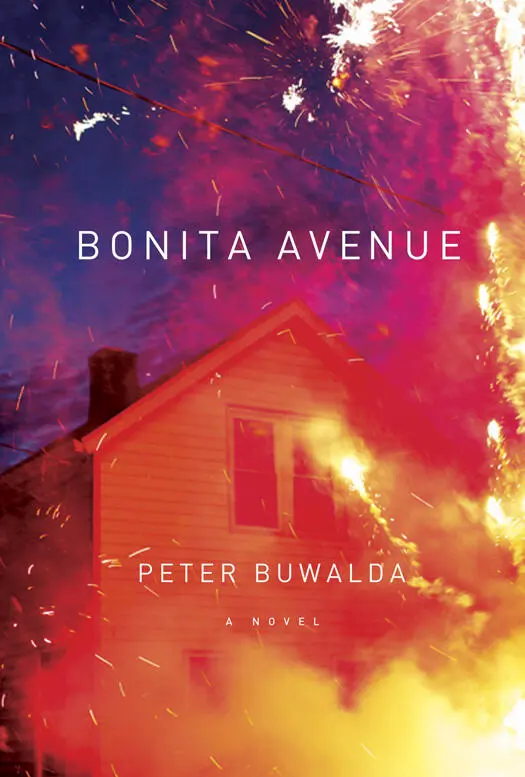
- Название:Bonita Avenue
- Автор:
- Издательство:Crown Publishing Group
- Жанр:
- Год:2015
- ISBN:978-0-553-41786-9
- Рейтинг книги:4 / 5. Голосов: 1
-
Избранное:Добавить в избранное
- Отзывы:
-
Ваша оценка:
Bonita Avenue: краткое содержание, описание и аннотация
Предлагаем к чтению аннотацию, описание, краткое содержание или предисловие (зависит от того, что написал сам автор книги «Bonita Avenue»). Если вы не нашли необходимую информацию о книге — напишите в комментариях, мы постараемся отыскать её.
A riveting portrait of a family in crisis and the ways that even the smallest twists of fate can forever change our lives,
is an incendiary, unpredictable debut of relationships torn asunder by lies, and minds destroyed by madness.
Bonita Avenue — читать онлайн бесплатно полную книгу (весь текст) целиком
Ниже представлен текст книги, разбитый по страницам. Система сохранения места последней прочитанной страницы, позволяет с удобством читать онлайн бесплатно книгу «Bonita Avenue», без необходимости каждый раз заново искать на чём Вы остановились. Поставьте закладку, и сможете в любой момент перейти на страницу, на которой закончили чтение.
Интервал:
Закладка:
“There he is,” Rusty said. Instead of Bobbi from Steamboat Springs standing at the main entrance, it was Vince from Cleveland, yawning, dwarfed by the high brick doorframe. Rusty raced past him and braked in front of the large, half-cylindrical roof that arched over the drill square.
“You gonna park inside?”
“No time.”
The heat poured like liquid into the Maybach; I instinctively held my breath against the stench of urine. A sinewy dog on a leash sniffed at my foot as I felt for the curb. “Afternoon,” Rusty said to the hefty black woman who jerked the dog back as though she were yanking life into an outboard motor. As we approached the building, Rusty’s gaze strayed up the side of the immense brick wall. “Did you know that Joe Louis and Rocky Marciano once boxed in there?”
“Yeah,” I said, “I’m the one who told you.”
I thought I caught Vince’s diffident puppy-dog gaze and waved, but he didn’t react. When we reached him, Rusty extended his hand to the new man. “Maestro,” he said jovially, “how’s the form? Good flight?”
Vince nodded.
“Great, nice. You’re looking tip-top.”
Vince looked decidedly un-tip-top. He looked like he’d just been mugged, not by Crips or Bloods, but by the Little Rascals. Instead of the ill-fitting suit from last time, he wore faded, baggy-kneed trousers made of jogging-suit material. Thick chest hairs on his pear-shaped figure curled out from under a Hawaiian shirt with enamel snaps. Despite the blazing heat he wore heavy black steel-toe boots. His equally pear-shaped face, a genetic echo of his idle body, was unshaven; jet-black stubble climbed up his hamster cheeks. Apparently for Vince a “follow-up interview” meant “come as you are.”
Rusty hummed as he unlocked the cast-iron doors and swung one heavily open. You could drive a tank through it. “Come on in,” he said in a homey chirp. The three of us entered the cool reception hall. “We’ve got lights,” Rusty said as he reached for the old-fashioned wall switches; after a slight delay three pendant lamps struggled their way on. “Here, at least.” The gleaming floor segments that spread out before us were made of flamed gneiss outlined in black granite. Withered balloons and clusters of paper streamers were scattered here and there, remnants of last week’s opening party. The beer tap still needed to be returned. Six stairways gaped like the pockets of a billiard table, between each pair were two wide polished oak doors.
Vince sniffed the stony, sweet-rotten smell with an inquiring frown. “I smell ground water,” he said.
He bugged me. Rusty had “scouted” him, as he put it, in some or other hot-sex issue of Cosmopolitan where Vince had tied up some models in a way that admittedly betrayed skill and imagination. “Sensitive nose you’ve got there,” I said. “There’s an underground branch of the Los Angeles River running under the foundation. Parts of the basement are under water.”
Vince briefly touched his nose. He studied the walnut wall paneling in silence. After his first interview I had taken him to a bagel joint on Ventura Boulevard, and by mostly keeping quiet and asking brief follow-up questions I managed to find out more about this forty-three-year-old. For instance, that he still lived at home; for the past fifty years his parents had applied themselves with unassuming and, I gathered from his words, maddening devotion to the Cleveland Indians. Vince’s mother manned a souvenir kiosk at the stadium and his father was the revered equipment manager of generations of baseball players who had all achieved something that Vince Jr. certainly did not . Maybe that’s why the son had racked up an impressive series of apathetic failures: after an exhausting outplacement from a security firm (chronic sleep rhythm disorders that led to depression) and subsequent years of unemployment (a handful of attempts at new careers, including mechanic and welder, notwithstanding), Vince had managed to get himself diagnosed as disabled due to rheumatism and psoriasis.
Rusty crossed the room and stood with one foot on the stairs opposite us. “A short tour,” his voice echoed. “I see our guest has worn his hiking shoes.” I let Vince go first.
It bothered and amused me at the same time, the pseudo-expertise with which Rusty showed his new friend around, his eagerness to share the structural details of the Barracks— my Barracks too, you could say, but you wouldn’t know it from watching Rusty. He spelt out his plan to beautify the place with his art collection, a “eureka moment” he had while in the Getty. I could just see him up on that Olympic mount, his pet-Rembrandt glowing at his back, Los Angeles spread out at his feet, daydreaming of his very own museum, a hedonistic anti -museum in the ugliest place on earth, in the most inward-looking, dank, poorly lit pile of bricks imaginable.
Vince trudged behind him with an expression somewhere between complete relaxation and a dopey smile. Every so often he would nod approvingly, or offering up some irritating monosyllable: “high,” “low,” “wood,” “rust.” Back in Cleveland, he had told me, he spent a few afternoons a week in a harbor warehouse his parents thought was a welfare-to-work center where he cabled machines, but in fact, together with two partners, one business and the other artistic-perverted, he cabled young ladies, the only skill he had truly mastered in all those lonesome years.
Vince’s story might have moved me if I hadn’t found him so repulsive. He was unsavory in the physical sense, but a bit musty under his scaly skull as well. Contact with women did not suit him (“scabs and flakes,” he mumbled, “all over,” gesturing with his hands over his torso and shoulders like a magnotherapist); he had only ever had one girlfriend, a brief romance that came to an abrupt and panicked end when the girl’s parents asked him at the front door to take off his shoes. But his deep-rooted desire to tie up women dated from much earlier; even as an eleven-year-old kid, he confessed tearily, he got an erection when “a broad” with a wad stuffed in her mouth lay waiting for Roger Moore. The Internet had liberated him. He survived puberty, he mumbled, and in fact early adulthood as well, thanks to Japanese bondage mags he picked up in Cleveland’s Asiatown. Up in the same attic room he still occupied he rehearsed and refined the art on himself .
“On yourself? You mean you tied yourself up?”
He rubbed his scaly eyes and nodded. “Who else?”
Did I have any grounds to object? Not really: from today onward, this Barracks was wacko central, everyone was nuts in their own way. And Rusty was brazen-faced: he didn’t give a damn whom he worked with every day, as long as they shared his licentiousness, and he was right. Just like us, Vince had migrated to a city that applauded anything and everything as long as it was impermanent, reckless, and outrageous. We lived on uncertain, decadent ground, on shifting tectonic plates, in a city that could collapse any minute with one great shudder and vanish into a gash, indifferent to one little Vincent more or less.
My feet started to hurt. Just as I was about to excuse myself—“gentlemen, I’ve got a job to do”—my phone rang. Squinting at the display, I left the vault where we were standing. I was surprised to see it was Boudewijn. I answered, but before the thing reached my ear the line went dead. He’d apparently already tried a number of times. Boudewijn never phoned unless there was a crisis with Mike. The last time was more than six months ago, and the next day I was at my son’s bedside in a San Francisco hospital: meningitis. I tried calling back but there was no signal. Taking off my shoes, I headed with softly flopping footsteps down a long, unlit corridor. On both sides were Brazilian rosewood doors leading to abandoned horse stalls and dripping boiler rooms whose immense, rusty machinery had been sparked back into service. In the distance, daylight from the stairwell. As I climbed the cool granite steps I tried in vain to reach my voice mail. Concern came first, then the internalized guilt. My uselessness as a mother was unarguable; I had come to terms with it. But of course it had its price. For the time being I paid with nightmares where the most terrible things happened to Mike: accidents, drowning, always the worst possible scenarios, but one day these nightmares would come true — death had made this much perfectly clear by now.
Читать дальшеИнтервал:
Закладка:
Похожие книги на «Bonita Avenue»
Представляем Вашему вниманию похожие книги на «Bonita Avenue» списком для выбора. Мы отобрали схожую по названию и смыслу литературу в надежде предоставить читателям больше вариантов отыскать новые, интересные, ещё непрочитанные произведения.




Обсуждение, отзывы о книге «Bonita Avenue» и просто собственные мнения читателей. Оставьте ваши комментарии, напишите, что Вы думаете о произведении, его смысле или главных героях. Укажите что конкретно понравилось, а что нет, и почему Вы так считаете.