Peter Buwalda - Bonita Avenue
Здесь есть возможность читать онлайн «Peter Buwalda - Bonita Avenue» весь текст электронной книги совершенно бесплатно (целиком полную версию без сокращений). В некоторых случаях можно слушать аудио, скачать через торрент в формате fb2 и присутствует краткое содержание. Год выпуска: 2015, ISBN: 2015, Издательство: Crown Publishing Group, Жанр: Современная проза, на английском языке. Описание произведения, (предисловие) а так же отзывы посетителей доступны на портале библиотеки ЛибКат.
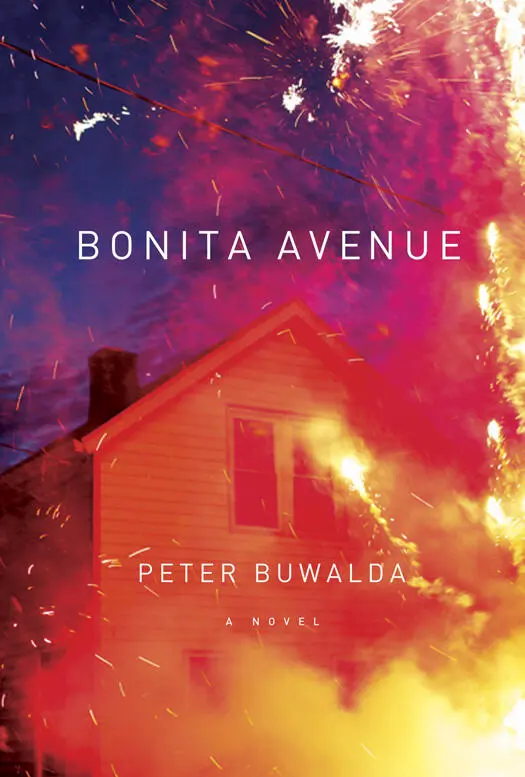
- Название:Bonita Avenue
- Автор:
- Издательство:Crown Publishing Group
- Жанр:
- Год:2015
- ISBN:978-0-553-41786-9
- Рейтинг книги:4 / 5. Голосов: 1
-
Избранное:Добавить в избранное
- Отзывы:
-
Ваша оценка:
Bonita Avenue: краткое содержание, описание и аннотация
Предлагаем к чтению аннотацию, описание, краткое содержание или предисловие (зависит от того, что написал сам автор книги «Bonita Avenue»). Если вы не нашли необходимую информацию о книге — напишите в комментариях, мы постараемся отыскать её.
A riveting portrait of a family in crisis and the ways that even the smallest twists of fate can forever change our lives,
is an incendiary, unpredictable debut of relationships torn asunder by lies, and minds destroyed by madness.
Bonita Avenue — читать онлайн бесплатно полную книгу (весь текст) целиком
Ниже представлен текст книги, разбитый по страницам. Система сохранения места последней прочитанной страницы, позволяет с удобством читать онлайн бесплатно книгу «Bonita Avenue», без необходимости каждый раз заново искать на чём Вы остановились. Поставьте закладку, и сможете в любой момент перейти на страницу, на которой закончили чтение.
Интервал:
Закладка:
“Nice.” From the middle of that little kitchen, which he now saw as unbearably filthy, musty, and shabby, Tineke stood beaming at him as though he’d just been knighted. She resembled her father, their faces had the same disarming roundness.
“It is not nice ,” said Profijt. “Because it is impossible . I’ve studied your work with extreme interest. At times it’s brusque, mostly surprisingly graceful. And always efficacious. It appears that certain operations and standard formulas have been derived — no, designed —on the spot. On this piece of cardboard are two, I repeat, two different proofs for Pythagoras.” He stopped briefly, weightily. “One of them, I’ve never even seen before. The other is three centuries old. If what you say is true, then I must congratulate you.”
“Dad,” Tineke said, “of course what Siem says is true. Come on, give them to him.”
Her father extended his hand. “Congratulations.” This was the first mathematician whose hand he shook, hundreds more would follow, perhaps thousands, but Tineke’s father was the very first. The hand was not calloused like a judo hand; it was also unlike his in-laws’ hands, which were clammy and jittered if they weren’t holding a bottle.
“You’ll be laid up another couple of months?” Profijt brought his attaché case to his lap and carefully removed a small stack of books. “I shall take responsibility for providing you with nourishment.” In addition to four Olympiad booklets he called “snack food,” Tineke’s father gave him something he had saved since his own student days: books sheathed in brown paper on integral calculus, on linear algebra, on integer theory, but also A Course of Pure Mathematics by G. H. Hardy, a final-year gymnasium textbook, Struik’s History of Mathematics , and even a satirical mathematics novella called Flatland .
“Work through them and let me know how you make out. Promise me that. And when you’ve finished I’ll bring some more. In return I would ask that as soon as you can walk again we pay a visit to the Uithof.”
“The Uithof?”
“The Utrecht mathematics faculty. And get well quickly, if you please. You’ve no time to waste.”
She sees him. She switches off the saw, takes off the ear protectors. “Coffee? Yes, please!” she calls out, laughing; slaps her work gloves onto a workbench outfitted with a variety of vises; glides, smiling, past a futuristic cabinet. She approaches him — carefree, unaware. His thoughts bounce over their countless discussions about Wilbert, with the late ’80s as desperate nadir, arguments that challenged everything they thought they knew about parenting. After the court case their marriage nearly fell apart, worn out as they were by that nut case. Yes, once Wilbert was out of the way they started arguing with each other , about everything. As a result she bloated up like a balloon, abandoned all discipline. After a hostile year she went off to a summer course in England, a top-notch academy for furniture makers, “the chance of a lifetime,” but in fact it was pure escapism. She spent three months in Dorset and he missed her terribly. So badly that before she got back he invested a small fortune transforming the abandoned stall into a studio: troughs and timber out, table saws in, storage racks, compressors for the vacuum, staple guns, a whale of a veneer press.
“What’s up?” she asks cheerfully, looking at him under halogen lighting so bright that he’s afraid she can read his thoughts.
Here? Now? What a mistake to think that he can spill out his pathetic, putrid news here, under the rafters of this hopeful hut. For ten years now, this workshop has symbolized the success of their marriage, every piece of furniture that has emerged from it reminds them that they have a grip on their lives, that they do have the power to influence events. And he’s going to tell her here, of all places, about Wilbert and Joni? Maybe because he doesn’t answer, his mouth just a slit from which he can see his breath, Tineke picks up the conversation. “You know what I was just thinking?” she says, taking his hand between her surprisingly warm fingers. “Wouldn’t it be a great idea to fly to California in February, around carnival time? Surprise Joni? I think that would be such fun.”
She has rented two films, it’s his choice. Secrets and Lies doesn’t seem like a good idea (he does not say why), so they curl up next to each other on the sofa for Magnolia , which is not unsavory enough to keep him from dozing off. What he dreams, he doesn’t know, he’s in a stifling quagmire, he’s in The Hague, but also in the Delft of his youth, he doesn’t know.
“ Y’KNOW, ” her voice suddenly blares in his ear. He bolts up with a start, she sounds so close by, the crown of her head tickles his chin. “You know what I forgot to mention?” She pauses the DVD.
“I was sleeping …”
“The mail,” she screams, or does it only seem like she’s screaming? “This strange envelope came last week. Have you had a look at the mail yet?”
He tries to talk and inhale at the same time. “No,” he says in a weak stammer, “well, yes, glanced through it.”
“That brown padded envelope,” she continues, “the fat one. Did you see it? Sent to the wrong address. There wasn’t a stamp, no return address either, I only realized later. Somebody must’ve delivered it by hand.”
“Why’s the movie stopped?”
“Because this suddenly occurred to me. Monday, I think it was. I didn’t know what to do with it, so I opened it up. A really strange little package, Siem. So strange.” Her voice sounds alarmed, as though a suppressed fear is rearing its head. “I tried to phone you about it.”
There is sand in his mouth, he can’t get a word out, and still he hears something: “What was inside?”
“I’ll just go get it,” she says, and makes a move to get up. “I taped it back shut. It’s not really—”
“Wait,” he says, wide awake now. “It’s upstairs, I think. I took the mail up to my study.” Before she can respond, he’s up off the sofa, walks toward the hall without looking back. “Want some wine?” she calls after him.
Numb, he stumbles up the stairs, his head is a reactor vessel. Throw the envelope out? Confess everything? Play dumb? Has she read the note? Like a zombie he opens the drawer.
“Ah,” she says as he returns to the living room, “so you’ve already opened it.” She sets two glasses of red wine on cork coasters. “And? What do you think?”
“Haven’t looked yet,” he says. Before he’s even sat down she grabs the envelope out of his hands and shakes the contents onto the sofa between them. The stockings, the panties, the handkerchief, they fall noiselessly to the seat cushion, the jet-black object bounces and lands on the back of his left hand; as though it is a huge insect, a giant caterpillar, a black widow, he yanks back his hand, the thing leaps up, clatters via the coffee table to the tiled floor.
Silence.
He is deft, socially speaking. He knows just how to look when he’s taken a swallow of scalding tea while standing face-to-face with the queen, he can debate in parliament, he can debate in parliament even while being called a fucking wanker. But now, he’s stuck. He slumps back with a groan, his burning back against the cold leather.
Hours later, walking across what is no longer his campus, he tells himself that the story he dished up was consistent and in a certain sense more logical than the truth. Although it was a pretty rough evening, the end of which is not yet in sight — tonight might never end, he thinks, Tineke is going to start brooding, she won’t leave it at this, he knows her, she’s going to fret as well, maybe she’s fretting already, she’s gone to bed, lies there staring up at the ceiling — at the same time he experiences both the relief of confession and the satisfaction of a well-told lie.
Читать дальшеИнтервал:
Закладка:
Похожие книги на «Bonita Avenue»
Представляем Вашему вниманию похожие книги на «Bonita Avenue» списком для выбора. Мы отобрали схожую по названию и смыслу литературу в надежде предоставить читателям больше вариантов отыскать новые, интересные, ещё непрочитанные произведения.







Обсуждение, отзывы о книге «Bonita Avenue» и просто собственные мнения читателей. Оставьте ваши комментарии, напишите, что Вы думаете о произведении, его смысле или главных героях. Укажите что конкретно понравилось, а что нет, и почему Вы так считаете.