Peter Buwalda - Bonita Avenue
Здесь есть возможность читать онлайн «Peter Buwalda - Bonita Avenue» весь текст электронной книги совершенно бесплатно (целиком полную версию без сокращений). В некоторых случаях можно слушать аудио, скачать через торрент в формате fb2 и присутствует краткое содержание. Год выпуска: 2015, ISBN: 2015, Издательство: Crown Publishing Group, Жанр: Современная проза, на английском языке. Описание произведения, (предисловие) а так же отзывы посетителей доступны на портале библиотеки ЛибКат.
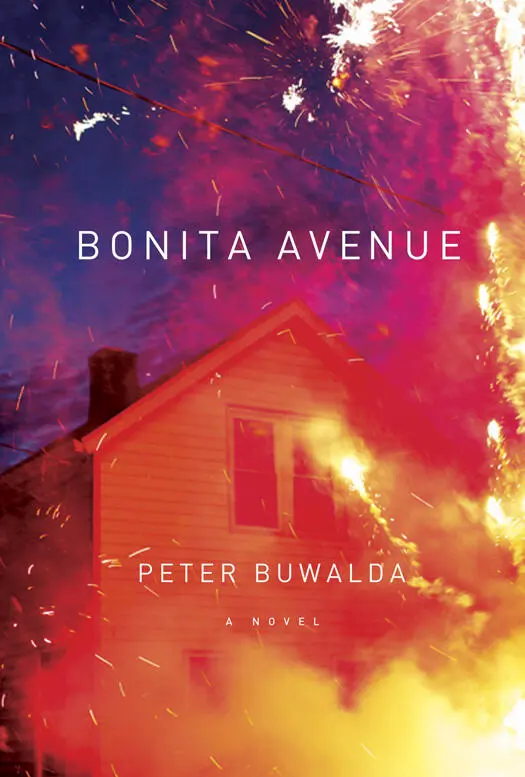
- Название:Bonita Avenue
- Автор:
- Издательство:Crown Publishing Group
- Жанр:
- Год:2015
- ISBN:978-0-553-41786-9
- Рейтинг книги:4 / 5. Голосов: 1
-
Избранное:Добавить в избранное
- Отзывы:
-
Ваша оценка:
Bonita Avenue: краткое содержание, описание и аннотация
Предлагаем к чтению аннотацию, описание, краткое содержание или предисловие (зависит от того, что написал сам автор книги «Bonita Avenue»). Если вы не нашли необходимую информацию о книге — напишите в комментариях, мы постараемся отыскать её.
A riveting portrait of a family in crisis and the ways that even the smallest twists of fate can forever change our lives,
is an incendiary, unpredictable debut of relationships torn asunder by lies, and minds destroyed by madness.
Bonita Avenue — читать онлайн бесплатно полную книгу (весь текст) целиком
Ниже представлен текст книги, разбитый по страницам. Система сохранения места последней прочитанной страницы, позволяет с удобством читать онлайн бесплатно книгу «Bonita Avenue», без необходимости каждый раз заново искать на чём Вы остановились. Поставьте закладку, и сможете в любой момент перейти на страницу, на которой закончили чтение.
Интервал:
Закладка:
Now too, he is well aware of why he fell in love with her: that vitality. Her lust for life, her exuberance. The way she stood there at that machine, the one they bought together at a factory in Münster, where she apparently knew everything there was to know about brands and model numbers, interrogated the salesman in fluent German about rpms and blade positions. She was his new beginning, she repaired his willpower. That is why he cannot walk over to her now and disassemble himself in front of her.
Not only did Tineke’s morning visits draw him out of his syrupy self-pity, but also without her he would never have discovered mathematics. She rang the bell at least once, sometimes twice a week, mostly when Margriet was sitting at the mail-sorting machine across town, and then he would yank the rope that disappeared via a pulley into the stairwell, down to the front door bolt, and she clumped up the stairs, with or without Joni on her arm — blond, large, attractive, cheery, interested, intelligent. She emptied his thermos into the kitchen sink and made fresh coffee, helped him onto the balcony if it was sunny, sometimes brought a loose chair or table leg that needed sanding, sat next to his bed and chatted to him about her day, her life, about how the construction of Hoog Catharijne was coming along downtown. On one of those mornings she came to cheer him up she brought him a box full of reading material: Libelle, Ariande, Privé, Panorama , a home and garden magazine, and some of it such junk he wondered why she read it, why that blues singer of hers read it.
“From my mother,” she said, and told him that her parents lived in Tuindorp, the neighborhood where she’d grown up, and only later in the week did he rummage through the box, and maybe already then, or later, three small moss-green books with Olympic rings slid out, it was a symbol he couldn’t look at without going all bilious, and those rings nearly prevented him from thumbing through the rest of the books.
Mathematics. Arithmetic. Long ago, in Delft, algebra and geometry came easily to him, which was the only reason he did MULO-B in high school: as few languages as possible, but all the so-called difficult subjects, they were a breeze. No time for anything but judo. Everything — his penchant for motorcycles and cars, his chess set, the high school, where his father had hoped he would study — took the backseat to judo. In retrospect, it was remarkable that no one, including himself, found it the least bit strange that he passed math and physics exams without doing any homework, without studying, yes, without prior knowledge . Let’s see, what do they want from me — that’s how he took an exam. Got an eight out of ten by inventing the wheel on the spot; right there in the lecture hall he figured out how to factor a quadratic equation.
It may have been his boundless boredom, with the mother of all wet blankets having been tossed over his life, that made him take a look at the problems in those booklets. He saw mathematics for the first time in twelve years, for the first time since the Oranje-Nassau MULO. He skimmed the word problems, the geometric figures and illustrations. There were five problems in all. He took a ballpoint pen and, on the cardboard cover he’d torn off one of the magazine folders, he tackled the first problem, fussed around with the data he’d distilled from the question, made a rough sketch. Just like a joke occurs to you, or the idea for a limerick, a solution welled up in him. OK, it’s got to go like this. And if not that, then like this. After forty-five minutes he had cracked the first problem, his solution was spot-on, he knew it for sure. He went straight to the second problem, and then yet another, until soon enough he himself throbbed with spot-on-ness. If he hadn’t been confined to a plaster cast he’d have bounded down the stairs to ring Tineke’s doorbell and show her what he’d accomplished.
Usually he just sat out the tedious hours; in that kitchen it seemed like evening would never come, and when evening did come it seemed bedtime would never come, but now, suddenly, Margriet was standing there in front of him with Wilbert, who wasn’t at school yet and spent days at his grandmother’s in Wijk C. It was already getting dark, but everyday reality passed him by, he’d misplaced it somewhere, he was lost in an opaque, radiant world where closely related phenomena were either true or false, with such clarity it filled him with a thrilling energy. Rather than staring peevishly out into space, or picking petty arguments with Margriet — this wasn’t her choice either, to be cooped up with such a bitter old fart — he spent the rest of the evening engrossed in the moss-green booklets, and part of the night too; it was cold, he still remembers, it froze in the kitchen, but he let his arms and fingers go numb, and when he’d answered all the questions he went through them again, solved a few in an even better way, out of camaraderie with the problem itself — what kind of feeling was that? — and honed his scribbled calculations or improvised embellishments.
One of the problems stuck with him ever since, not so much because of the Olympic connotation, or its inventiveness, but because he came up with a variant of his own: “ada/kok =.fastfastfast …” was the given, and the question was which digits could replace the letters so that the equation would be correct. He licked that one pretty fast, but had to work much harder to give Ada a friend: “pele × play = kick × goal,” the fruits of incredible mental acrobatics that kept him awake until he heard Margriet showering upstairs.
Pelé and his goal was the first thing that Tineke’s father wanted to talk about. Unannounced and totally to his surprise, a week later the man stood next to his makeshift bed; he was more gentleman than anything, he wore a distinguished lemon-yellow spencer and had soft white hair that looked as though it had been washed and touched up on the way over. “So this is the culprit,” said Mr. Profijt, his future father-in-law, mathematics teacher at the Christelijk Gymnasium on the Diaconessenstraat. The elegant hand that sported a slim wedding ring held up the fully scribbled magazine cover that, he gathered, Tineke had brought him. “Young man,” he said earnestly, “I’ve spent my whole weekend on that Pelé kicking a goal. I can’t crack it. Save me.” Whereby Tineke’s father squatted down next to his bed and Sigerius explained, step by step, in a ring notebook the man pulled out of a leather attaché case with a flap, how he constructed the brainteaser.
“Beautiful,” said the man who was Joni’s grandfather. “Robust. And elegant at the same time. Playful too. My daughter claims you’re not a mathematician. She is mistaken. Where did you study, if I may ask?”
“In Delft,” he replied. “Oranje-Nassau MULO.”
A moment of silence. Then: “That’s impossible,” Profijt said. Tineke’s father had a friendly voice in which he wrapped schoolmasterish sentences. “It is not possible that you’ve only done MULO.”
“I’m afraid so, Mr. Profijt.”
“Then you must have had help. Is this your handwriting? Do you know what these are?” He tapped one of the moss-green booklets.
“Math problems?”
“These exercise books contain the second-round problems from the National Mathematics Olympiad, 1969 edition. These five open questions, young man, were devised by the brightest mathematical minds in the country. The most talented A+ high school students train for a year, only to bang into this wall of mathematical ingenuity.”
“Aha.”
“The majority of that elite corps, the flower of the nation, one could well call it, scores two out of five. At best. Twenty points out of a possible fifty. Those students can go home well pleased. The top ten score between thirty and forty. Sometimes, but only sometimes, once every five years or so, there will be an exceptionally gifted boy among them, sadly they are always boys, a lad who gets almost everything right. Only once in the history of the Olympiad, I believe in 1963, did someone get a perfect score. Like you did. Zero mistakes. Fifty points. Flawless.”
Читать дальшеИнтервал:
Закладка:
Похожие книги на «Bonita Avenue»
Представляем Вашему вниманию похожие книги на «Bonita Avenue» списком для выбора. Мы отобрали схожую по названию и смыслу литературу в надежде предоставить читателям больше вариантов отыскать новые, интересные, ещё непрочитанные произведения.



Обсуждение, отзывы о книге «Bonita Avenue» и просто собственные мнения читателей. Оставьте ваши комментарии, напишите, что Вы думаете о произведении, его смысле или главных героях. Укажите что конкретно понравилось, а что нет, и почему Вы так считаете.