Pete Hamill - Forever
Здесь есть возможность читать онлайн «Pete Hamill - Forever» весь текст электронной книги совершенно бесплатно (целиком полную версию без сокращений). В некоторых случаях можно слушать аудио, скачать через торрент в формате fb2 и присутствует краткое содержание. Год выпуска: 2008, ISBN: 2008, Издательство: Paw Prints, Жанр: Современная проза, на английском языке. Описание произведения, (предисловие) а так же отзывы посетителей доступны на портале библиотеки ЛибКат.
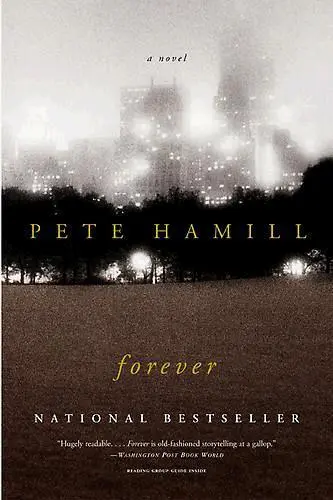
- Название:Forever
- Автор:
- Издательство:Paw Prints
- Жанр:
- Год:2008
- ISBN:9781435298644
- Рейтинг книги:4 / 5. Голосов: 1
-
Избранное:Добавить в избранное
- Отзывы:
-
Ваша оценка:
Forever: краткое содержание, описание и аннотация
Предлагаем к чтению аннотацию, описание, краткое содержание или предисловие (зависит от того, что написал сам автор книги «Forever»). Если вы не нашли необходимую информацию о книге — напишите в комментариях, мы постараемся отыскать её.
Reprint. 100,000 first printing.
Forever — читать онлайн бесплатно полную книгу (весь текст) целиком
Ниже представлен текст книги, разбитый по страницам. Система сохранения места последней прочитанной страницы, позволяет с удобством читать онлайн бесплатно книгу «Forever», без необходимости каждый раз заново искать на чём Вы остановились. Поставьте закладку, и сможете в любой момент перейти на страницу, на которой закончили чтение.
Интервал:
Закладка:
“Do you have a name yet, officer?” Cormac said.
“Dubious,” the policeman said.
“That’s her name?”
“Yeah. Dubious Jones. No wonder he killed her.”
He laughed a cop’s dark laugh.
“Who’s the he?” Cormac said. “The one who killed her.”
“Fucked if I know,” the cop said.
Cormac kept making notes. A single thick candle burned down to a saucer, the wax glazing the table. A wick like a thin stump of charcoal. Her left leg bent at the edge of the bed, one bare foot on the greasy stone floor. A laced black boot on the other foot, caked mud on the heel. Dark blood soaking the bed beneath her buttocks. The dress jerked up. Cut there too.
A rat with a leathery tail appeared under the bed, licking the drying blood.
Cormac turned away, the yellow fluid thickening in his veins. He heard footsteps coming down the stairs behind him. Inspector Ford. And Jennings from the Journal-Advertiser, notebook in hand.
“What’s it we’ve got here?” Jennings said.
“What’s it look like we’ve got here?” said Inspector Ford. His reddish mustaches looked fierce, his nostrils flared. “We’ve got a fucking murder.”
“Can I quote you on that?” Jennings said, smiling. He flashed his rabbity front teeth, touched the brim of his bowler hat. Thin, young, a British edge to his accent. “Jesus,” he said, “it smells like a bear’s ass down here.”
“It would smell like that if you filled it with flowers,” Cormac said.
“Ah, an aesthetic observation from the aging veteran of the Evening Post, ” Jennings said.
“Why don’t you interview the rat under the bed, Jennings?” Cormac said. “He must’ve been an eyewitness.”
“Totally unreliable.”
“Perfect for you,” Cormac said.
“Will you two goddamned shite-for-brains shut up, please?” Inspector Ford said. “I’m trying to work.”
Cormac turned, the bile rising, the yellow fluid surging, and hurried up the stairs. He walked through the barroom, with its watercolors of the Hudson and its worried owner, and made it to Cedar Street. He held on to a tree and then vomited into the gutter.
A fine way to spend a birthday, he thought, walking toward the Evening Post on Pine Street. A fine way to celebrate another ninth of September. Puking my guts out on Cedar Street. Happy birthday, in the year of the Lord 1834. And even now, I don’t feel much better. The air is the same as it was before I got sick. And it’s filling me and rotting my guts.
Who killed Dubious Jones? he asked himself.
I don’t care, he answered.
The morning had been cool and quiet, and as always on his birthday, he walked to the edge of the North River and dropped a white rose into the flowing waters. As always, he wished for it to sail out past the many-masted ships and through the Narrows and into the Atlantic. With any luck, it would float all the way to Ireland. He sent that rose each year to his mother. She, after all, had done all the work on the day he was born. She was the one who should be celebrated. As always at the edge of the river, he thought about the coat of many colors and the magical pots simmering on the fire and her dark hair and wonderful smile. Then he went to work.
That morning, as on most weekday mornings for the past twelve years, he left the river’s edge and went to the office of the Evening Post on Pine Street. The morning was hot, with steamy August lingering into sweet September. The odor was beginning to rise from the streets, the buildings, the people.
He spent the morning scanning month-old newspapers from London, Edinburgh, Dublin, and Paris, freshly arrived on the Liverpool packet. On slow days, he would cobble together stories from those newspapers, including the dailies in French. In a way, such work was like painting, which he did in the rooms on Cortlandt Street that he’d rented now for sixteen years. You took various elements, you were precise about each one of them, but you made them fresh by the way you arranged them. The process kept his brain alert and alive. Or so he thought, as the months became years, and the years became decades.
He liked the work of journalism from the day he started at the old Commercial-Advertiser just before the century turned. He’d been urged into the craft by a printer who had employed him for night work when his business was heavy. For the first ten years Cormac used the name Ridley Rattigan, but it never mattered what name he used in his new life since no article was ever signed. The same was true at the Evening Post . The skills of the acting craft helped him in several ways. He could make himself gradually look older, so that when he announced his retirement from the Commercial-Advertiser, he could go off, paint for a year on his savings, and then apply for work at the Evening Post as a new young man, eager to work on a newspaper. The other skill of the actor’s trade was technical: He could write in whatever voice was required. He could be a Hamiltonian conservative or a Tom Paine radical. He could be lyrical and melancholy or sarcastic and scathing. And he could supply what his editors most frequently demanded: a tone of numbing banality. Cormac worked at this craft ten hours a day, six days a week, which left him about twenty hours a week for his painting. He soon discovered that he needed both: the journalism to eat time, help it pass swiftly, to give him a sense of human proportion; the painting to slow it down, to allow him to meditate on sky and weather and the endless varieties of the human body.
He had a talent for newspaper work, delighting in the discovery of stories and then writing them in units of five hundred or a thousand words. He became quick and accurate. He enjoyed the company of other journalists, even the unspeakable Jennings. He liked the way the day’s routine could always be interrupted. He’d be assembling a tedious story about the fate of the Bonapartes, a story that would be read by about seventy-five people in New York, and someone would rush in the door, breathless and urgent. As had happened this morning. “Bloody murder! Woman killed at seven Cedar Street.” And out the door he’d go. There were more and more homicides in the town these past ten years, because of the opening of the Erie Canal and the flooding of the town with strangers. The newspaper had to record them. But Cormac knew that the gory details would never make it into the sanitized columns of the Evening Post . Such details, said his editors, Mr. Bryant and Mr. Leggett, were low and common. But still, someone had to go. Someone had to ask a policeman: Who killed Dubious Jones? Even if the answer never appeared in the newspaper.
There was one other part of newspaper writing that he came to need more than all the others, including the regularity of a paycheck.
It was about other people, not himself.
He walked to the office of the Post and paused at a stall on the crowded Broadway corner to buy a cup of mocha coffee and a piece of plain bread from a heavy black woman named Beatriz Machado. She was also selling corn and oysters, but he needed something plain in his trembling stomach.
“You look like you swallered a boiled ferret, Mist’ Co’mac,” she said.
“I feel worse than I look, Beatriz.”
She leaned in and whispered, “You need somethin’ special?”
“No,” he said, “just a hot bath.”
“Now, that’s harder for to get you,” Beatriz said. “Easier for to get a hot woman than a hot bath in this dirty ol’ town.”
In addition to corn, oysters, and mocha coffee (introduced the year before by seamen from Jamaica), Beatriz sold other things, secret things, ranging from magical roots, fried insects, and herbs to opium. These were not displayed in her stall, but she had them for her special customers. Adding and subtracting, Cormac tried to remember how long he’d known her. It was now fifty-seven years since Bantu died, and Big Michael died, and Aaron died and Silver died and Carlito died. Beatriz had been born a slave, up by Albany, but came with her parents to New York when she was seven, right after the Revolution, and had lived to see the final end of slavery in New York. That was just seven years ago. Forty-four years after the Revolution. Cormac had met her with Quaco at the African Bookshop on Lispenard Street when she was seventeen. She had just given birth to her first child. Cormac couldn’t recall the name of her husband but remembered him as a grave, humorless young man who forbade her to talk with white men. He was soon gone, but Cormac didn’t see Beatriz again until Quaco died at ninety-eight years old in 1816. They met at the burial ground. She was then heavier, the mother of four boys, living with her third husband.
Читать дальшеИнтервал:
Закладка:
Похожие книги на «Forever»
Представляем Вашему вниманию похожие книги на «Forever» списком для выбора. Мы отобрали схожую по названию и смыслу литературу в надежде предоставить читателям больше вариантов отыскать новые, интересные, ещё непрочитанные произведения.







Обсуждение, отзывы о книге «Forever» и просто собственные мнения читателей. Оставьте ваши комментарии, напишите, что Вы думаете о произведении, его смысле или главных героях. Укажите что конкретно понравилось, а что нет, и почему Вы так считаете.