J. Ledgard - Submergence
Здесь есть возможность читать онлайн «J. Ledgard - Submergence» весь текст электронной книги совершенно бесплатно (целиком полную версию без сокращений). В некоторых случаях можно слушать аудио, скачать через торрент в формате fb2 и присутствует краткое содержание. Год выпуска: 2011, ISBN: 2011, Издательство: Random House UK, Жанр: Современная проза, на английском языке. Описание произведения, (предисловие) а так же отзывы посетителей доступны на портале библиотеки ЛибКат.
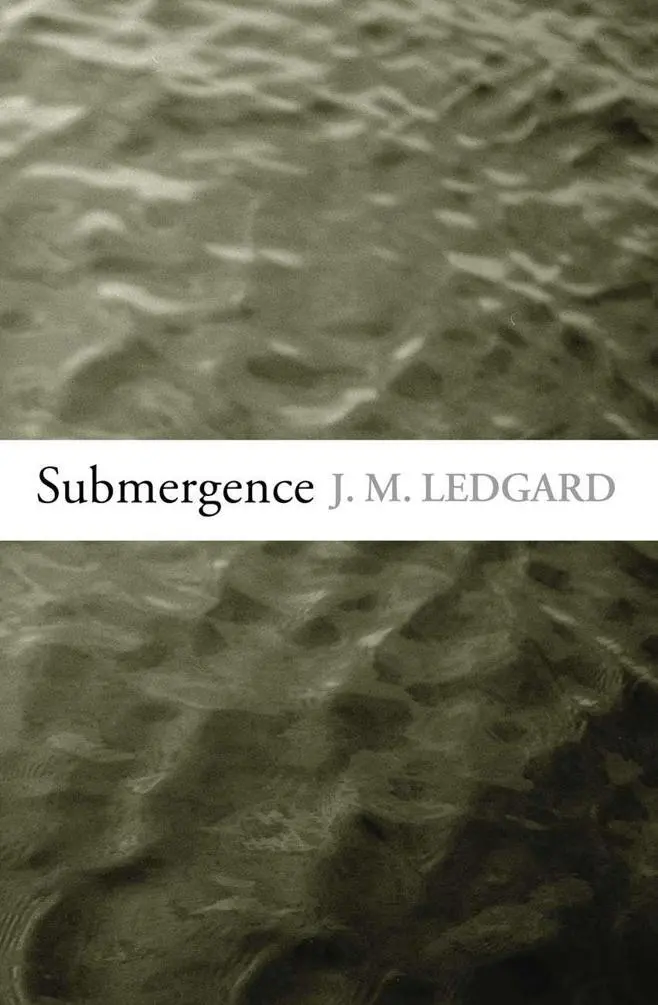
- Название:Submergence
- Автор:
- Издательство:Random House UK
- Жанр:
- Год:2011
- ISBN:9781446496831
- Рейтинг книги:5 / 5. Голосов: 1
-
Избранное:Добавить в избранное
- Отзывы:
-
Ваша оценка:
Submergence: краткое содержание, описание и аннотация
Предлагаем к чтению аннотацию, описание, краткое содержание или предисловие (зависит от того, что написал сам автор книги «Submergence»). Если вы не нашли необходимую информацию о книге — напишите в комментариях, мы постараемся отыскать её.
Both are drawn back to the previous Christmas, and to a French hotel on the Atlantic coast, where a chance encounter on the beach led to an intense and enduring romance. For James, his mind escapes to utopias both imagined and remembered. Danny is drawn back to beginnings: to mythical and scientific origins, and to her own. It is to each other and to the ocean that they most frequently return: magnetic and otherworldly, a comfort and a threat.
Submergence — читать онлайн бесплатно полную книгу (весь текст) целиком
Ниже представлен текст книги, разбитый по страницам. Система сохранения места последней прочитанной страницы, позволяет с удобством читать онлайн бесплатно книгу «Submergence», без необходимости каждый раз заново искать на чём Вы остановились. Поставьте закладку, и сможете в любой момент перейти на страницу, на которой закончили чтение.
Интервал:
Закладка:
James spoke out in favour of the Boni and was punched in the face. Perhaps it was because he was a witness to the unkindness, or perhaps it was the way he stared so rudely at the wine-coloured callus on the forehead of one of the Pakistanis, where the young man struck his forehead to the ground in prayer. Perhaps it was just because morale was low.
It was not true that the jihadists were self-sufficient and needed nothing more than a prayer mat. They had had high hopes of this camp where there had been so many martyrs before them. They had expected more. The boys from Mogadishu were especially desolate. They had seen a documentary in a video shack about the British Army and had persuaded themselves that the jihad had these facilities. Instead of a shower block and a canteen there were only ruined huts, the roofs collapsed, with the water a walk through the overgrown bush.
There was a baobab tree in the centre of the camp that afforded shade and shelter from the rain. He was ordered to make his own shelter under the tree. He took mangrove stems and drove them into the sand and hung up the mosquito net. He made a palm roof and scooped out a hollow in the sand. He was bound again inside the netting, but with such a length of rope that he could crawl freely and see the comings and goings of the camp.
The first days were spent repairing the huts, hacking out routes in the bush, collecting firewood, and digging latrines. It was hard. They sandbagged the main hut with food aid sacks filled with wet sand. On each of the sacks was a Stars and Stripes and the words Gift of the People of the United States .
A fighter fell into a Boni trap and was sent back to Chiamboni with a broken thighbone. There was an infestation of flies, also scorpions. They slept outside on plastic sheeting, under mosquito nets. Food was in short supply. They had handfuls of maize meal, fish and crab. Spaghetti was rationed.
They pinned up a picture of Osama bin Laden. His body was drowned, yet remained living to them. They played games on a laptop, including one where you got to fight Christians in the sixth-century Holy Land. They trained with rocket-propelled grenades and explosives. They trained with knives. There was no mobile-phone signal; the only connection with the world was by speedboat.
Days passed. Weeks. Baboons encircled the camp. The females had red arses to compare with the blue testes of the male colobus monkeys. He watched the baboons coming and going, quarrelling over fruit and scraps. He studied their personalities. He named them after his captors. They were dog-human; they pissed like dogs, but their faces were human.

It was the French polar explorer Jean-Baptiste Charcot, who, on his many voyages to the Greenland Sea, 2discovered that the temperature of the Hadal deep is a uniform four degrees Celsius around the world. Its sole virtue is constancy. Its processes are uniform. Cold water percolates into the rock, is superheated, and spurts from the chimneys of hydrothermal vents. It dissolves minerals and metals in the rock and, in this way, provides the ingredients for chemical life in what would otherwise be a deathly night, visited only by matter from above.
Until the discovery of hydrothermal vents off the Galapagos Islands in 1977, scientists assumed that life on earth was photosynthetic and belonged to the surface. It was the other way around: photosynthetic life came later, when cells strayed to the top where they were cooked for millions of years before evolving a way to absorb the light, and all the while the chemosynthetic life in the abyss was evolving a stability we cannot hope for.
The hydrothermal vents are only a small part of it. In the fissures, crevices, clefts and cracks; in the volcanic pus, in all the amazing lattices of the deep, are heat-loving or hyperthermophile protists, archaea, fungi and especially bacteria, which together constitute the earliest life on our planet. They are chemosynthetic, with no need of the sun. They live off hydrogen, carbon dioxide or iron. They excrete methane, or eat it. Some breathe in rust to produce magnetic iron. They feed on the anaerobic and on what is no longer living. When you place them in a Petri dish, they multiply into a colony visible to the naked eye. If you dwell on them they change the way we see ourselves. They are the factory workers, unquestioning, dynamic: the base. Less than one per cent of them have been identified, they are a part of you. You carry a weight of them in your belly and on your skin.
The microbial life of the deep exists in the queerest plane, where worms live in scalding pools and keep fleeces of microbes on their backs that are even more extraordinary than those that live on the timbers of our eyelashes.
In the white night of the fourth day out of Iceland, the Pourquoi Pas? dropped anchor over the underworld they sought. Enki was the northernmost hydrothermal vent field yet discovered, with some of the largest recorded sulphide deposits. The water that poured from its chimneys was 399 degrees Celsius. There was proof of a chemosynthetic life cycle, with acid-feeding bacteria at its foundation, working up to tube worms, white clams, and other bivalves. It was extraordinarily large and ancient. More than that was unclear. The 2011 expedition had discovered the field near where the Knipovich and Mohn undersea ridges joined after weeks of dragging a CTD (where C was conductivity, T was temperature and D was depth) sensor behind the boat in sawtooth patterns. The sensor looked for anomalies. When it found them, it took a sample of vent water, which could then be analysed for telltale levels of dissolved hydrogen and methane oxidised in the water column by microorganisms. Her challenge for 2012 was to scrape from a fissure some richer material, of mathematical consequence.
The first scheduled dives to Enki were for orientation and mapping. The next were for the geologists. The dives for the biologists and mathematicians were to take place close to the end of the cruise. There were various teams of biologists. The evolutionary group were working towards extracting DNA. Another was looking at viruses; they wanted to know how they in their sickness spread from one vent field to another. The French and Swiss astrobiologists Danny and Thumbs were working closely with were gathering samples on behalf of the European Space Agency. The hope was to identify new microorganisms. Claude, the French leader of their team, had placed a bet that life would be found in the methane oceans of Titan in his lifetime. He felt that the search for extraterrestial life was compromised by surface chauvinism: it looked only on the outside of planets, moons and rocks, not deep in the cracks where it was more likely to be. She agreed. Man’s fixation with façades, with outward appearances, was another reason why there was not more interest in oceanography.
She took a bullish view. Microbial life was tenacious. It swarmed even in mineshafts and caves. Seen from up close, the cracks in the sea floor were like the cross-hatching on a metal-plate engraving. She believed that some of them went down 8 kilometres into the mantle, and were carpeted with a density of microbial life that, taken together with the deep biota, was more than all the photosynthetic life on the surface of the planet combined. To prove her thesis she had to come up with methods of counting the methanogens, the hyperthermophilic autotrophic iron reducers, and the peculiar states and leagues of archaea and bacteria. She had also tried to identify the boundary which separated the living part from where there was no life and to understand the percolation between existence and non-existence.
Читать дальшеИнтервал:
Закладка:
Похожие книги на «Submergence»
Представляем Вашему вниманию похожие книги на «Submergence» списком для выбора. Мы отобрали схожую по названию и смыслу литературу в надежде предоставить читателям больше вариантов отыскать новые, интересные, ещё непрочитанные произведения.





Обсуждение, отзывы о книге «Submergence» и просто собственные мнения читателей. Оставьте ваши комментарии, напишите, что Вы думаете о произведении, его смысле или главных героях. Укажите что конкретно понравилось, а что нет, и почему Вы так считаете.