J. Ledgard - Submergence
Здесь есть возможность читать онлайн «J. Ledgard - Submergence» весь текст электронной книги совершенно бесплатно (целиком полную версию без сокращений). В некоторых случаях можно слушать аудио, скачать через торрент в формате fb2 и присутствует краткое содержание. Год выпуска: 2011, ISBN: 2011, Издательство: Random House UK, Жанр: Современная проза, на английском языке. Описание произведения, (предисловие) а так же отзывы посетителей доступны на портале библиотеки ЛибКат.
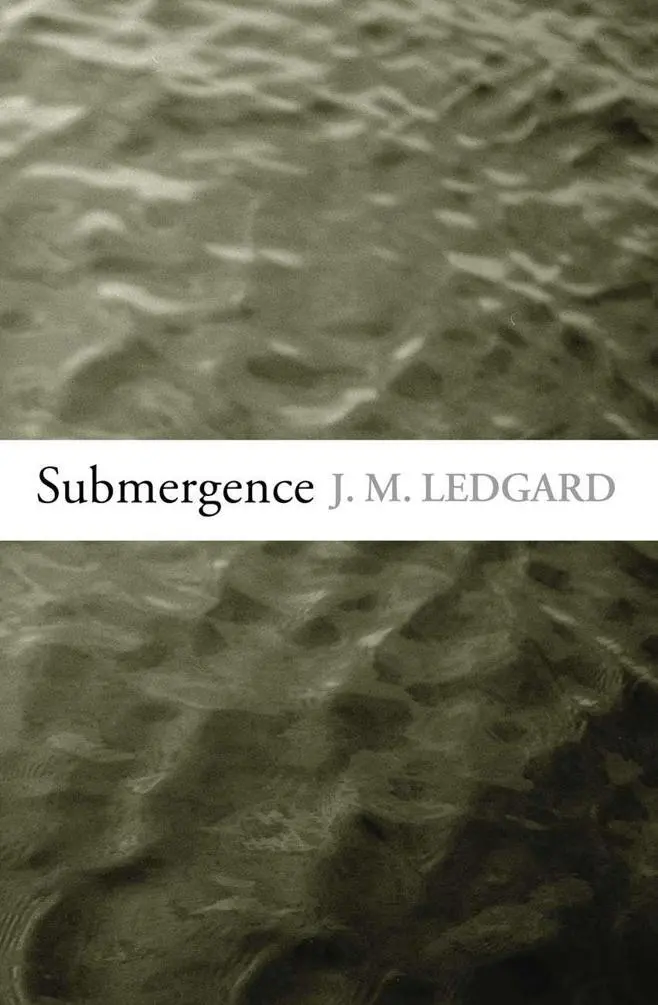
- Название:Submergence
- Автор:
- Издательство:Random House UK
- Жанр:
- Год:2011
- ISBN:9781446496831
- Рейтинг книги:5 / 5. Голосов: 1
-
Избранное:Добавить в избранное
- Отзывы:
-
Ваша оценка:
Submergence: краткое содержание, описание и аннотация
Предлагаем к чтению аннотацию, описание, краткое содержание или предисловие (зависит от того, что написал сам автор книги «Submergence»). Если вы не нашли необходимую информацию о книге — напишите в комментариях, мы постараемся отыскать её.
Both are drawn back to the previous Christmas, and to a French hotel on the Atlantic coast, where a chance encounter on the beach led to an intense and enduring romance. For James, his mind escapes to utopias both imagined and remembered. Danny is drawn back to beginnings: to mythical and scientific origins, and to her own. It is to each other and to the ocean that they most frequently return: magnetic and otherworldly, a comfort and a threat.
Submergence — читать онлайн бесплатно полную книгу (весь текст) целиком
Ниже представлен текст книги, разбитый по страницам. Система сохранения места последней прочитанной страницы, позволяет с удобством читать онлайн бесплатно книгу «Submergence», без необходимости каждый раз заново искать на чём Вы остановились. Поставьте закладку, и сможете в любой момент перейти на страницу, на которой закончили чтение.
Интервал:
Закладка:
A biblical scene — no, a Koranic scene — the clerics, the men standing behind the piles of stones, the exclamations, the strange trees casting their shapes, the dust itself, the stones flying and missing. It was ancient, also new. The sermon that followed was played over loudspeakers in the town. He had pushed the bird away and listened. Barbed wire was drawn across the square, the gun on one of the Land Cruisers was directed at the crowd. There was a camera recording it for a website. They downloaded the video onto a phone and forced him to watch. No matter how many times it was sped up or slowed down, no matter the cutaway or close-ups, there was no way to correct it: it was an injustice that could never be corrected. If you paused it, he thought, the stones would not stop in the air. If you muted it, the sound would continue.

When the feeding of the people in the port was over, he walked across the town square with the fighters. The moon was out. The square was ashen. The pit was still there. One of the fighters pointed it out. It was filled in with darker earth. A pock.
He fainted one afternoon in the surgery, in the white, and saw Yusuf al-Afghani standing in a wadi in the Somali desert. Clouds passed over. Yusuf’s arms were sunk to his elbows in a jar of spermaceti. It shifted, and Yusuf was on the deck of a ship, a sea captain, a brigand, the ship standing still, the sails limp, it was before a tropical storm, all the air sucked out. Then the ship was gone, sunk, and Yusuf stood under a palm tree and he saw the smooth black hands entering into spermaceti. They must be there in the white jar, they could not disappear, but how was it possible to know? What was Yusuf doing? Was he going to anoint himself with a mark of spermaceti oil on his forehead, a blessing at a coronation, or was he going to bring handfuls of the white stuff to his mouth and eat it softly like calf’s brain? He watched and was made cognisant of another image, of the Finnish painter Hugo Simberg’s wounded angel, carried by two boys, a painting he had seen as a young man in a Helsinki summer long ago, and which forever changed the way he saw the world.
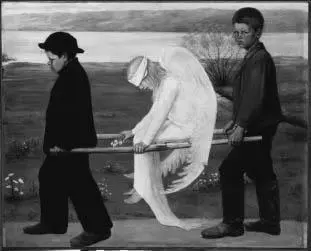
It was a melting in him, visually. There was John More swallowed by a sperm whale off the Patagonian coast and Yusuf with his forearms sunk in a jar of spermaceti, and there was Simberg’s angel, and he could not see the connection, except in the whiteness of the windows in the surgery, of the jar, of John More cut by flensers from the whale’s belly, the whiteness of the angel’s bandage, and the wound beneath; and there was the face of the boy in the Simberg painting, who stared at him as he passed by, a face that could have been his own.
She walked by herself on the beach the next morning. She had left him asleep in her bed — their bed, perhaps — and felt the need to be scoured by the wind, to see the Atlantic, to feel its rhythm, the way the water met and was contained by the land. It was colder than when she had swum and the wind was at her back and seemed to lift her along the shore.
The lighthouse was white with a band of black and a band of orange around the light itself. It was built beyond the breakers on the higher side of a reef. The reef’s dingy cracks were infested with insects and molluscs and its plunging walls, rank with glistening seaweed, resembled the palm of a hand outstretched from France, resisting the storms. The door of the lighthouse was high above the reef, approached by slimy steps, and the light was often obscured in the mists. How was it built? First, they raised an iron drum on wooden stilts. Men worked on the lighthouse in fair weather and sheltered in the drum during storms and at night, singing songs and playing the accordion in the dreadful echoing wet. After several years, the windows in the lighthouse were put in and sealed and the workmen rowed back to the shore, leaving a beacon to swing across the bay and out to sea.
She could see the jagged rocks further out to sea on which many ships had foundered. The sailors, fearing being drowned so close to shore, must have called out for an acre of barren ground; broom, furze, anything, in their fear.
The waves were messy, porridgy, falling off before the lighthouse. There were no surfers. She knew how deep it was out there at the horizon. She had these other languages of numbers and sonar. She saw the deepness that was at the edge of France and it made the beach under her feel like a ledge on a cliff.
When she turned around and began walking back towards the Hotel Atlantic the wind almost knocked her over. It was like the skiing in Scotland in her undergraduate days, where the wind came so hard that even dropped into a schuss on the steep slopes she barely moved.
The longest golf drive recorded was hit on the moon. Man has yet to return to the Challenger Deep. The lesson from this is that it is easier for human beings to push outwards than it is for them to explore inwards. The wind that carries you away like a kite will blow you on your back if you turn to face it. Consider how the surface area of a balloon grows when air is blown into it. When we push out, we create new frontiers we might populate. When we take the air out of a balloon, it deflates, and becomes shrivelled.
Millions and millions of years ago we lived in the ocean. When we emerged we had to move in two dimensions, instead of three. That was painful at first. No up, nor any down. We learned to drag ourselves along without legs then with them, going faster and faster, and faster again, by any means. The lack of a third dimension is one explanation for our need to head out over the horizon. Another explanation is that we were raised up from chemosynthetic life in the deep ocean to become photosynthetic life at the top. Having ascended from the eternal night we cannot stop ourselves from heading towards the light. We are moths in the thrall of the sun and the stars, shedding off darkness. That is our instinct, but our conscious nature is also to be drawn to the unknown. We want to know what is behind the wood, what the next valley looks like, and the valley beyond that. We want to know what is in the sky and what is behind the sky. These have been our obsessions since our beginnings, yet the curiosity does not extend to the ocean. We forget there is so much darkness in our world, and to be out on a beach is to be lucky. We know the tides, because they cover the edges of our countries and swell our river mouths and fill our fishing nets, but the connection with the ocean has been lost. If it is described at all, it is as a tomb or a hiding place. Even Tennyson needed the Kraken to batter huge sea worms in its sleep until the last fires heated the deep. Moby-Dick is the greatest novel in the English language about the sea. It is not concerned with the ocean. Only at the end of the book is there a sense of sinking and what is beneath, when the Pequod twists into a whirlpool and a death shroud of water closes over it and calms, rolling as it did 5000 years ago. You may have read Twenty Thousand Leagues Under the Sea . The distance in the title refers to the journey taken across, not down. If you read it as a child, it would have been an adventure story. As a grown-up, you might be more interested in Captain Nemo’s background as an Indian national embittered by the Sepoy mutiny. At any rate, there is nothing of oceanography to be learned from the book. Nemo steers the Nautilus down deep, but Jules Verne makes the deep hospitable! There is no weighing of atmospheres, no crushing pressure, no eternal night. When Nemo takes Professor Aronnax on an underwater hike to sunken Atlantis, Verne asks the reader to imagine a forested slope in the Harz mountains in Germany, only underwater.
Читать дальшеИнтервал:
Закладка:
Похожие книги на «Submergence»
Представляем Вашему вниманию похожие книги на «Submergence» списком для выбора. Мы отобрали схожую по названию и смыслу литературу в надежде предоставить читателям больше вариантов отыскать новые, интересные, ещё непрочитанные произведения.


Обсуждение, отзывы о книге «Submergence» и просто собственные мнения читателей. Оставьте ваши комментарии, напишите, что Вы думаете о произведении, его смысле или главных героях. Укажите что конкретно понравилось, а что нет, и почему Вы так считаете.