Daniel Alarcon - Lost City Radio
Здесь есть возможность читать онлайн «Daniel Alarcon - Lost City Radio» весь текст электронной книги совершенно бесплатно (целиком полную версию без сокращений). В некоторых случаях можно слушать аудио, скачать через торрент в формате fb2 и присутствует краткое содержание. Год выпуска: 2008, Издательство: Harper Perennial, Жанр: Современная проза, на английском языке. Описание произведения, (предисловие) а так же отзывы посетителей доступны на портале библиотеки ЛибКат.
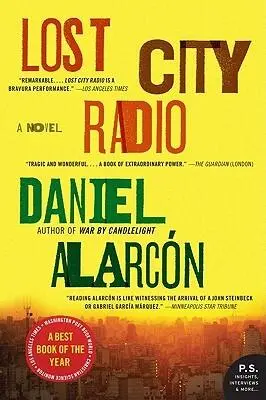
- Название:Lost City Radio
- Автор:
- Издательство:Harper Perennial
- Жанр:
- Год:2008
- ISBN:нет данных
- Рейтинг книги:4 / 5. Голосов: 1
-
Избранное:Добавить в избранное
- Отзывы:
-
Ваша оценка:
Lost City Radio: краткое содержание, описание и аннотация
Предлагаем к чтению аннотацию, описание, краткое содержание или предисловие (зависит от того, что написал сам автор книги «Lost City Radio»). Если вы не нашли необходимую информацию о книге — напишите в комментариях, мы постараемся отыскать её.
, she reads the names of those who have disappeared — those whom the furiously expanding city has swallowed. Through her efforts lovers are reunited and the lost are found. But in the aftermath of the decadelong bloody civil conflict, her own life is about to forever change — thanks to the arrival of a young boy from the jungle who provides a cryptic clue to the fate of Norma's vanished husband.
Lost City Radio — читать онлайн бесплатно полную книгу (весь текст) целиком
Ниже представлен текст книги, разбитый по страницам. Система сохранения места последней прочитанной страницы, позволяет с удобством читать онлайн бесплатно книгу «Lost City Radio», без необходимости каждый раз заново искать на чём Вы остановились. Поставьте закладку, и сможете в любой момент перейти на страницу, на которой закончили чтение.
Интервал:
Закладка:
“I don’t understand.”
“Of course. There aren’t many of us who really know you.” The man eyed him and didn’t blink. “Shall I say your other name? Shall I prove it?”
Rey felt suddenly that his youth was a decade in the past, that he had become, seemingly overnight, old and decrepit, a man with nothing to lose. He was dying. He shook his head. He hadn’t seen Norma again, hadn’t thought of her until that exact moment. Would he even recognize her? He had spent six months confined by the unsettling substance of his own dreams. Rey took the envelope without looking at it, slipped it into his inside coat pocket. It was thin and waxy. He knew instinctively the envelope was empty. It was a test.
The man smiled. “Avenue F–10. Lot 128. Ask for Marden.”
They’ll lock me up again, Rey thought, and this time no one will see me. This time they won’t spare me. If he went to the police, what would he say? What would he have for them? An empty envelope and vague descriptions of a man with a thin beard and an ill-fitting suit. And where did you meet this man, the police would ask — oh, here it is, where I give myself away: when I was a prisoner, sir, at the Moon.
The man scratched his brow. “You have questions I can’t answer,” he said. “In the meantime, I’ll ask you one: those soldiers. The ones who kept us company when we last met. Do you hate them?”
The bus was a half-block away. Hate was a word Rey never used. It meant nothing to him. The soldiers had pissed on him joylessly, with the detachment of scientists performing an experiment. When Rey was a boy, he and his friends captured beetles, placed them in plastic tins, and set them on fire, blissfully cruel: a group of boys, charmed by this collaborative act of malice. Why did this memory fill him with such nostalgia, and why were the soldiers so dispassionate in their cruelty? They had tortured him with the same conviction with which he wandered around Tamoé. That is to say, they had done so listlessly, by rote. How could he hate them? It was their job. If they had so much as snickered, Rey felt certain, he could. Loathe them. Absolutely. Without that, they seemed strangely innocent.
The bus jerked to a stop before them, and Rey made as if to rise, but the man in the wrinkled suit held him back. “You’ll wait for the next one,” he said. He got on the bus and didn’t look back.
HE KEPT on to the envelope for two weeks. That first night, after Trini had come and gone, after his father had gone off to sleep, Rey held it up to the light and verified it was empty. There was a script letter M in the upper right-hand corner. The envelope was sealed, thin, and insubstantial.
Rey returned to Tamoé all that week, expecting each morning to see the man with the thin beard. He never did. He walked around the neighborhood as he always had, taking notes, drawing his crude maps, filling out forms with illiterate men who insisted on looking everything over before signing an X to the bottom of the page. He studiously avoided Avenue F–10, never crossing it on foot: if he was to work on the north side of F–10, he took the bus a few stops past and spent the entire day there. On other days, he confined himself to the south side, never nearing this new, artificial border.
It took him two weeks, but when Rey finally decided to see Marden, he did it right away. Later he would wonder why he went at all, and decide it was curiosity — a natural curiosity — and tell himself that a healthy interest in the unknown would always be useful. In his career as a scientist, and in his life, if he were allowed to live it. It was not the hate that the man in the wrinkled suit wanted him to feel: Rey felt proud of that somehow. Still, he was afraid. He dressed that day as he normally would, washed his face under the cold-water tap of his father’s apartment, and folded the empty envelope into his front pocket. When he pulled the door shut behind him, Rey felt a heaviness in the act.
Avenue F–10 ran roughly east-west through Tamoé, a potholed four-lane road divided by a gravel median, dotted with the occasional withering shrub. The avenue was lined with squat apartment houses, crowded repair shops, and a few restaurants of questionable cleanliness and limited menus. If a place like Tamoé could be said to possess a center, F–10 was it: one of two avenues with streetlights in the newly colonized district. On his north-side days, Rey’s bus ride home crossed the avenue: he could sense its glow, its energy from blocks away. After dark, groups of boys congregated beneath F–10’s streetlights: laughing, alive, they squatted around these totems, bathing in the pale orange glow. Rey found it perplexing: it seemed the youth of the district never left Tamoé; instead, they came here, to this avenue, just to stand in the light.
That morning, Rey got off in the heart of F–10 and walked east. Even by day, it was crowded with young people. Women sold tea from wooden carts, emollients of pungent odors, syrups that promised to cure any cough. Moto-taxis clustered on the corner, ferrying vendors to the market a few blocks away. But ten blocks on, the avenue regained the provincial air that defined the rest of the district. The asphalt disappeared abruptly, and the four-and five-story apartment houses, Tamoé’s most solidly constructed buildings, were replaced by shanties, of the kind that concerned Rey and his work most directly: ad hoc homes of considerable ingenuity, homes built of material scavenged from the city. Illegal, ubiquitous, inevitable, the city would grow and grow and no one could imagine it ever stopping. The avenue itself petered out at the base of a crumbling, yellow hill, a dusty lane running headlong into a mound of scree. Here, a shirtless child had planted a red flag in the pile of rock. A half-dozen children ran around it, ignoring Rey, now and then clambering up, only to be repelled by a hail of stones. They played war. A thin, black dog sat at a safe distance from the children, chewing nervously on a piece of Styrofoam.
Lot 128 was set just off the dusty edge of the street, to the left of the pile of rocks. It was a house like any other on the block, mud brick with small, paneless windows on either side of the door, and lined with a knee-high fence of woven reeds. Rey stepped over it. The number was painted neatly in the center of the door. Rey resisted the urge to peek through the windows. He knocked twice and waited.
“Marden,” Rey said when the door opened. “I have a message for Marden.”
The man in the doorway was large and pale, wearing an undershirt and dark drawstring pants patched at the knees. He was older than fifty, perhaps much older. His hair was the color of a used cigarette filter, and his face, jowly and slack, had that same exhausted, yellow-gray pallor. If he was Marden, the name seemed to have no effect on him, or rather not precisely the effect Rey had been expecting: a look of recognition, even camaraderie. The man looked down the street suspiciously, then waved Rey in. He pointed to a chair in the center of the room, and squatted in front of a tiny gas burner resting on the dirt floor. With a bent fork, he tended to a single egg. It bobbed and sank in a pot of boiling water.
“Breakfast,” the man said. He apologized for having nothing to offer his visitor, but he did so in a tone Rey could not mistake for warmth.
“I ate, thank you,” Rey said. The man shrugged and tapped his egg.
The room was dark, the air full of dust and smoke and steam. Besides the chair, there was a twin bed and a radio on the nightstand. In the generally colorless room, there was one grand splash of reddish orange: a finely knit bedspread, fiery and bright and out of place.
The man must have caught him looking. “My mother made it,” he said. “Years ago.”
Читать дальшеИнтервал:
Закладка:
Похожие книги на «Lost City Radio»
Представляем Вашему вниманию похожие книги на «Lost City Radio» списком для выбора. Мы отобрали схожую по названию и смыслу литературу в надежде предоставить читателям больше вариантов отыскать новые, интересные, ещё непрочитанные произведения.






Обсуждение, отзывы о книге «Lost City Radio» и просто собственные мнения читателей. Оставьте ваши комментарии, напишите, что Вы думаете о произведении, его смысле или главных героях. Укажите что конкретно понравилось, а что нет, и почему Вы так считаете.