Daniel Alarcon - Lost City Radio
Здесь есть возможность читать онлайн «Daniel Alarcon - Lost City Radio» весь текст электронной книги совершенно бесплатно (целиком полную версию без сокращений). В некоторых случаях можно слушать аудио, скачать через торрент в формате fb2 и присутствует краткое содержание. Год выпуска: 2008, Издательство: Harper Perennial, Жанр: Современная проза, на английском языке. Описание произведения, (предисловие) а так же отзывы посетителей доступны на портале библиотеки ЛибКат.
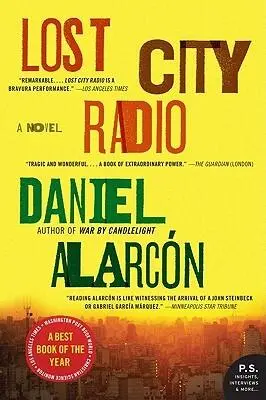
- Название:Lost City Radio
- Автор:
- Издательство:Harper Perennial
- Жанр:
- Год:2008
- ISBN:нет данных
- Рейтинг книги:4 / 5. Голосов: 1
-
Избранное:Добавить в избранное
- Отзывы:
-
Ваша оценка:
Lost City Radio: краткое содержание, описание и аннотация
Предлагаем к чтению аннотацию, описание, краткое содержание или предисловие (зависит от того, что написал сам автор книги «Lost City Radio»). Если вы не нашли необходимую информацию о книге — напишите в комментариях, мы постараемся отыскать её.
, she reads the names of those who have disappeared — those whom the furiously expanding city has swallowed. Through her efforts lovers are reunited and the lost are found. But in the aftermath of the decadelong bloody civil conflict, her own life is about to forever change — thanks to the arrival of a young boy from the jungle who provides a cryptic clue to the fate of Norma's vanished husband.
Lost City Radio — читать онлайн бесплатно полную книгу (весь текст) целиком
Ниже представлен текст книги, разбитый по страницам. Система сохранения места последней прочитанной страницы, позволяет с удобством читать онлайн бесплатно книгу «Lost City Radio», без необходимости каждый раз заново искать на чём Вы остановились. Поставьте закладку, и сможете в любой момент перейти на страницу, на которой закончили чтение.
Интервал:
Закладка:
Norma smiled at him, and she looked like sunshine. She hadn’t forgotten him, either. Rey panicked.
It was true. It was always true: you could believe one thing and its opposite simultaneously, be afraid and reckless all at once. You could write dangerous articles under an assumed name and believe yourself to be an impartial scholar. You could become a messenger for the IL and fall in love with a woman who believed you were not. You could pretend that the nation at war was a tragedy and not the work of your own hand. You could proclaim yourself a humanist and hate with steely resolve.
When, after the conflict, the displaced thousands returned to the site of the Battle of Tamoé, they found their homes burned, their avenues cratered, their hills littered with unexploded ordnance. Tanks had run through their streets, bulldozers had razed entire blocks of houses. Their beloved streetlights had fallen too, but in any case, there were few young people left to gather around them. The entire district would be rebuilt. Without a monument to the dead, without so much as a plaque to commemorate what had been there before. It was announced that the families who had their paperwork in order would be permitted to return, would be forgiven. If they could find their old plot, it was theirs, regardless of their role in the battle or their sympathies for the IL. An office was set up on a burned-out block of F–10 to process the petitions. A line gathered there each morning before dawn. For months, they came, heads bowed like penitents, carrying the forms Rey had written for them or the maps he had drawn, and it was all they owned in the world.
NINE
MANAU ARRIVED in the city and inhaled. Its odor was enough: that potent mix of metal and smoke. He was home. Adela’s boy held his hand, and Manau felt keenly the possibility of forgetting: her taste, her body, her caresses. He shut his eyes.
The boy looked up at him: “What will we do?”
Manau squeezed his hand and pulled him along. He carried both their bags over his shoulder. The street outside the bus station was full of people, spilling off the sidewalks, scrambling between the cars. The boy had said almost nothing the last hour of the bus ride. Even this simple question — what will we do? — had to be viewed as progress. He gazed at everything with wide, fearful eyes. The boy was not home: he was in hell. And the city was a terrible place, to be sure, but the world was made up of terrible places. Maybe Victor was too young to take solace in that fact. And there were other facts: Adela was dead, and now they were both alone. Manau tried, as he had for the previous four days, to clear his mind, but still he was pursued by the urge to weep. Ten days before, he had made love to Adela on a mat of reeds. It had been a moonless night. Around them, above them, in the near distance of the forest, birds had made their bright and inscrutable music. A pang of desire shot through him at the memory: he and Adela had scratched one another and pushed, they had rolled clumsily off the mat and onto the ground. The moist earth had stuck to their bodies. Later, the rains came to clean them: a sky split by lightning, curtains of purple water crashing loudly over the trees.
In the city, the sky and its clouds glowed white. It was a year since he’d seen this shade of color above.
“Is it going to rain?” Victor asked. “Is that what you’re looking at?”
Manau managed a smile. “I don’t think so.” He didn’t say that they were in the coastal desert now, that as long as he stayed in the city, Victor would not see anything recognizable as rain. Always cloudy, this city, always humid. It’s a trick, Manau wanted to say. “Are you hungry?” he asked instead, and the boy nodded.
An Indian woman squatted on the sidewalk, selling bread from a covered basket balanced on a crate. She puffed on the stub of a hand-rolled cigar and did not smile. Manau took two rolls of bread and paid her with a handful of coins. The woman held them in her palm for a second, then frowned. She took one between her molars and twisted it. The metal coin bent in her teeth.
“It’s fake,” she said, handing it back. “Don’t give me this jungle money.”
Her mountain accent was thick with masticated vowels. Jungle money? Manau mumbled an apology and fished a bill from his pocket. The boy watched the proceedings without comment. He had already eaten half of his roll. The woman scowled. “Pay first, then eat, boy.” She held Manau’s bill up, inspecting it. “Where do you come from?” she asked.
“From 1797,” Manau said. He tried a joke: “The money’s good, madam. I made it myself.”
She released a mouthful of smoke. Not even a smile. “You people have ruined this place.” She handed Manau his change and turned to serve another customer.
Manau felt his blood rising. The city was impregnated with the smell of ruin: it swirled in the sodden air and stuck to you, wherever you went. It followed me all the way to the jungle, Manau thought, and now he stood accused of bringing it home again. He looked at the woman, at the boy. In the neighborhood where he was raised, there was an Indian woman who shined shoes and sharpened knives. She walked the streets, chatting with the women who knew her, offering candy to the children. She lived beneath the bridge at the end of the street, and she always smiled and never complained, not even when the war got bad and half her customers moved away — that’s how they were supposed to be: these mountain people, these desperate poor.
Manau spat on the sidewalk in front of the woman.
“Move on!” she hissed.
Then he had done it, not for himself but for the boy: with a swift kick, Manau upended the woman’s basket of bread, knocking it off the crate. There was a shout. Bread spilled everywhere on the dirty sidewalk, rolled into the gutter. In an instant, the woman was up, her face hot, her fists clenched. She would have attacked and certainly hurt him — but there was no time: the passersby had turned on her, had swarmed her, they were stealing her bread. The woman scurried behind them, swatting at hands, but it was no use. Her bread disappeared into the hands of men in work clothes, and mothers in housedresses, and ratty street kids with matted hair. “Thieves!” the woman yelled, red to bursting, her face a livid, unnatural color. Something animal had been unleashed in her, and she waved her cigar in frantic, menacing loops. She attacked a man who had snatched a roll and, for a brief and shocking instant, it seemed she might bite him.
A day’s worth of bread vanished in fifteen seconds.
It happened so fast that he couldn’t be sure why he had done it, only that he did not regret it. Not at all. Manau tossed some change at the upturned basket, took Victor’s hand, and backed away. He looked down the avenue. In the distance was the radio’s spire, a woven metal phallus pointing skywards, adorned with blinking red lights. “Let’s go,” Manau said to the boy, and they went toward it, first walking, then racing, as if someone or something were chasing them.
IT WAS only ten days before, as they drank palm wine and waited hopefully for a breeze, that Zahir had invited Manau to touch his stumps. “Be kind to an old man,” he said, though Manau did not think of his landlord and friend as old. “I’m sad today.”
“Are you sure?”
“Of course I’m sure. It’s about time you did. You stare.”
Manau blushed and began to protest, but Zahir interrupted him. “It’s all right,” he said. “Everyone does.”
The sun had sunk behind the trees, and the sky dimmed toward a lacquered blue-black. It was the edge of night in the jungle: a nimbus of mosquitoes buzzed around the kerosene lantern. Manau sipped his wine from a gourd. Nico had been gone for months now, and no one had heard from him. That night and every night, Manau was careful not to mention Zahir’s son. When the wine loosened his tongue, Manau felt he might confess, but then he was unsure what to say, and so said nothing. Nearly half a year had passed this way. A harvest had come and gone.
Читать дальшеИнтервал:
Закладка:
Похожие книги на «Lost City Radio»
Представляем Вашему вниманию похожие книги на «Lost City Radio» списком для выбора. Мы отобрали схожую по названию и смыслу литературу в надежде предоставить читателям больше вариантов отыскать новые, интересные, ещё непрочитанные произведения.




Обсуждение, отзывы о книге «Lost City Radio» и просто собственные мнения читателей. Оставьте ваши комментарии, напишите, что Вы думаете о произведении, его смысле или главных героях. Укажите что конкретно понравилось, а что нет, и почему Вы так считаете.