Daniel Alarcon - Lost City Radio
Здесь есть возможность читать онлайн «Daniel Alarcon - Lost City Radio» весь текст электронной книги совершенно бесплатно (целиком полную версию без сокращений). В некоторых случаях можно слушать аудио, скачать через торрент в формате fb2 и присутствует краткое содержание. Год выпуска: 2008, Издательство: Harper Perennial, Жанр: Современная проза, на английском языке. Описание произведения, (предисловие) а так же отзывы посетителей доступны на портале библиотеки ЛибКат.
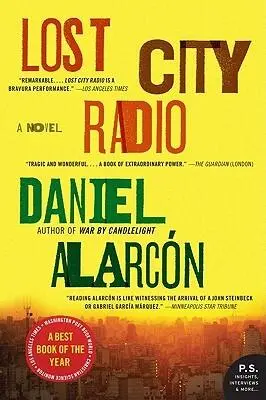
- Название:Lost City Radio
- Автор:
- Издательство:Harper Perennial
- Жанр:
- Год:2008
- ISBN:нет данных
- Рейтинг книги:4 / 5. Голосов: 1
-
Избранное:Добавить в избранное
- Отзывы:
-
Ваша оценка:
Lost City Radio: краткое содержание, описание и аннотация
Предлагаем к чтению аннотацию, описание, краткое содержание или предисловие (зависит от того, что написал сам автор книги «Lost City Radio»). Если вы не нашли необходимую информацию о книге — напишите в комментариях, мы постараемся отыскать её.
, she reads the names of those who have disappeared — those whom the furiously expanding city has swallowed. Through her efforts lovers are reunited and the lost are found. But in the aftermath of the decadelong bloody civil conflict, her own life is about to forever change — thanks to the arrival of a young boy from the jungle who provides a cryptic clue to the fate of Norma's vanished husband.
Lost City Radio — читать онлайн бесплатно полную книгу (весь текст) целиком
Ниже представлен текст книги, разбитый по страницам. Система сохранения места последней прочитанной страницы, позволяет с удобством читать онлайн бесплатно книгу «Lost City Radio», без необходимости каждый раз заново искать на чём Вы остановились. Поставьте закладку, и сможете в любой момент перейти на страницу, на которой закончили чтение.
Интервал:
Закладка:
Rey promised Norma: he’d been cleansed of all political ambitions. “It’s simple,” he said with such fervor she might have believed him. Indeed, the essence of what he said was true: “I want to live. I want to grow old with you. I don’t ever want to go back.”
BUT IT began only six months after he’d returned from the Moon, a few years before the tadek controversy, on a morning crosstown bus, the day Rey spotted the man with the beard. He wore the same wrinkled suit, the same look of amused indifference. Was it him? It was; it wasn’t. Rey rubbed his eyes. Here, among strangers, he usually did his best thinking: divagations of the mind, blurring and then effacing that which he did not care to remember. The Moon, the Moon: it stayed with him, a song whose melody he couldn’t escape. His uncle Trini had found him a job in Tamoé, inspecting the settlements, working for the government agency that ratified land takeovers. It was temporary, an invisible post in an invisible bureaucracy, something to hold him over until he could muster the strength to return to the university. He’d been there only three weeks, wandering among the shanties, asking questions of mothers who eyed him suspiciously, as if he were coming to take their homes away. He wrote names on his clipboard, drew rudimentary maps of the squalid neighborhoods on graph paper the office provided him. He lunched in silence at the open-air market, and these were his days. He remembered the Moon, imagined it just behind every hill. The bus ride was an hour and a half each way, spent between sleep and a kind of autohypnotism he’d perfected: watching his fellow passengers until his eyes crossed, until they became shapes and colors and not people at all. The city passed in the window, now and then a word calling him from the newspaper someone might be reading, the war appearing in headlines, still on an inside page, still a distant nightmare. He himself never read the newspaper; he made a point not to.
Now the bus took a tight turn, the passengers swaying with it — dancers, all of them — and Rey caught another glimpse of the man: we were chained together, Rey thought, and he shut his eyes tightly. The dreams were evenly spaced now, not every night, but twice-weekly explosions of filmic violence. He ground his teeth in his sleep, could feel the soreness in his jaw each morning, the grit of enamel peppering his tongue. He stayed with his father, slept on the sofa, and Trini came over every evening to see his shell-shocked nephew; together, they relived better days over steaming cups of tea. “You need a woman,” Trini said, and it was the only thing Rey’s father and uncle could agree on.
The man in the wrinkled suit was staring at him. Or perhaps Rey was staring. It was impossible to tell: one would have imagined that the city was a perfect place for anonymity, a place to disappear, a place so opaque it would do your forgetting for you. But here he was. Their eyes met. It’s my second home, the man had said. Rey shuddered. It meant he was marked. A time bomb. More than anything, Rey wanted to get off at the very next stop: he was content to wait for the next bus on any strange, unknown corner of the city, anywhere far away from this man — I’ll be late for work, he thought, it doesn’t matter. Rey noticed he was sweating, his heart skipping along, frantic, while the man in the wrinkled suit — Rey could see him now, amid the somnolent, workaday crowd — the man seemed perfectly calm. He met Rey’s gaze; he didn’t flinch or turn away.
Rey rode the rest of the way with his eyes half-closed, pretending to sleep. When he awoke, the man was gone. It was a clear day in Tamoé, a day of bright sun that acted upon him as a drug might: Rey found himself knocking on the wrong doors, stumbling over his prepared speech — I represent the government; I am here to help you legitimize your claim on this land, on this house. Sweat beaded on his brow, stung his eyes. Doors were slammed in his face, women refused to speak with him without their husbands present. He left business cards and promised to return, but the day stretched on in an opiate haze, Rey trudging from one dusty street to the next. He represented the government — just as those soldiers had, the night they pissed on him beneath the stars. The generous embrace of power, Trini called it, with a smirk. “Don’t worry, boy,” his uncle had said. “If they blacklisted everyone they sent to the Moon, there’d be no one left to hire.”
A couple of days passed before he saw the man in the wrinkled suit again: on the same morning bus ride through the city to Tamoé. This time, the man boarded a few stops after Rey and nodded at him — it was unmistakable! brazen! — before burying his face in a newspaper. The next day, it was the same thing. And the next. Rey called in sick on the fourth day, an unnecessary courtesy he felt compelled to provide: he was a minion in a swollen bureaucracy, and no one would have noticed. Still, he wrapped himself in a coat, stumbled outside, and called from the pay phone on the corner, shivering. He dutifully reported symptoms as vague as they were real: a slight sense of vertigo, a pain in his shoulder, a shallowness of breath. He said nothing of the fear or the nightmares of paralyzing intensity. What he needed, he decided as he spoke to an uninterested secretary, was some rest.
Rey returned to work the following day, and this time, the man in the wrinkled suit was waiting for him at the bus stop, seated on the bench with a newspaper folded under his arm, staring blankly at the passing traffic. Rey hadn’t mentioned this apparition to anyone — not to his father or Trini. It felt like an assault. There was no one else at the bus stop. Rey glared at the man, and the man smiled back.
“Are you following me?” Rey asked.
“Won’t you sit?” The man’s tone was warm, avuncular. “We have things to discuss, you and I.”
“I find that hard to believe,” Rey said, but he sat anyway. “I’m not scared of you.”
“Of course,” the man said. He had gained some weight since Rey saw him last. Then again, one might assume they all had. At the Moon, a soldier came by twice a day and dropped pieces of bread into the hole, along with a plastic bag full of water. “Tamoé,” the man said, “is the future of this stricken nation.”
A bus came; a woman with a bag of vegetables stepped off. The bus driver held the door open, waiting for Rey, but the man in the wrinkled suit waved it away.
“In Tamoé, the foundation will be laid. Is being laid, I should say, at this very moment. Tell me, do you enjoy your work?”
What was there to like? It was a slum like any other. Rey coughed into his hand.
“We have people there,” the man continued. He nodded slowly, the edges of his mouth creeping toward a smile. “I would like you to meet them.” He reached into an inside pocket and pulled out an envelope. “I can’t visit them with you. It wouldn’t be safe.”
Rey looked at the man and then around him at the busy avenue. From a distance, they were simply two men — strangers, acquaintances — chatting. Was anyone watching them? Listening? They could be speaking of the weather, or the weekend scores, or anything. The man placed the envelope on the bench between them. “Why me?” Rey asked.
“Because I know your name,” the man said. “Not the one you were born with. The other one.”
The name, the ID. For an instant, an image flashed before him: the woman he hadn’t seen since the night his misfortunes began. Norma was her name. Norma. “I don’t know what you’re talking about,” Rey said, but the words had a disappointing lack of weight to them: they sounded weak, tenuous.
“I see they succeeded in frightening you at the Moon. There are other things you can do for us. Quiet things. Clean things. You needn’t be public anymore to be useful.”
Читать дальшеИнтервал:
Закладка:
Похожие книги на «Lost City Radio»
Представляем Вашему вниманию похожие книги на «Lost City Radio» списком для выбора. Мы отобрали схожую по названию и смыслу литературу в надежде предоставить читателям больше вариантов отыскать новые, интересные, ещё непрочитанные произведения.





Обсуждение, отзывы о книге «Lost City Radio» и просто собственные мнения читателей. Оставьте ваши комментарии, напишите, что Вы думаете о произведении, его смысле или главных героях. Укажите что конкретно понравилось, а что нет, и почему Вы так считаете.