Rafael Yglesias - Hot Properties
Здесь есть возможность читать онлайн «Rafael Yglesias - Hot Properties» весь текст электронной книги совершенно бесплатно (целиком полную версию без сокращений). В некоторых случаях можно слушать аудио, скачать через торрент в формате fb2 и присутствует краткое содержание. Город: New York, Год выпуска: 2010, ISBN: 2010, Издательство: Open Road Integrated Media LLC, Жанр: Современная проза, Юмористическая проза, на английском языке. Описание произведения, (предисловие) а так же отзывы посетителей доступны на портале библиотеки ЛибКат.
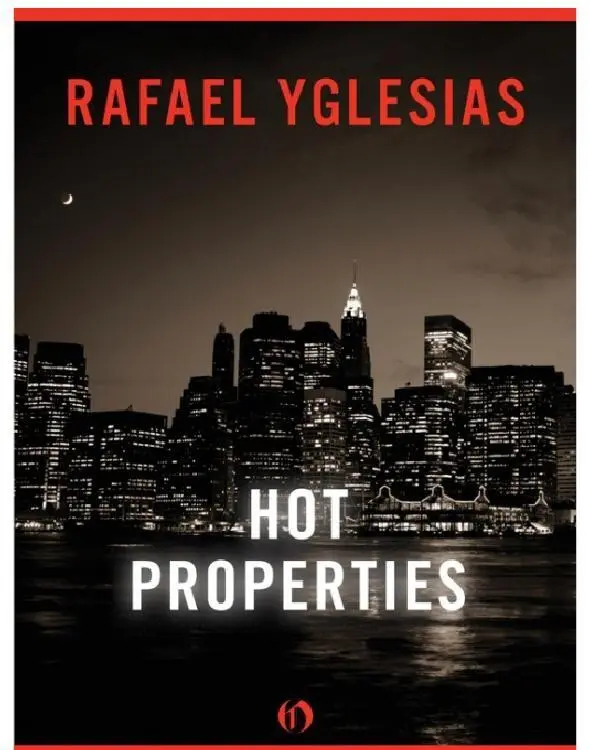
- Название:Hot Properties
- Автор:
- Издательство:Open Road Integrated Media LLC
- Жанр:
- Год:2010
- Город:New York
- ISBN:9781453205082
- Рейтинг книги:3 / 5. Голосов: 1
-
Избранное:Добавить в избранное
- Отзывы:
-
Ваша оценка:
Hot Properties: краткое содержание, описание и аннотация
Предлагаем к чтению аннотацию, описание, краткое содержание или предисловие (зависит от того, что написал сам автор книги «Hot Properties»). Если вы не нашли необходимую информацию о книге — напишите в комментариях, мы постараемся отыскать её.
Rafael Yglesias’s most sharp-tongued satire,
exposes the greed, envy, and backbiting in a media world bloated with money and power.
This ebook features a new illustrated biography of Rafael Yglesias, including rare photos and never-before-seen documents from the author’s personal collection.
Touted by the gossip columns as a roman a clef about the publishing world, Yglesias's fourth novel has definite commercial potential, since there are always people who like to read sordid tales about the media. Focusing on a group of ambitious, opportunistic New York yuppies, each desperate for success, power, fame, money and glamorous sexual partners, Yglesias follows his characters as their aspirations flourish or fade. And even for the one person who comes up with a smashing bestseller, happiness is an elusive emotion, banished by inner fear and self-loathing. The leading players in this fermenting brew are introduced in the book's opening scene, a dinner party so exquisitely awkward that even the reader is embarrassed. Thereafter we watch an aspiring playwright sell out to Hollywood; a sexy blonde discover she can really write, but must use her body to assure publication; a blocked novelist lose his scruples, professional and personal; a journalist at a leading newsmagazine realize that his way to the top has been sabotaged by office intrigue. Yglesias views his characters with cynicism, but he knows how to create the dramatic momentum that will have readers turning the pages. And if his book does become a bestseller, he will have the ironic last laugh.
Copyright 1986 Reed Business Information, Inc.
“
[is] the novel you want in the Hamptons. It lambastes the pretensions of the people you’ve been glaring at on the beach all day, and excoriates the city you’ve left behind.”
— “Sharp, funny, and fresh insight into the American literary world…”
—
From Publishers Weekly
Review
Hot Properties — читать онлайн бесплатно полную книгу (весь текст) целиком
Ниже представлен текст книги, разбитый по страницам. Система сохранения места последней прочитанной страницы, позволяет с удобством читать онлайн бесплатно книгу «Hot Properties», без необходимости каждый раз заново искать на чём Вы остановились. Поставьте закладку, и сможете в любой момент перейти на страницу, на которой закончили чтение.
Интервал:
Закладка:
Back in his office, David tried to think it through. He needed to have a line on it for the drinks at lunch. (He regularly ate on Tuesdays with a group of other senior editors and a number of the top writers.) But his search was for a real explanation. He felt upset. And that also bothered him. Why should he?
His Power Phone buzzed. He jumped at the loud squawk. It made him react nervously. No doubt it had been designed to produce that effect. “Yes?” he called into it.
“David.” Chico’s voice thundered metallically, “could you come up for a few minutes?”
“Sure,” he said. He tried to block out any thoughts of the meeting, assuming that Chico wanted to see him about something else and that even a hint of self-consciousness might anger Chico.
He found Chico reading blues. He nodded at David and held up a finger while he finished a paragraph. He nodded at the door. “Could you close it?”
As convinced as David had been on his way there that Chico wanted to see him about something other than the cover meeting, he was now persuaded that it was about that bizarre scene. He closed the door slowly, nervous, wishing he could delay talking with Chico until after lunch. He had had no time to think. But no matter how lightly he pushed the door, it still shut too quickly for David to have an answer to the question Chico then asked:
“What do you think that was about?”
“You mean the cover meeting?” David stalled.
Chico’s eyes shut with irritation. “Of course!” he said so forcefully that the phrase was almost an expletive.
David told the truth. “I have no idea. I couldn’t figure out what it was about.”
Chico cocked his head, interested. “I’m surprised,” he said. “I thought it was so obvious.”
David sat down, relaxed. He felt tremendously relieved by his admission. He didn’t know why he had felt obligated to have an answer, but now that he had failed to provide one, he felt sure of himself. “Not to me. Maybe I’m dense, but I don’t know what Rounder thought he was proving. I can’t believe he won’t do the Olympics as a cover.”
“If he does, he’ll be a laughingstock.” Chico shook his head no. “He won’t. It was all done to keep me in my place. He knows I should have his job. He wants me and everyone else to know that I don’t have it. He’s in charge.”
“You don’t think he’s trying to force you out?” David asked this so frankly because Chico’s words had been naked. By Newstime’s standards, they were an unprecedented catharsis. If David had had time to think, he would never have asked his question.
“He can’t. He wishes he could. But Mrs. Thorn wouldn’t allow it. She’s not prepared to trust him absolutely.”
“Maybe he meant it about the cover. Maybe he’s that naive.”
“He’s not that dumb.” Chico picked up a pen on his desk and threw it down hard. It bounced up and fell to the floor. “What do you think everyone else’s reaction was?”
“I’ll find out at lunch,” David said, again without thinking.
“Good. Call me after you come back and let me know.”
David nodded and rose slowly. I’ve just agreed to spy for him, he thought, appalled that he had committed himself so easily to such a role. No matter how much good it might do him with Chico. wasn’t it unseemly? Wouldn’t it lower him even in Chico’s eyes?
He left, went into the elevator, and on down to the lobby in a daze. He dreaded each step that took him closer to the Boar, the Newstime hangout. He had loved being in that elite circle, drinking and opening up to his peers, saying the unsayable to each other about the magazine. But now he’d have to take notes, remembering who said what, judging whether it was fit to report or not. He could alienate a rival from Chico’s affections, cast himself as Chico’s only defender. That simple promise was an endless ladder down into the depths of corruption: only his own will could keep him from the black depths of the bottom rung.
As he opened the dark glass doors and saw the gang already assembled, he almost felt like crossing himself or finding a clove of garlic to wear around his neck. Anything that could ward off the devil … and allow him to keep his soul above the slime of this opportunity.
Tony Winters waved to Lois while she turned off Sunset Boulevard. She had helped him pick the route he would take to the Valley Studios for a meeting at International Pictures, though she had laughed at his refusal to get on any freeways or to take shortcuts through the canyons. Instead, she explained he could stay on Sunset almost all the way, although a brief stint (one exit) on the Hollywood Freeway was unavoidable.
He felt a sad loneliness watching her car go. A childish, weak sensation in his belly. Maybe he was nervous about the meeting. The summons to Los Angeles had been so abrupt, and the lack of comment on his first draft of the script so puzzling and ominous. He had been sufficiently startled that he called his father — fresh from recently seeing him in New York — and asked whether the request for him to come without any comment on the script was a good or bad sign.
His father was silent for a moment or two. Then he sighed. “Neither. The odds are they neither love the script nor hate it, If they loved it. they would have said something. If they hated it, they wouldn’t want you out here for a meeting. They probably want changes, and Garth is notoriously insensitive. He probably doesn’t think you need to be stroked. After all, you’re just a writer.”
Just a writer. My God, what a universe of difference there is in the movie business between their view of writers and mine, Tony thought. He took the gentle curves of Sunset with pleasure, soothed by the silent flow of traffic and pavement, surrounded by the whoosh of his car’s air conditioning. Just a writer. To Tony, to be a writer was to be royalty. A breed of humanity that could survive time. The triumphant recorders of human life. A master psychologist, a delicate historian, a great lover, loving parent, actor, set designer, director, sound technician — to be a writer, to Tony, meant being all those things, and more, much more. Priest, comic, fool, wise man. A writer must know every line and every thought. The look of things, the sound of things, the ideas of life, and its trivialities. A writer must master everything or he is nothing. Just a writer! To him, the others were the limited ones. Temporal, insignificant. Tools to help him build his monuments.
The enormity of his task, the noble vision of its demands, cheered him as he approached the Hollywood Freeway. I have mastered these things. Maybe not as well as the great geniuses, but I have written good stuff. Shakespeare, Chekhov, Shaw, they would welcome me. I’d get a round of drinks from them. I’d get some stroking. And with determination and time, one day another Garth in another century will dream of playing the roles I write!
He negotiated a terrifying crossing of the freeway within a distance of a few hundred yards from an entrance on the extreme left to an exit on the extreme right with relative ease. Soon he was descending a hill into the pancake of the Valley. The huge billboards of International’s current movies loomed beside his car as he began to look for Gate Three. The low brown buildings of the studio seemed peaceful in the morning sun, like beach bungalows for a lower-middle-class resort. Only the parking lots filled with Mercedeses and BMW’s suggested money.
The security guard at Gate Three, who seemed to regard him suspiciously when he announced himself and whom he had come to see, became instantly servile when he found the drive-on pass that confirmed Tony Winters had a right to be there. Probably that was all in my head, he lectured himself while finding the lot where he was supposed to park. Why can’t I rid myself of this monitoring whether the world approves? I approve, dammit!
Читать дальшеИнтервал:
Закладка:
Похожие книги на «Hot Properties»
Представляем Вашему вниманию похожие книги на «Hot Properties» списком для выбора. Мы отобрали схожую по названию и смыслу литературу в надежде предоставить читателям больше вариантов отыскать новые, интересные, ещё непрочитанные произведения.








Обсуждение, отзывы о книге «Hot Properties» и просто собственные мнения читателей. Оставьте ваши комментарии, напишите, что Вы думаете о произведении, его смысле или главных героях. Укажите что конкретно понравилось, а что нет, и почему Вы так считаете.