Rafael Yglesias - Hot Properties
Здесь есть возможность читать онлайн «Rafael Yglesias - Hot Properties» весь текст электронной книги совершенно бесплатно (целиком полную версию без сокращений). В некоторых случаях можно слушать аудио, скачать через торрент в формате fb2 и присутствует краткое содержание. Город: New York, Год выпуска: 2010, ISBN: 2010, Издательство: Open Road Integrated Media LLC, Жанр: Современная проза, Юмористическая проза, на английском языке. Описание произведения, (предисловие) а так же отзывы посетителей доступны на портале библиотеки ЛибКат.
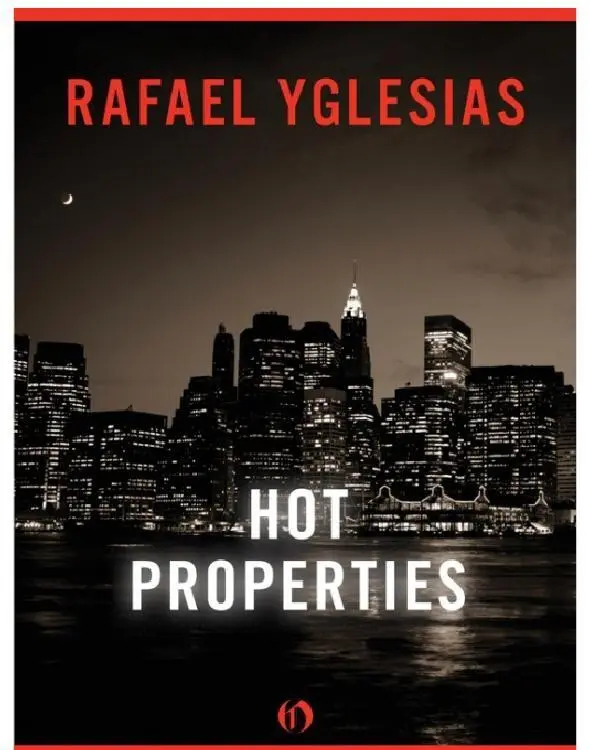
- Название:Hot Properties
- Автор:
- Издательство:Open Road Integrated Media LLC
- Жанр:
- Год:2010
- Город:New York
- ISBN:9781453205082
- Рейтинг книги:3 / 5. Голосов: 1
-
Избранное:Добавить в избранное
- Отзывы:
-
Ваша оценка:
Hot Properties: краткое содержание, описание и аннотация
Предлагаем к чтению аннотацию, описание, краткое содержание или предисловие (зависит от того, что написал сам автор книги «Hot Properties»). Если вы не нашли необходимую информацию о книге — напишите в комментариях, мы постараемся отыскать её.
Rafael Yglesias’s most sharp-tongued satire,
exposes the greed, envy, and backbiting in a media world bloated with money and power.
This ebook features a new illustrated biography of Rafael Yglesias, including rare photos and never-before-seen documents from the author’s personal collection.
Touted by the gossip columns as a roman a clef about the publishing world, Yglesias's fourth novel has definite commercial potential, since there are always people who like to read sordid tales about the media. Focusing on a group of ambitious, opportunistic New York yuppies, each desperate for success, power, fame, money and glamorous sexual partners, Yglesias follows his characters as their aspirations flourish or fade. And even for the one person who comes up with a smashing bestseller, happiness is an elusive emotion, banished by inner fear and self-loathing. The leading players in this fermenting brew are introduced in the book's opening scene, a dinner party so exquisitely awkward that even the reader is embarrassed. Thereafter we watch an aspiring playwright sell out to Hollywood; a sexy blonde discover she can really write, but must use her body to assure publication; a blocked novelist lose his scruples, professional and personal; a journalist at a leading newsmagazine realize that his way to the top has been sabotaged by office intrigue. Yglesias views his characters with cynicism, but he knows how to create the dramatic momentum that will have readers turning the pages. And if his book does become a bestseller, he will have the ironic last laugh.
Copyright 1986 Reed Business Information, Inc.
“
[is] the novel you want in the Hamptons. It lambastes the pretensions of the people you’ve been glaring at on the beach all day, and excoriates the city you’ve left behind.”
— “Sharp, funny, and fresh insight into the American literary world…”
—
From Publishers Weekly
Review
Hot Properties — читать онлайн бесплатно полную книгу (весь текст) целиком
Ниже представлен текст книги, разбитый по страницам. Система сохранения места последней прочитанной страницы, позволяет с удобством читать онлайн бесплатно книгу «Hot Properties», без необходимости каждый раз заново искать на чём Вы остановились. Поставьте закладку, и сможете в любой момент перейти на страницу, на которой закончили чтение.
Интервал:
Закладка:
The Knicks, although they gave their fans a good scare near the end. won the game, Ray Williams perfectly playing his role of the athlete redeeming personal tragedy through triumphant performance. He won the game with his controlled, determined leadership and showed no vulgar pleasure in his achievement or the fans’ delight. He left the court with his head bowed, accepting the congratulating embraces of his teammates with an unprecedented modesty.
For Fred, also, the evening was a triumph. While they shuffled into the elevator to take them out, Tom turned to him suddenly. “Where’s your friend?”
“My friend?”
“Who did you bring to the game?”
Despite the fact that Fred had had hours to prepare a response, he still fumbled over his response: “I gave it away to one of the teenagers outside.”
“You didn’t sell it?” Tony Winters asked, and again Fred thought that perhaps in his tone there was an insult, a suggestion that Fred was incapable of any act that might be considered generous or good.
Before the game, when Fred arrived in a taxi outside Madison Square Garden, there was a collection of kids desperately asking, “Selling any? Anybody selling?” as there usually is preceding a hot game. Normally there are plenty of ticket scalpers available, but their goods must have gone quickly, because by the time Fred arrived — only five minutes before game time — with his spare ticket, having thought of no one he wanted to accompany him to the box at halftime. the forlorn cries, “Ticket? Anybody got a ticket?” had not been comforted. He spotted a pair of black teenagers and walked up to them, whispering, “I’ve got one. I can give you one.”
“How much, man?” asked one.
“Where is it?” the other said before Fred could answer.
“Courtside.” Fred said.
They looked startled. And then wary. “How much you want for it?”
“Nothing. Cost me nothing.” He held the ticket out, leaving to them how to resolve which one would get it. One of them grabbed it, saying, “It’s my turn. You said it was my turn.”
“Fuck,” was all the other one could say, listlessly, suggesting that his whole life had been dominated by ill fortune.
During the first half, the kid had sat next to him, in a state of ecstasy, totally into the game, shouting himself hoarse, arguing with the refs, advising the players, cursing extravagantly at the opposition. All around them, people smiled at his intensity and laughed at his expressions of agony.
Fred had felt stupid, stuck with the extra ticket, embarrassed by his deception of Marion and his inability to think of someone to invite along that he would be comfortable with, but the accident of having provided a seat for that kid salved his conscience. You see it was for the best, he told himself. I’m a good guy, after all.
When they were released onto Seventh Avenue, surrounded by the happy departing crowd, Tom turned to Fred in a determined manner (as though this was something he had been considering for a while and had made up his mind to do because he had decided it was the right thing) and said. “I told Karl I’d drop by the poker game and play for the last couple hours. Why don’t we both go?”
“Uh …” Fred couldn’t think how to put it, and found himself telling the truth: “He didn’t invite me.”
“I know. Cause of crazy Sam. Well. Karl’s being stupid about it. Come along. Sam’s bark is worse than his bite. He’s a child. He has to be told no, or his demands just escalate endlessly.”
Fred tried to refuse, but Tom insisted, and later, sitting at the game, while everybody totaled up winnings and losses, and Karl was busy writing a check to Fred for thirty dollars. Sam said to him, “You really played good poker tonight,” in a tone that implied concession and acceptance.
I’ve won, he thought calmly, without the usual silly rush of adrenaline. He felt like tragic Ray Williams, head bowed, a champion at last, scarred to be sure, but with the home crowd finally — finally, at long last! — on his side.
David Bergman sipped his cold coffee. Presumably that morning its flavor had been heated and reheated away, and now it had even lost that one virtue — heat. But he liked sipping it. He was at the cover meeting, listening to a furious argument between Chico and Harpo over whether the Russian withdrawal from the Olympics was a Nation story (Chico’s domain) or an International story (Harpo’s bailiwick).
David listened dispassionately, enjoying, as were the other senior editors, the spectacle their supervisors were making of themselves. The effort Chico and Harpo put into disguising this battle of ego as a disagreement of substance was especially diverting. Harpo, with his longish blond hair, cheerful open face, and relaxed manner, contrasted well with Chico’s dark-haired, beady-eyed controlled rage.
The majority in the room felt friendlier toward Harpo. He now occupied, and had occupied in the past, a position of less power than Chico, but only part of the good feeling toward Harpo was a result of his having fewer natural enemies. After all, Harpo was a Marx Brother. He hired and fired, he top-edited, he had to (in theory) obey the law of middle management: toady to superiors, bully inferiors. But Harpo, unlike Chico, seemed to take Newstime (its intrigues, its etiquette, its self-delusions) less to heart than Chico. On a week when Weekly’s cover clearly bested Newstime’s, Chico seemed hurt and baffled, a grieving man, while Harpo made jokes, sometimes gallows humor to be sure, but jokes nevertheless, which implied he had a sense of proportion, a knowledge that after all, this was simply a job, and Newstime merely a magazine. Chico made people feel that to point out such an obvious fact to him would be roughly equivalent to informing Genghis Khan that a battle he had just lost was insignificant, and his quest, in general, merely a transitional phase between one empire and the next. Telling Chico the truth might get you decapitated and your head stuck on top of a hot-dog stand’s multicolored umbrella.
Today, however, Harpo seemed to be taking things seriously. “Look, five countries have pulled out. More will follow. There’s no way LA’s problems are bigger news than the international implications.”
“They’re national!” Chico’s voice squeaked. An amusing disparity with his huge body, it brought secret smiles to the faces of the senior editors. David looked away from Mary Gould (senior editor, back-of-the-book) because her mischievously twinkling eyes threatened to crack his smile into noisy laughter. He studied the only neutral face there— Rounder’s. “Who gives a shit whether Yugoslavia will come or not! This is really about Soviet-American relations, the MX, the effect on the election—”
“We’ve heard the list,” Harpo said dryly. “I agree, no question, there are obviously important Nation implications but, my God, how you can argue that the Olympics, by definition, isn’t an international story is beyond me.”
“Excuse me,” Rounder said. There were laughs around the room. But they were cut off by the surprised look on the editor in chief’s face. Apparently he hadn’t meant his polite interruption to be sarcastic. “We’re not going to put this in either Nation or International, are we? It’s the …” He hesitated, as though unsure. “… cover, right?”
David looked down. He had again caught the eye of Mary Gould and several of the other senior editors, and he felt himself want to laugh at their astonishment. It was astonishing. Surely Rounder should know what Chico and Harpo were really arguing about, namely whose writers were more qualified to cover the Soviet withdrawal, and therefore who was going to top-edit the story. Normally Chico could conduct a raid on someone else’s province like this without opposition, but today Harpo had decided to put up a fight (justifiably, David thought, since it really was an international story) and it was up to Rounder (as editor in chief) to resolve the conflict. Apparently he didn’t even understand its terms.
Читать дальшеИнтервал:
Закладка:
Похожие книги на «Hot Properties»
Представляем Вашему вниманию похожие книги на «Hot Properties» списком для выбора. Мы отобрали схожую по названию и смыслу литературу в надежде предоставить читателям больше вариантов отыскать новые, интересные, ещё непрочитанные произведения.








Обсуждение, отзывы о книге «Hot Properties» и просто собственные мнения читателей. Оставьте ваши комментарии, напишите, что Вы думаете о произведении, его смысле или главных героях. Укажите что конкретно понравилось, а что нет, и почему Вы так считаете.