Rafael Yglesias - Hot Properties
Здесь есть возможность читать онлайн «Rafael Yglesias - Hot Properties» весь текст электронной книги совершенно бесплатно (целиком полную версию без сокращений). В некоторых случаях можно слушать аудио, скачать через торрент в формате fb2 и присутствует краткое содержание. Город: New York, Год выпуска: 2010, ISBN: 2010, Издательство: Open Road Integrated Media LLC, Жанр: Современная проза, Юмористическая проза, на английском языке. Описание произведения, (предисловие) а так же отзывы посетителей доступны на портале библиотеки ЛибКат.
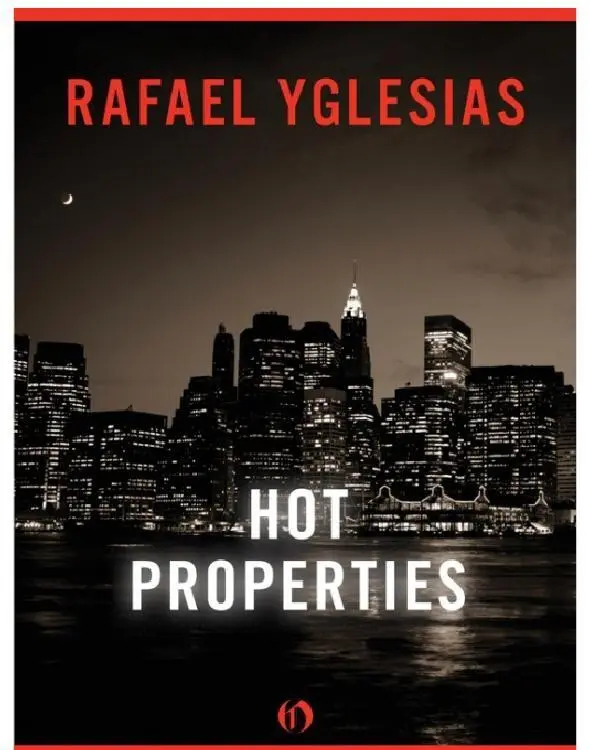
- Название:Hot Properties
- Автор:
- Издательство:Open Road Integrated Media LLC
- Жанр:
- Год:2010
- Город:New York
- ISBN:9781453205082
- Рейтинг книги:3 / 5. Голосов: 1
-
Избранное:Добавить в избранное
- Отзывы:
-
Ваша оценка:
Hot Properties: краткое содержание, описание и аннотация
Предлагаем к чтению аннотацию, описание, краткое содержание или предисловие (зависит от того, что написал сам автор книги «Hot Properties»). Если вы не нашли необходимую информацию о книге — напишите в комментариях, мы постараемся отыскать её.
Rafael Yglesias’s most sharp-tongued satire,
exposes the greed, envy, and backbiting in a media world bloated with money and power.
This ebook features a new illustrated biography of Rafael Yglesias, including rare photos and never-before-seen documents from the author’s personal collection.
Touted by the gossip columns as a roman a clef about the publishing world, Yglesias's fourth novel has definite commercial potential, since there are always people who like to read sordid tales about the media. Focusing on a group of ambitious, opportunistic New York yuppies, each desperate for success, power, fame, money and glamorous sexual partners, Yglesias follows his characters as their aspirations flourish or fade. And even for the one person who comes up with a smashing bestseller, happiness is an elusive emotion, banished by inner fear and self-loathing. The leading players in this fermenting brew are introduced in the book's opening scene, a dinner party so exquisitely awkward that even the reader is embarrassed. Thereafter we watch an aspiring playwright sell out to Hollywood; a sexy blonde discover she can really write, but must use her body to assure publication; a blocked novelist lose his scruples, professional and personal; a journalist at a leading newsmagazine realize that his way to the top has been sabotaged by office intrigue. Yglesias views his characters with cynicism, but he knows how to create the dramatic momentum that will have readers turning the pages. And if his book does become a bestseller, he will have the ironic last laugh.
Copyright 1986 Reed Business Information, Inc.
“
[is] the novel you want in the Hamptons. It lambastes the pretensions of the people you’ve been glaring at on the beach all day, and excoriates the city you’ve left behind.”
— “Sharp, funny, and fresh insight into the American literary world…”
—
From Publishers Weekly
Review
Hot Properties — читать онлайн бесплатно полную книгу (весь текст) целиком
Ниже представлен текст книги, разбитый по страницам. Система сохранения места последней прочитанной страницы, позволяет с удобством читать онлайн бесплатно книгу «Hot Properties», без необходимости каждый раз заново искать на чём Вы остановились. Поставьте закладку, и сможете в любой момент перейти на страницу, на которой закончили чтение.
Интервал:
Закладка:
Fred, although he knew as a sportswriter it was an appealing angle, was also convinced that Ray was a hopelessly stupid and undisciplined basketball player who, in time, would return to his selfish and disorganized play. People don’t change, most of all athletes. Fred knew. The yearning of the Knick fans to believe in a mystical transformation through personal tragedy was precisely the reason Fred wanted to escape from sportswriting. Covering the Knicks, Fred would be obliged to go along with the pretense: fans didn’t want the truth, namely that whatever makes a player weak transcends whether his wife loves him or his father dies on the night of the big game, or all the other movie clichés. The young power hitter who can’t hit a change-up won’t do so simply because he’s fallen in love, the brilliantly talented quarterback who chokes under pressure and throws fourth-quarter interceptions will go on throwing them even if his two-year-old son recovers from leukemia, and Ray Williams would continue to turn the ball over, despite his sister’s tragic death, because he was too dumb to keep his concentration up. But all that has to be concealed from the sports fans. They don’t want the illusion destroyed that the games they watch possess a significant soap-opera subplot. Why couldn’t they appreciate the games as games? Fred wondered. Why isn’t the simple majesty of men able to follow a ninety-mile-an-hour ball and hit it with a stick of wood enough to astonish and delight? Even inconsistent Ray, twisting his muscled arms in midair and lightly flipping a basketball through windmills of flailing arms up against the backboard and into the basket, was a miracle of nature, an awesome proof of humanity’s ingenuity, a modern preservation of our savage past, the physical equivalent of our evolution from painting on cave walls to splashing paint on a canvas. Now we celebrate the warriors who toss pigskin spears. Who cares if their wives love them, if they need cocaine to face the modern equivalent of death (failure), or if Ray Williams needs a sister to die in order to know he shouldn’t take jump shots from the top of the key when Bill Cartwright is loose under the basket? Watch him do it! Whatever the reason!
“Yeah,” Fred answered. “I guess he’s dedicating the game to her.”
There was a murmur from them at this.
“I think she kind of raised him.” Fred said, making it up, but already busy convincing himself it must be true. “His bad play this year dates almost exactly from when she was diagnosed.” That bit of sentiment originated with the Knick publicist whom Fred had called to get his ticket. The Garden organization was taking a truly clever tack: immediately after saying that, the publicist went on, “But Ray doesn’t want that known. He doesn’t want people to think he’s using his sister’s corpse as an excuse.” Who knows, Fred said to himself while the others in the box gave him their full attention, eyes wide open with the wonderment of children, maybe it’s true, maybe her being sick really did bother him. But then what was bugging Ray for the previous six years?
“How come nobody said anything about it while he was fucking up?” Tom asked peevishly.
“Ray kept it from everyone but Hubie and asked him to keep it a secret. He didn’t want to use her death as an alibi.” Boy, is this bullshit, Fred thought, amazed that he was holding their attention so easily. I’ll bet Tom isn’t sorry he invited me, he thought proudly. “They’re a very close family. You know,” he said to the leather-skinned woman. Melinda wife of the powerful producer, “Ray’s brother, Gus, plays for the SuperSonics. They grew up guarding each other. It’s great when they play in an NBA game opposite each other. Suddenly you can picture them playing as little kids on a dirty playground on a summer day in New York.”
“Yeah, it’s fantastic,” Tom Lear said. “Straight out of a movie.”
“Does sound like a movie,” Sam Billings said, and for a moment the room seemed to hold its breath. By Fred’s count there were certainly three writers in the room and he suspected one of the men at the bar was also. Fred almost blurted out, “I’ll write it.”
“Yeah,” Tony Winters said. “Think of the dream casting. Richard Pryor and Eddie Murphy.”
Someone murmured appreciatively. Fred cursed himself for not having thought of it.
Tony, meanwhile, frowning with concentration, went on: “Richard Pryor and Robert Redford. Eddie Murphy and Clint Eastwood—”
People began to laugh as they understood he was fooling.
“As brothers?” Tom Lear said, spelling out the joke.
“Yeah,” Tony went on. “You do a movie in which Redford and Pryor are two poor brothers who grew up in the slums and who end up facing each other in the championship game. Call it De Naturals. Don’t bother to explain how they’re brothers. Just assert it.” Tony looked thoughtful while people, with slight embarrassment, laughed sporadically. “Meryl Streep could play their mother. I think it would be a good stretch for her. She could play a Polish mother—”
Now the room was laughing shamelessly, except for Fred, who stared sullenly at Tony. That’s disgusting, he said to himself with rage. Making fun of talent that way — it’s a cheap shot.
“—she could do a Polish black accent,” Tony elaborated. “Now that would be interesting!”
Fred wanted to say something cutting, shut off Tony from the group’s admiration as thoroughly as he had been. Tony would deserve it — his smug attitude of equality with the people he made fun of infuriated Fred. Tony had no right to such a pose. What play of his had run on Broadway? Everything was so easy for men like Tony. He took his presence in the private box for granted. Probably his father had been bringing him to elite seats his whole life. Someone like Tony Winters had never sat in the mezzanine of anything. And Fred, poor Fred, he had been stuck way up in the back, in life’s cheap seats, scraping ancient gum off his shoes and straining for a view of the action.
“Are you a sportswriter?” Richard Winters asked Fred in his low, calm tone while the others were elaborating on Tony’s joke.
“Uh, used to be. I’m writing a novel now.”
Richard nodded wisely, as though he had expected that answer. “Did you cover basketball?”
Tony called across the room, answering for him: “You probably have read Fred’s stuff, Dad. He did a lot of writing for American Sport magazine. The interviews?”
Fred was bothered by Tony having overheard (why is he on my case?) and made nervous by his tone. He had called it “Fred’s stuff,” not even giving it the dignity of an “article.”
But Richard Winters snapped his fingers and looked delighted at Fred. “Of course! You did that great interview with Billy Martin. First time I understood both why he was a great manager and also why he’s crazy. Everything else I read about him would do one or the other, never both.”
“You two know each other?” Tom Lear asked Fred, meaning him and Tony. There was ill-concealed surprise in the question.
“Oh, sure,” Tony said. “We’re old friends.”
Fred now relaxed, decided he had been paranoid. Obviously Tony was trying to be helpful and friendly. He did not notice, nor did the others, that Tony smiled to himself after his assertion of amity with Fred, like a man contemplating an irony.
Below, the buzzer sounded to signal an end to the halftime warm-ups and the teams went to their benches for final instructions before the start of the second half. Fred moved toward the door. “I’d better get back—”
“No, stay!” Tom said, and a few others did also.
“We have plenty of room,” Richard Winters added with a note of warmth sufficient to imbue his words with urgency, but not intense enough to suggest even a hint of desire.
Читать дальшеИнтервал:
Закладка:
Похожие книги на «Hot Properties»
Представляем Вашему вниманию похожие книги на «Hot Properties» списком для выбора. Мы отобрали схожую по названию и смыслу литературу в надежде предоставить читателям больше вариантов отыскать новые, интересные, ещё непрочитанные произведения.







Обсуждение, отзывы о книге «Hot Properties» и просто собственные мнения читателей. Оставьте ваши комментарии, напишите, что Вы думаете о произведении, его смысле или главных героях. Укажите что конкретно понравилось, а что нет, и почему Вы так считаете.