Rafael Yglesias - Hot Properties
Здесь есть возможность читать онлайн «Rafael Yglesias - Hot Properties» весь текст электронной книги совершенно бесплатно (целиком полную версию без сокращений). В некоторых случаях можно слушать аудио, скачать через торрент в формате fb2 и присутствует краткое содержание. Город: New York, Год выпуска: 2010, ISBN: 2010, Издательство: Open Road Integrated Media LLC, Жанр: Современная проза, Юмористическая проза, на английском языке. Описание произведения, (предисловие) а так же отзывы посетителей доступны на портале библиотеки ЛибКат.
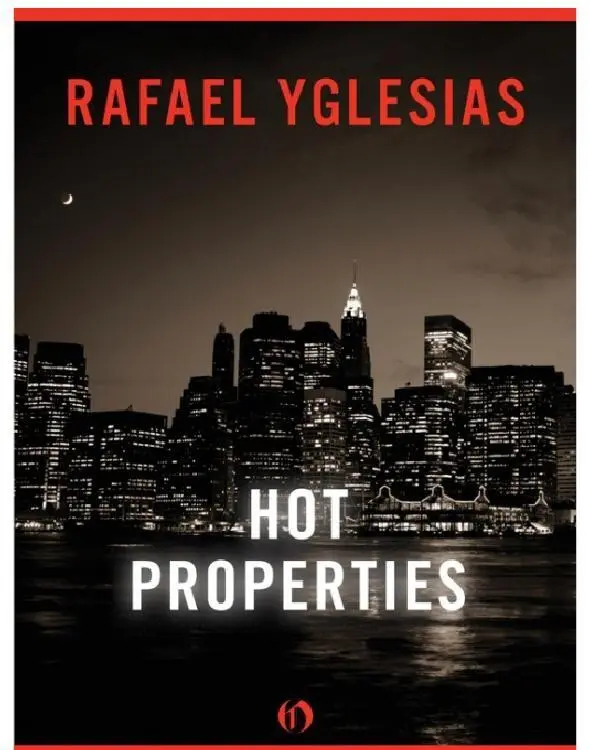
- Название:Hot Properties
- Автор:
- Издательство:Open Road Integrated Media LLC
- Жанр:
- Год:2010
- Город:New York
- ISBN:9781453205082
- Рейтинг книги:3 / 5. Голосов: 1
-
Избранное:Добавить в избранное
- Отзывы:
-
Ваша оценка:
Hot Properties: краткое содержание, описание и аннотация
Предлагаем к чтению аннотацию, описание, краткое содержание или предисловие (зависит от того, что написал сам автор книги «Hot Properties»). Если вы не нашли необходимую информацию о книге — напишите в комментариях, мы постараемся отыскать её.
Rafael Yglesias’s most sharp-tongued satire,
exposes the greed, envy, and backbiting in a media world bloated with money and power.
This ebook features a new illustrated biography of Rafael Yglesias, including rare photos and never-before-seen documents from the author’s personal collection.
Touted by the gossip columns as a roman a clef about the publishing world, Yglesias's fourth novel has definite commercial potential, since there are always people who like to read sordid tales about the media. Focusing on a group of ambitious, opportunistic New York yuppies, each desperate for success, power, fame, money and glamorous sexual partners, Yglesias follows his characters as their aspirations flourish or fade. And even for the one person who comes up with a smashing bestseller, happiness is an elusive emotion, banished by inner fear and self-loathing. The leading players in this fermenting brew are introduced in the book's opening scene, a dinner party so exquisitely awkward that even the reader is embarrassed. Thereafter we watch an aspiring playwright sell out to Hollywood; a sexy blonde discover she can really write, but must use her body to assure publication; a blocked novelist lose his scruples, professional and personal; a journalist at a leading newsmagazine realize that his way to the top has been sabotaged by office intrigue. Yglesias views his characters with cynicism, but he knows how to create the dramatic momentum that will have readers turning the pages. And if his book does become a bestseller, he will have the ironic last laugh.
Copyright 1986 Reed Business Information, Inc.
“
[is] the novel you want in the Hamptons. It lambastes the pretensions of the people you’ve been glaring at on the beach all day, and excoriates the city you’ve left behind.”
— “Sharp, funny, and fresh insight into the American literary world…”
—
From Publishers Weekly
Review
Hot Properties — читать онлайн бесплатно полную книгу (весь текст) целиком
Ниже представлен текст книги, разбитый по страницам. Система сохранения места последней прочитанной страницы, позволяет с удобством читать онлайн бесплатно книгу «Hot Properties», без необходимости каждый раз заново искать на чём Вы остановились. Поставьте закладку, и сможете в любой момент перейти на страницу, на которой закончили чтение.
Интервал:
Закладка:
“Yes,” Chico said, his voice loud and impatient, “but who’s gonna write it?”
There was an uneasy silence. Rounder made the situation worse by trying to look imperious to cover what was obviously confusion. “Why don’t we first decide if it is the cover?” Rounder said haughtily, implying that Chico was the one who was asking foolish questions.
“The Russians withdraw from the Olympics!” Chico said so vehemently that a stranger entering the room might think the news had just broken and Chico was a proprietor of several large Los Angeles hotels. “What else are we gonna put on the cover?”
“Robert Redford in The Natural?” Mary Gould suggested playfully. That had been a proposed cover before the Russians had withdrawn, but she was kidding.
Chico, however, wheeled on her. “We’d look like assholes if we did that!”
“Sell more copies than with news that’s four days old,” Harpo said, throwing the line away. He meant this as bitter fact, not a rationale for giving in.
Again Chico chose to attack as though the speaker was in earnest. “Oh, great! So why don’t we just close up shop and let People Magazine handle all the news?”
“Maybe we should go with Redford,” Rounder said, only he was not kidding or musing philosophically. He spoke in a tone of wonder while making the suggestion, as if the notion hadn’t been discussed at all and he had just had a flash of inspiration.
His question hung in the air like a mysterious phenomenon of nature. They all looked incredulously at it, unable to guess at its origin, its future course, or what action could be taken. Primitive tribesmen couldn’t have been more stunned by a comet than they were by this naive indecisiveness.
“Fine!” Chico said abruptly, and sat down. He stared at the table, silent, like a sullen child, intending to deprive them of any further human intercourse.
Harpo stared at Chico, amazed by his silence. He looked at the others (David met his eyes briefly and saw the desperation, with a plea implicit in their quick, darting movements. Can’t somebody help me? they asked). Then he seemed to pull himself together. Harpo looked at Rounder. “I think we’d look really irresponsible.”
“But Weekly will put the Olympics on the cover, and there won’t be any way to distinguish ourselves from them.”
Rounder said this in a tone of discovery, a medical researcher uncovering a previously unknown and deadly microbe.
Again Harpo looked at Chico imploringly. Chico folded his arms and sank lower in his chair, his eyes fixed on the table. Harpo despaired of him and said to Rounder, “That’s always the problem. But it’s inevitable that we do the Olympics anyway. There are some news events that can’t be ignored, no matter how obvious or boring to our readers they will be.” The surreal quality of this moment, someone explaining to the editor in chief of a national newsmagazine its most basic fact of existence, washed over David, numbing him. He began to feel he wasn’t really present in the scene, that it was something he was watching or dreaming. “Sure,” Harpo continued, “on Monday everybody will pass the newsstands and groan at the Olympics being on the cover, but if it wasn’t …” Harpo stopped, as though the implied explosion of rage on the part of their readership was too horrible to imagine.
“But why?” Rounder smiled his brilliant smile, his blue eyes glistening with excitement. “We have to start questioning these assumptions we make. By Monday the Russian withdrawal will be old, old news. The magazine will sit on the stand for the next few days becoming more horribly dated with each day. I’m not saying we don’t banner it inside and give it thirty columns anyway, but let’s do Redford on the cover. At least we’ll sell more copies and therefore more people will have the benefit of reading our excellent coverage of the Olympics.” He beamed at them with the pleasant immodesty of a child topping adults at something their greater experience should have taught them.
“If we really want to surprise them,” Chico said in a mumble, “let’s not cover it at all. We could do a thirty-column takeout on Redford’s marriage.”
Several people laughed. David did not. He stiffened, a soldier ready for incoming artillery. Sarcasm at a Groucho suggestion was simply not done without consequences. Either it signaled the end of Rounder or the end of Chico, David believed, or rather felt instinctively. You don’t make fun of the boss’s major policy ideas. You can kid him about his tie, or the way Mrs. Thorn praised him at a general meeting, but never joke about his ideas in front of the staff — at least not when he’s there to hear you. To David it was unthinkable, unbelievable, something he never thought he would see someone like Chico do. It was as if the bartender had just tossed a shot of bourbon in Jesse James’s face — get away from the bar and duck behind a table, cause there’s gonna be some shootin’.
Instead of such dramatics, Rounder turned to Mary Gould and said, “I’m sorry, I haven’t seen the piece. Is there material about his marriage?”
Chico audibly groaned. He sank lower in his chair, his small eyes scrunched together, fiercely staring at the table. Mary, suddenly on the spot, dropped her cheerful attitude and answered in a hasty rush: “No, not really. Just an allusion to it. It’s really about the movie and how long it’s taken Redford to do one. Been four years since he’s appeared in anything, and three since he directed Ordinary People.”
“Wow,” Chico said in a dull, flat voice.
“It wasn’t intended as an exposé,” Mary said at Chico’s head, since he was still utterly absorbed by the conference table and made his comments in a tone that implied he couldn’t be heard, as though they were private thoughts. “It’s not controversial or newsy,” she added, apparently a polite way of voting no on its superseding the Olympics.
“But it’s fun? It looks good?” Rounder asked imperiously, making his question seem silly, since his attitude implied that only an affirmative answer was acceptable.
“Yes,” she admitted, but with a trace of reluctance. “We have great pictures. Redford looks sensational.”
“Easy, Mary, whoa, girl,” Harpo said pleasantly.
She winked at him. “Say, how come senior editors don’t get to do interviews?”
The room broke up, except for Chico, who seemed to have become statuary, his big body still, although in David’s mind there was explosive, ominous animation implied.
“This is what I suggest,” Rounder said. “Let’s proceed with both the Olympics and Redford as covers. We’ll see how lively the Olympics story is by the end of the week. If there’s more juice in it, we’ll do the Olympics and, run Redford the next issue.”
“Redford’s a cover either way?” Mary asked.
“Definitely,” Rounder said. “That’s a cover or it’s nothing. Don’t you agree?” he asked Chico, or rather, the body of Chico.
Chico stood up. The speed of it startled those around him. For a moment he said nothing. “Yes,” he announced to the wall finally. “Who’s top-editing the Olympics?”
“Ray, why don’t you do it?” Rounder said to Harpo, using his real name, of course. Harpo, now having won the battle he began, looked as though he considered it a Pyrrhic victory. Chico nodded knowingly at this news of his defeat and announced. “I have to go to the John,” and made for the door.
“We’re done,” Rounder said, continuing his style thus far namely making no acknowledgment of Chico’s behavior.
They filed out slowly and quietly. That was atypical of the end of cover meetings. David caught the eyes of several others while they moved, and each time, there was an embarrassed glance away on both sides. All of them knew that they had witnessed a remarkable meeting, that they would be gossiping like mad about it soon, but right at that moment they all tried hard, far too hard, to pretend that it had been routine.
Читать дальшеИнтервал:
Закладка:
Похожие книги на «Hot Properties»
Представляем Вашему вниманию похожие книги на «Hot Properties» списком для выбора. Мы отобрали схожую по названию и смыслу литературу в надежде предоставить читателям больше вариантов отыскать новые, интересные, ещё непрочитанные произведения.







Обсуждение, отзывы о книге «Hot Properties» и просто собственные мнения читателей. Оставьте ваши комментарии, напишите, что Вы думаете о произведении, его смысле или главных героях. Укажите что конкретно понравилось, а что нет, и почему Вы так считаете.