Rafael Yglesias - Hot Properties
Здесь есть возможность читать онлайн «Rafael Yglesias - Hot Properties» весь текст электронной книги совершенно бесплатно (целиком полную версию без сокращений). В некоторых случаях можно слушать аудио, скачать через торрент в формате fb2 и присутствует краткое содержание. Город: New York, Год выпуска: 2010, ISBN: 2010, Издательство: Open Road Integrated Media LLC, Жанр: Современная проза, Юмористическая проза, на английском языке. Описание произведения, (предисловие) а так же отзывы посетителей доступны на портале библиотеки ЛибКат.
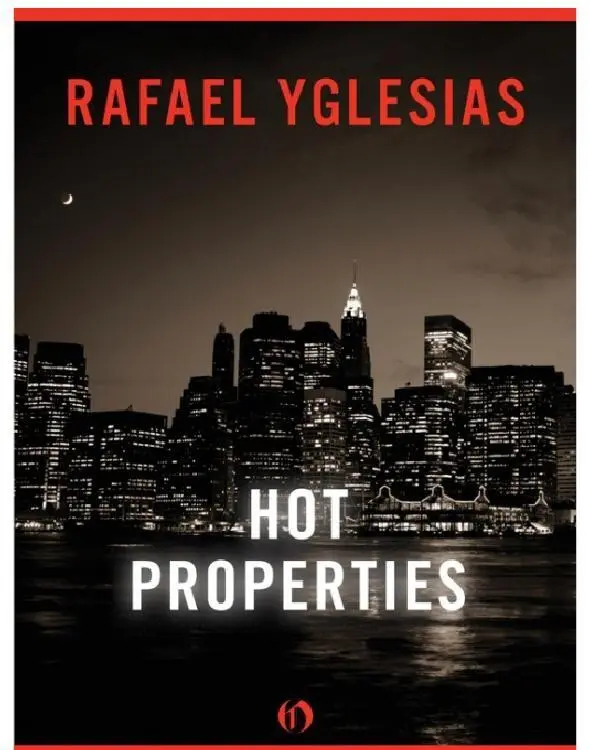
- Название:Hot Properties
- Автор:
- Издательство:Open Road Integrated Media LLC
- Жанр:
- Год:2010
- Город:New York
- ISBN:9781453205082
- Рейтинг книги:3 / 5. Голосов: 1
-
Избранное:Добавить в избранное
- Отзывы:
-
Ваша оценка:
Hot Properties: краткое содержание, описание и аннотация
Предлагаем к чтению аннотацию, описание, краткое содержание или предисловие (зависит от того, что написал сам автор книги «Hot Properties»). Если вы не нашли необходимую информацию о книге — напишите в комментариях, мы постараемся отыскать её.
Rafael Yglesias’s most sharp-tongued satire,
exposes the greed, envy, and backbiting in a media world bloated with money and power.
This ebook features a new illustrated biography of Rafael Yglesias, including rare photos and never-before-seen documents from the author’s personal collection.
Touted by the gossip columns as a roman a clef about the publishing world, Yglesias's fourth novel has definite commercial potential, since there are always people who like to read sordid tales about the media. Focusing on a group of ambitious, opportunistic New York yuppies, each desperate for success, power, fame, money and glamorous sexual partners, Yglesias follows his characters as their aspirations flourish or fade. And even for the one person who comes up with a smashing bestseller, happiness is an elusive emotion, banished by inner fear and self-loathing. The leading players in this fermenting brew are introduced in the book's opening scene, a dinner party so exquisitely awkward that even the reader is embarrassed. Thereafter we watch an aspiring playwright sell out to Hollywood; a sexy blonde discover she can really write, but must use her body to assure publication; a blocked novelist lose his scruples, professional and personal; a journalist at a leading newsmagazine realize that his way to the top has been sabotaged by office intrigue. Yglesias views his characters with cynicism, but he knows how to create the dramatic momentum that will have readers turning the pages. And if his book does become a bestseller, he will have the ironic last laugh.
Copyright 1986 Reed Business Information, Inc.
“
[is] the novel you want in the Hamptons. It lambastes the pretensions of the people you’ve been glaring at on the beach all day, and excoriates the city you’ve left behind.”
— “Sharp, funny, and fresh insight into the American literary world…”
—
From Publishers Weekly
Review
Hot Properties — читать онлайн бесплатно полную книгу (весь текст) целиком
Ниже представлен текст книги, разбитый по страницам. Система сохранения места последней прочитанной страницы, позволяет с удобством читать онлайн бесплатно книгу «Hot Properties», без необходимости каждый раз заново искать на чём Вы остановились. Поставьте закладку, и сможете в любой момент перейти на страницу, на которой закончили чтение.
Интервал:
Закладка:
“Well …” Tony said, again his first impulse being to argue, followed by an equally strong impulse not to. The result was inarticulate hesitation.
“Hitchcock wouldn’t do it that way,” Foxx said after a brief wait for Tony to say more. “He always kept the fun in his thrillers. Even Psycho is fun!”
Psycho is fun? Tony asked himself. It gave him nightmares for six months. But he nodded in agreement, looking chastened. He wanted to slow Foxx down. He feared the producer was talking himself into believing Tony’s script was unsalvageable. Tony realized he had given up any notion of trying to defend what he had written; he was fighting now to stay on the project, to be allowed another chance to satisfy them. “I’ll be happy to rewrite it,” he said.
Garth smiled. “You have to rewrite it,” he said in a gentle voice, but with a disdainful look in his eyes.
“Of course,” Tony said. Somehow he had now aroused Garth, the last thing he had wanted. The harder he tried to act humble and harmless, the more aggressive they seemed to become.
“Why did you hand it in if you weren’t sure of it?” Foxx asked. He put a hand in his pocket and looked down at Tony, jiggling the keys impatiently.
This question stunned Tony. He wanted to cry foul. He hadn’t contested their opinions out of deference to them. It was unfair now to turn his niceness against him. He stared at Foxx, unable to respond.
“I mean, are you happy with this draft?” Foxx continued, seeing Tony paralyzed.
Tony looked at Garth, a plea for protection from these low blows. But Garth didn’t look like a referee; rather he stared at Tony as if he were the other member of a wrestling tag team, trying to decide if he would be needed to finish Tony off.
“Uh …” came out of Tony, the groan of a wounded man. But resistance welled in him. He straightened in his seat — he noticed while doing so that he must have slumped quite low in the chair earlier — and banished the cautious censor that had accompanied him to the meeting. “Look, that’s a silly question. Do you think I want to hand in an unsatisfactory draft? Is that something a writer would want to do? You think I want to be fired? You think I want to fail? I liked the draft. I thought it worked. Do you want me to sit here and stubbornly argue about it? Would I be able to change your minds?” He snorted and allowed himself a sardonic smile. He returned Garth’s stare, challenging him to answer his questions. Foxx looked surprised, curious, studying Tony as though he had just entered the room with amazing news. “Right? If I told you you were wrong and sat here for an hour arguing and arguing, would you like that? Would you consider that professional? Helpful? My job is to give you a script you want. Not what I want. What you want. Isn’t that right?”
Garth returned his daring glance, watching as though he were appreciating a performance. Foxx, however, seemed thrown. “Well,” the producer said, almost stammering, “if … I mean, if you think we’re off-base, if we’re missing something, then you should argue. Your name goes on the script. Not ours.”
Tony stayed on Garth. He felt contempt for Foxx. He had backed down so easily. It was Garth who got stronger as Tony fought. Garth, who had seemed so pliant, ready to compromise, was the one who had suddenly gotten firm and unyielding. Tony stared at him. After a moment of this, Tony said, “Let’s go through the script. When I disagree, we’ll discuss it. But if you really don’t like something, I’m not gonna sit here and waste our time arguing, it’s your project.”
Foxx jiggled his keys. Garth continued to study Tony. Then he said quietly, “Yeah. Let’s get to work.” He broke his pose and leaned forward, opening a copy of Tony’s draft.
Foxx crossed back to the couch and opened a soft leather carrying case, removing another copy.
“I don’t have one,” Tony said forlornly.
Foxx turned, surprised. “You don’t have a copy of the script?”
Tony looked embarrassed. “No, I … uh …”
Garth got up. “We’ve got more.” he said, smiling, and walked to shelves behind Tony. He handed him a script, and then, before moving on, he quickly rubbed the top of Tony’s head, tousling his hair with the affection of an older brother, the way he had in the Polo Lounge almost a year before.
I won, Tony thought, opening his screenplay. I won, he told himself. I didn’t know this was a fight for survival, but I won it anyway.
Patty had been keeping a secret. For the first time in her life, she had confided in no one. Usually, if Patty limited information to three or four people, that qualified as top security. Perhaps she had occasionally held it as low as two people. But this fact, that she had been writing a novel, a serious novel (or at least a nonromance book), for the past two months, was absolutely private.
The pressure was becoming unbearable.
She had written an amazing amount, nearly a hundred pages, and no matter how many times she read them over, she continued to admire and like them. As opposed to her one and a half romance novels, a rereading of which inspired nausea. She felt delighted with herself, with her newfound passion, and she ached to hand her pages to someone and get confirmation of her own good opinion. But who?
David? As a critic, he frightened her. He was the type of person who compulsively pointed out misspellings and grammatical mistakes. No doubt there were a few, but any editor could catch them, and Patty knew they would be rare and unimportant. But the presence of even one would be noted by David. And he would judge her against major writers, evaluating her novel as though she had placed it as a candidate for the Nobel Prize against Tolstoy. Joyce, and Mailer.
Betty? She would mark the misspellings and grammatical mistakes, but not mention them until she was through praising Patty. And every allowance would be made for her inexperience, her age, and the general difficulties of existence. No comparisons or impossible standards would be constructed for Patty’s hundred pages to hurdle.
David would be too tough. Betty too easy.
There were other friends, but they weren’t in publishing and had no expertise in judging writing other than the fact that they read books. Their response might tell her if it was good, but not how to improve it or how to finish it. The last was Patty’s worry. She had gone into her story blind, without a true plan. So far that hadn’t hurt her. She started each day with a shortened horizon, but somehow it moved as she moved, keeping just enough ahead of her so that she never fell off the edge into nothingness. Up until now she had been content with this daring voyage into an unknown sea, but lately she worried that without a map, without a navigator, she would never reach land.
David could certainly help her there. He was so organized. his first impulse would be to plot the rest of her novel even if she had one figured. Betty, oddly, she wasn’t sure could. Theoretically, it was her job to do so. She was an editor. Her ambition was to edit novels. So far she had only worked on books that were acquired by her boss, always by established writers who either didn’t need or were contemptuous of Betty’s abilities. She often complained to Patty that she was no more than a copyeditor on those manuscripts. Her larger skills as an editor, helping to shape a book for example, had been limited to self-help books, at which she’d been successful. However, Betty despised that accomplishment. The truth was, it became obvious to Patty, that years of hearing Betty downgrade her career had infiltrated Patty’s mind and made her think of Betty as inexperienced and insecure — not someone to go to with confidence.
Читать дальшеИнтервал:
Закладка:
Похожие книги на «Hot Properties»
Представляем Вашему вниманию похожие книги на «Hot Properties» списком для выбора. Мы отобрали схожую по названию и смыслу литературу в надежде предоставить читателям больше вариантов отыскать новые, интересные, ещё непрочитанные произведения.







Обсуждение, отзывы о книге «Hot Properties» и просто собственные мнения читателей. Оставьте ваши комментарии, напишите, что Вы думаете о произведении, его смысле или главных героях. Укажите что конкретно понравилось, а что нет, и почему Вы так считаете.